
 Nov, 27 2025
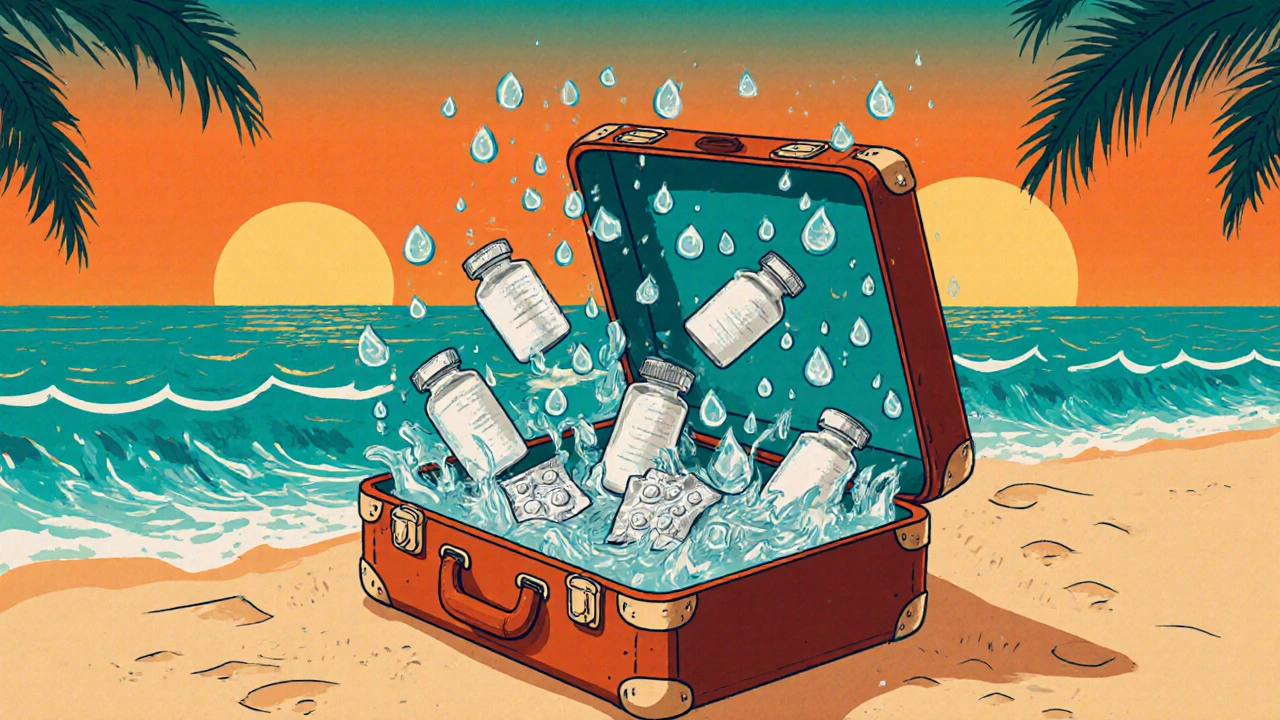
When you’re traveling to a tropical destination, packing your meds isn’t just about tossing pills into a bag. High heat and wet air can wreck your medications faster than you think - and you might not even notice until it’s too late. In places like Bali, Lagos, or Bangkok, humidity often hits 80-95% and temperatures stay above 28°C. That’s not just uncomfortable - it’s dangerous for your pills, capsules, and inhalers. Studies show up to 30% of medications in tropical regions lose potency before they reach patients. You don’t want to be one of them.
Why Tropical Humidity Destroys Medications
Medications aren’t designed to survive in swamp-like conditions. The real enemy is water - not heat alone. When moisture gets into your pills, it triggers a chemical reaction called hydrolysis. This breaks down the active ingredients. For example, amoxicillin can absorb up to 10% of its own weight in water at 75% humidity. That’s enough to cut its effectiveness by half in just 30 days. Antibiotics like tetracycline degrade 3.5 times faster under these conditions. You might still see the pill - it hasn’t melted or changed color - but it’s no longer doing its job. Other problems include:- Tablets cracking or sticking together (called caking)
- Capsules getting soft and leaking
- Inhalers clogging because powder particles clump
- Orally disintegrating tablets taking 5 times longer to dissolve
What Storage Conditions Actually Work
The science is clear: the safest range for most medications is 30-45% relative humidity and 15-25°C. That’s not easy to find in a humid jungle town. But you don’t need a lab-grade fridge to protect your meds. Here’s what works in real life:- Avoid bathrooms. Humidity there regularly hits 80-90% - especially after showers. Never store meds near sinks, showers, or windows.
- Don’t leave pills in your suitcase on a hot car seat. Temperatures inside parked cars can hit 50°C - that doubles degradation rates every 10°C.
- Keep medications off the floor. Moisture rises from the ground. Store them on a shelf, in a drawer, or inside a sealed container.
Best Packaging Solutions for Travel
Your original medicine bottle? Probably not enough. Most plastic bottles let moisture seep in over time. Here’s what to use instead:- Aluminum blister packs: These are the gold standard. They block 99.9% of moisture. If your meds come in them, leave them in. Don’t pop them out unless you’re about to take one.
- Desiccants: Those little white packets labeled “Do Not Eat”? Keep them in the container. Silica gel absorbs moisture and keeps the inside dry. For a 100mL container, use 1-2 grams of silica gel. Replace them every 30 days in humid climates.
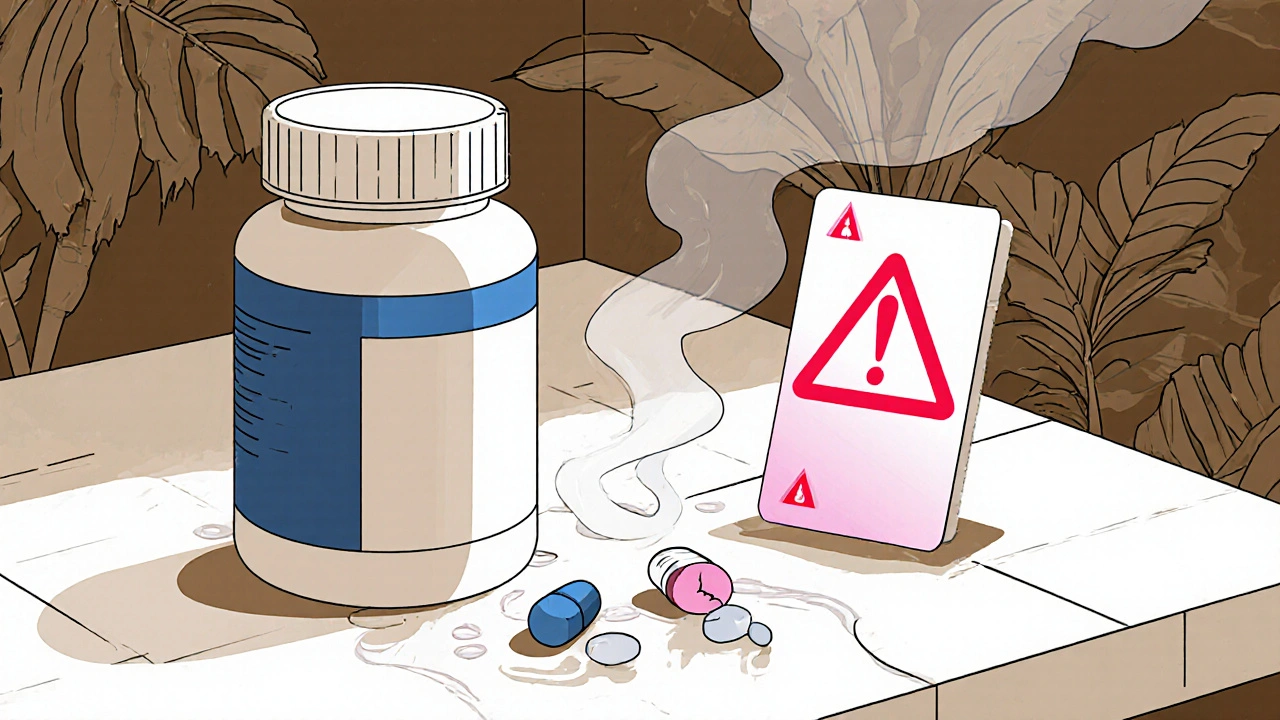
- Humidity indicator cards: These change color when moisture gets too high. Blue = dry. Pink = wet. You can buy them online for under $2 each. Stick one in your travel case and check it weekly.
High-Risk Medications to Watch Out For
Some drugs are way more sensitive than others. If you’re taking any of these, treat them like fragile electronics:- Antibiotics (amoxicillin, tetracycline, doxycycline): Hydrolysis ruins them fast. Even 10% degradation can lead to treatment failure or antibiotic resistance.
- Antifungals (fluconazole, itraconazole): Moisture causes clumping and uneven dosing.
- Pediatric formulations: Syrups and chewables often contain sugar and moisture-sensitive binders. They’re more likely to mold or crystallize.
- Insulin: Must be kept cool. Once opened, it lasts 28 days at room temperature - but only if humidity is controlled. In tropical heat, it can spoil in under a week.
- Dry powder inhalers (albuterol, fluticasone): Moisture makes the powder stick. You might inhale half your dose - or none at all.
- Orally disintegrating tablets (ODTs): They dissolve on your tongue. But if they get damp before you take them, they’ll turn to mush and lose potency.
Low-Cost Solutions for Budget Travelers
You don’t need a $10,000 dry cabinet to keep your meds safe. In fact, the WHO’s “PharmaSeal” system - used in 32 tropical countries - costs just $0.85 per unit. Here’s how to replicate it:- Buy a small plastic container with a tight lid (like a pill organizer with a locking seal).
- Put your meds inside.
- Add 1-2 silica gel packets.
- Seal it. Check the humidity card every week.
What Not to Do
Here are common mistakes that ruin medications:- Storing meds in your purse or backpack on a hot day. Temperatures can spike fast.
- Leaving pills in a hotel bathroom. Even if it’s air-conditioned, humidity from showers builds up.
- Using expired desiccants. They stop working after 30-60 days in humid air.
- Assuming your meds are fine because they “look okay.” Color and shape don’t tell you if potency is gone.
- Putting insulin in checked luggage. Checked bags get cold and then hot - temperature swings destroy biologics.
What to Do If You Suspect Degradation
Signs your meds might be damaged:- Tablets are softer than usual or crumble easily
- Capsules are sticky or leaking
- Powders have clumps or look wet
- Color changes (e.g., tetracycline turning dark yellow)
- Odor changes - a sour or musty smell means mold
Future Tech on the Horizon
The good news? Better solutions are coming. Companies like Aptar now make bottle caps with built-in moisture-scavenging polymers that keep humidity below 30% for 18 months. The Gates Foundation has distributed over 500 million desiccant-integrated blister packs across Africa - and reduced spoilage by 58%. Researchers at MIT are testing graphene oxide coatings that block 99.7% of moisture. These won’t be in your local pharmacy yet, but they’re proof that the problem is being solved. For now, stick with what works: airtight containers, silica gel, and awareness. You don’t need fancy gear - just smart habits.Can I store my medications in the refrigerator in a tropical country?
Only if the medication requires refrigeration. Most pills don’t need it. But if you’re carrying insulin, vaccines, or certain biologics, yes - keep them at 2-8°C. Just make sure the container is sealed tightly. Condensation forms when cold items meet humid air, and that moisture can damage your meds. Use a sealed plastic bag with desiccants inside the fridge to prevent this.
Do all medications degrade equally in humidity?
No. Solid oral tablets with anhydrous lactose are more vulnerable than those with microcrystalline cellulose. Antibiotics, antifungals, and pediatric formulations are the most sensitive. Inhalers and ODTs fail faster than regular pills. Always check the manufacturer’s storage instructions - they’re based on real stability testing.
How often should I replace desiccant packets?
Replace them every 30 days in tropical humidity. Some packets say they last 6 months, but that’s under ideal lab conditions. In real-world heat and moisture, they saturate faster. Use humidity indicator cards to check - if they turn pink, replace the desiccant immediately.
Is it safe to carry medications in checked luggage?
No. Checked baggage can reach temperatures over 50°C in the cargo hold, especially on long flights. Humidity levels also fluctuate wildly. Always carry medications in your carry-on. Keep them in your pocket or a small bag you can access easily. Airlines and airport security allow this - you just need to declare them if asked.
What if I can’t find silica gel packets abroad?
Buy small rice socks - fill a clean cotton sock with uncooked rice, tie it shut, and put it in your container. Rice absorbs moisture and works as a cheap desiccant. Replace it every 2 weeks. It’s not as good as silica gel, but it’s better than nothing. You can also buy silica gel online before you travel - it’s lightweight and lasts for years if sealed.
Final Checklist Before You Travel
- Keep all meds in original packaging with labels.
- Use aluminum blister packs whenever possible.
- Add silica gel packets to every container.
- Use a humidity indicator card - check it weekly.
- Store meds in a sealed container away from bathrooms, windows, and heat sources.
- Carry meds in your carry-on - never checked luggage.
- Know the signs of degradation: soft pills, clumps, odd smells, color changes.
- Bring extra doses - just in case.
Leah Doyle
November 29, 2025 AT 02:44This is so helpful! I never realized how much humidity could wreck my meds-especially my insulin. I always just tossed them in my bag and hoped for the best. 😅 Now I’m grabbing silica gel packets before my trip to Bali next month.
Graham Moyer-Stratton
November 30, 2025 AT 01:57Just don’t fly with them. Period.
Jacob Hepworth-wain
November 30, 2025 AT 09:59Agreed with Graham. Carry-on only. Also, if you’re using a Ziploc, double-bag it. I learned this the hard way in Thailand when my albuterol got soggy. Took me three days to get a replacement.
Geethu E
November 30, 2025 AT 23:49Been working in Kerala for 8 years-this is spot on. I’ve seen people take degraded antibiotics and then blame the doctors when it doesn’t work. Always check for stickiness or weird smells. And yes, rice socks work in a pinch. I keep a few in my first-aid kit.
Michelle N Allen
December 2, 2025 AT 06:31I mean I get it but honestly if you’re traveling somewhere that hot and humid maybe you should just not take the meds at all or find a local pharmacy and buy them there because honestly who even carries their own meds for a month long trip anyway I’m just saying
Madison Malone
December 3, 2025 AT 12:52Hey, I know it’s easy to feel overwhelmed by all this, but you’ve got this! Even just using a small container with a desiccant packet is a huge step. And if you’re worried about your insulin, just ask your pharmacist for a travel cooler-they’re tiny and fit in your pocket. You’re not alone in this.
Alexander Rolsen
December 3, 2025 AT 13:20Another American pretending they know how to handle tropical medicine… Meanwhile, people in Nigeria have been storing meds in clay pots for centuries-natural evaporative cooling. But no, let’s all buy silica gel packets from Amazon. Classic Western over-engineering.
Alexis Mendoza
December 4, 2025 AT 02:08It’s funny how we treat medicine like it’s some fragile thing that needs perfect conditions, when nature doesn’t care. Plants grow in swamps. Animals survive. Maybe the real issue isn’t the humidity-it’s our assumption that everything needs to be perfectly controlled. But still… better safe than sorry, I guess.
king tekken 6
December 6, 2025 AT 01:17Wait so you’re telling me my tetracycline from 2022 might be useless because I left it in my gym bag? Bro I thought it was just expired if the date passed… also silica gel is just like… what do you call it… those little rocks in shoeboxes? I thought they were for smell
Craig Hartel
December 8, 2025 AT 01:11Just got back from a month in Costa Rica-used the rice sock trick for my doxycycline. Worked great! No clumps, no weird smell. I even gave one to my host family. They were amazed. Little hacks like this make travel so much less stressful. You don’t need fancy gear-just a little awareness.
tom charlton
December 9, 2025 AT 02:38Thank you for this comprehensive and scientifically grounded guide. The integration of WHO protocols with practical, low-cost solutions demonstrates a commendable balance between evidence-based medicine and real-world accessibility. I commend the inclusion of humidity indicator cards and the clarification regarding refrigeration protocols. This is precisely the type of public health education that reduces morbidity in resource-limited settings.
anant ram
December 11, 2025 AT 02:15Don’t forget to replace your desiccant every 30 days, no matter what the package says! I lost my entire supply of fluconazole because I ignored this-now I write "REPLACE 7/15" on the container with a Sharpie. Also, if you’re in India, buy silica gel from the pharmacy near the train station-it’s cheaper than Amazon and they know what they’re selling.
Chris Kahanic
December 11, 2025 AT 07:01Interesting. I’ve been storing my meds in the hotel safe for years. Never thought about humidity. I’ll start using a Ziploc and a silica packet from now on. Thanks for the reminder.