
 Feb, 10 2026
If you’ve ever felt like the room is spinning even when you’re sitting still - and then got a pounding headache right after - you might be dealing with vestibular migraine. It’s not just a bad headache. It’s a neurological condition that mixes vertigo, dizziness, and migraine in ways that can wreck your daily life. Unlike typical migraines, you don’t always get the head pain. Sometimes, it’s just the spinning, the nausea, the light sensitivity - and no one seems to understand why.
It’s more common than you think. About 1 in 100 people have it. Women are 3.5 times more likely to be affected than men. And here’s the kicker: most people wait over a year to get diagnosed. Too many end up being told they have BPPV (a simple inner ear issue) or Ménière’s disease - and get treatments that don’t touch the real problem. That’s because vestibular migraine doesn’t show up on scans or blood tests. It’s diagnosed by your history, your symptoms, and how they line up with migraine patterns.
What Exactly Is Vestibular Migraine?
Vestibular migraine is when your brain’s balance system gets caught in the same storm as your pain pathways. The same nerve networks that trigger migraine headaches also mess with your inner ear signals. That’s why you get dizzy, unsteady, or feel like you’re on a boat even when you’re standing still.
Episodes can last anywhere from 5 minutes to 3 days. Some people get them once a month. Others have them weekly. The vertigo isn’t always violent - sometimes it’s just a vague sense of imbalance, or a feeling that things are moving when they’re not. Alongside that, you might notice:
- Sensitivity to light (photophobia)
- Sensitivity to noise (phonophobia)
- Blurred vision or visual aura (zigzag lines, blind spots)
- Nausea or vomiting
- Feeling worse with movement - like walking, turning your head, or riding in a car
And here’s the thing: you might not even have a headache during an attack. That’s why so many people are misdiagnosed. If you’ve had migraine headaches in the past - even if they’re rare now - and you’re suddenly getting dizziness, vestibular migraine is likely the culprit.
What Triggers These Attacks?
Triggers vary from person to person, but a few show up over and over again in patient logs and clinical studies:
- Stress - 82% of people report it as a major trigger
- Sleep disruption - too little, too much, or irregular sleep patterns
- Weather changes - barometric pressure shifts, humidity, or storms
- Caffeine - both too much and sudden withdrawal
- Alcohol - especially red wine
- Aged cheeses - cheddar, blue, brie - anything with tyramine
- Hormonal shifts - common in women around menstruation or menopause
Keeping a symptom diary for 6-8 weeks is the single most useful thing you can do. Write down what you ate, how much you slept, your stress level, and exactly what happened during each episode. You’ll start seeing patterns. Maybe it’s not coffee - maybe it’s coffee after a bad night’s sleep. That’s the kind of insight that changes everything.
How Is It Diagnosed?
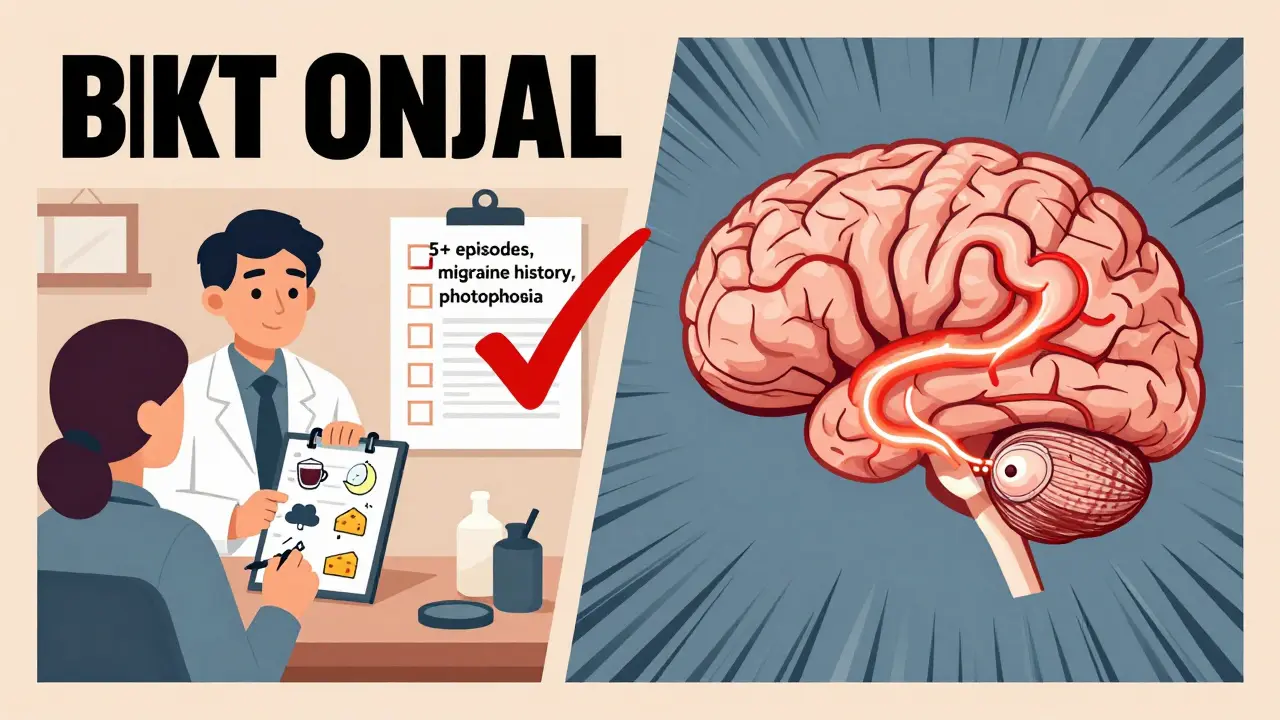
No MRI will confirm vestibular migraine. No blood test will show it. Diagnosis is based on strict criteria from the International Headache Society:
- You’ve had at least 5 moderate-to-severe episodes of vertigo or dizziness
- Each episode lasts 5 minutes to 72 hours
- You have a history of migraine (with or without aura)
- During at least half of the episodes, you also have one or more migraine features - headache, light/sound sensitivity, or visual aura
- No other cause (like inner ear disease or neurological disorder) explains the symptoms
Doctors will often rule out other conditions first. That’s why you might see an ENT, then a neurologist, then a vestibular therapist. It takes time. But if your symptoms match this pattern - especially if you’ve had migraines before - it’s likely vestibular migraine.
How to Treat It: The Three-Step Plan
Treatment isn’t one-size-fits-all. But most successful cases follow a clear three-step approach:
Step 1: Lifestyle and Trigger Management
This is where most people start - and where many fail because they skip it. You can’t medicate your way out of triggers. You have to manage them.
- Cut back on caffeine - not just coffee, but energy drinks, chocolate, and even some painkillers that contain caffeine
- Keep sleep regular - same bedtime, same wake time, even on weekends
- Stay hydrated - 2 liters of water a day, especially during attacks
- Avoid known food triggers - aged cheeses, processed meats, MSG, artificial sweeteners
- Manage stress - even 10 minutes of daily breathing exercises can cut attack frequency by 20%
One study found that simply stopping caffeine reduced attacks by 35%. That’s more than some medications.
Step 2: Managing Acute Attacks
When an attack hits, you need fast relief - for both the dizziness and the headache.
For dizziness and nausea:
- Prochlorperazine - 5-10 mg orally. Works in under 2 hours for 68% of people
- Ondansetron - 4-8 mg. Great for nausea, no drowsiness
- Domperidone - 10-20 mg. Effective for nausea, low risk of side effects
For headache:
- Sumatriptan - 50-100 mg. Works for 70% of headache pain within 2 hours
- Ibuprofen or naproxen - 400-800 mg. Good for mild to moderate pain
Also, don’t underestimate the power of the dark room. Lying down in silence, with no screens, no noise, and no movement - this reduces symptom severity by 35% on average. It’s not a cure, but it gives your brain a chance to reset.
Step 3: Preventing Future Attacks
If you have more than 4 attacks a month, prevention is key. And there are several proven options:
- Propranolol - 40-160 mg daily. Works for 62% of patients in reducing attack frequency
- Metoprolol - 50-200 mg daily. Similar effectiveness, fewer side effects for some
- Amitriptyline - 10-75 mg at night. Reduces vertigo frequency by 40-60%. Side effects: drowsiness, dry mouth
- Topiramate - 25-100 mg daily. 54% of patients cut attacks in half. Side effects: brain fog, tingling
- Verapamil - 120-240 mg daily. A calcium channel blocker that works well for those who can’t tolerate beta-blockers
- Flunarizine - 5-10 mg daily. First-line in Europe. Not FDA-approved in the U.S., but widely used off-label
Non-drug options also work:
- Magnesium - 600 mg daily. Reduces attack frequency by 30-40%
- Riboflavin (B2) - 400 mg daily. Proven in clinical trials
- Coenzyme Q10 - 300 mg daily. Minimal side effects, good for long-term use
Many people try one or two of these before finding what works. Don’t give up after the first try. It often takes 2-3 tries to find the right fit.
Vestibular Rehabilitation Therapy (VRT): The Game-Changer
This is the part most people overlook - and it’s one of the most effective.
Vestibular rehabilitation therapy (VRT) is a set of customized exercises designed to retrain your brain to rely less on your inner ear and more on your vision and body senses for balance. It’s not about fixing your inner ear. It’s about rewiring how your brain interprets signals.
Studies show:
- 45-60% improvement in dizziness severity after 8-12 weeks
- 78% of patients report over 50% symptom reduction after 12 sessions
- Benefits last long after therapy ends
VRT isn’t just for people with chronic dizziness. Even if you’re still getting attacks, VRT helps you recover faster and feel more stable between episodes. It’s strongly recommended by the European Academy of Neurology and supported by multiple randomized trials.
Most clinics offer 6-10 sessions with a physical therapist trained in vestibular disorders. Then you do daily home exercises - 10-15 minutes a day. It’s not glamorous. But it works.
What Doesn’t Work - And Why
So many people waste time on treatments that don’t touch vestibular migraine:
- Diuretics (like hydrochlorothiazide) - used for Ménière’s disease. Only 20% of VM patients respond. They won’t help you.
- Corticosteroids - used for vestibular neuritis. Only 30% effective for VM. You’re treating the wrong thing.
- Prolonged benzodiazepines (like Valium or Xanax) - they might calm you down short-term, but they interfere with your brain’s natural ability to adapt. Long-term use can make dizziness worse.
- Butterbur - once popular. But it can damage your liver. Withdrawn in Europe and warned against in the U.S. since 2015.
And here’s the big one: misdiagnosis. Over 40% of vestibular migraine cases are mistaken for BPPV or Ménière’s. If you’ve had canalith repositioning maneuvers (like the Epley maneuver) and it didn’t help - that’s a red flag. BPPV is short, sharp spins triggered by head movement. Vestibular migraine is longer, more variable, and tied to migraine triggers.
What’s New in 2025-2026
The field is moving fast. In 2023, the FDA approved atogepant for migraine prevention - and early data shows 56% of vestibular migraine patients had fewer attacks. Rimegepant, another new drug, reduced vertigo days by 49% in a 2022 trial. These are part of a new class called CGRP inhibitors - originally designed for headaches, but they’re working for dizziness too.
Genetic testing is starting to play a role. If you have a mutation in the CACNA1A gene (found in about 25% of families with VM), you’re more likely to respond to calcium channel blockers like verapamil. It’s not routine yet - but it’s coming.
Non-invasive devices like gammaCore (a vagus nerve stimulator) are now FDA-cleared for migraine prevention. In trials, it cut vertigo frequency by 45%. It’s a small handheld device you use for 2 minutes a day. No pills. No side effects.
And researchers are close to a diagnostic test. A simple hearing and balance test called VEMPs (vestibular-evoked myogenic potentials) showed 82% accuracy in spotting vestibular migraine in 2022. If this gets rolled out widely, diagnosis could drop from 11 months to under 2 weeks.
What to Do Next
If you think this sounds like you:
- Start a symptom diary - track food, sleep, stress, and dizziness for 6 weeks
- See a neurologist who specializes in headaches - not just any neurologist
- Ask about vestibular rehabilitation therapy - insist on it
- Don’t accept a diagnosis of BPPV if it doesn’t fit your full pattern
- Try one preventive supplement first: magnesium 600 mg daily, riboflavin 400 mg, or CoQ10 300 mg
- If attacks are frequent, ask about propranolol or amitriptyline - both are generic, affordable, and well-studied
There’s no magic cure. But with the right approach - trigger control, targeted meds, and vestibular rehab - most people cut their attacks by 70% or more within 6 months. It takes patience. But it’s possible.
Can vestibular migraine go away on its own?
Sometimes, yes - especially if triggers are managed well. Many people find attacks become less frequent after menopause or with consistent lifestyle changes. But without treatment, vestibular migraine can become chronic. About 30% of people who delay treatment for more than 2 years develop persistent dizziness and brain fog. Early intervention makes a big difference.
Is vestibular migraine the same as Ménière’s disease?
No. Ménière’s disease involves hearing loss, ringing in the ears (tinnitus), and pressure in the ear - along with vertigo. It’s caused by fluid buildup in the inner ear. Vestibular migraine has no hearing loss. It’s caused by brain hyperexcitability. Treatments are completely different. Diuretics help Ménière’s but rarely help VM. Triptans help VM but do nothing for Ménière’s.
Can I drive if I have vestibular migraine?
During an active attack - no. Dizziness and visual disturbances make driving dangerous. Between attacks, most people can drive safely. But if you have frequent episodes or unpredictable triggers (like weather changes), it’s smart to avoid driving alone on long trips. Always have a plan for what to do if you feel an attack coming on while driving.
Do I need to avoid all caffeine forever?
Not necessarily. Many people find that eliminating caffeine for 6 weeks cuts attacks dramatically. After that, some can tolerate small amounts - like one cup of coffee every few days. But sudden withdrawal or spikes in intake can trigger attacks. The key is consistency. If you drink caffeine, do it at the same time every day. No binges. No skips.
Why do I feel dizzy even when I’m not having an attack?
That’s called interictal dizziness - and it’s common. Your brain gets stuck in a heightened state of sensitivity. It’s not an attack, but your balance system is still on edge. Vestibular rehabilitation therapy is the best way to reset this. It trains your brain to stop overreacting to normal movements. Medications alone won’t fix this - you need the exercises.
Rachidi Toupé GAGNON
February 12, 2026 AT 05:57OMG this is me in a nutshell 😭 I thought I was just a mess until I read this. Dizziness + headache = my life. Caffeine was my enemy, but cutting it out? Game. Changer. Now I just sip tea slow and steady. No more spinning like a top in the grocery aisle. 🙌
Craig Staszak
February 12, 2026 AT 16:32Ive been dealing with this for 3 years and honestly the VRT made all the difference no joke I was skeptical but 10 mins a day and now I can walk my dog without feeling like Im on a cruise ship lol
Alyssa Williams
February 12, 2026 AT 20:52Thank you for this. I finally feel seen. I used to think I was just anxious but nope it was my brain being weird. Magnesium changed my life. Also dont sleep in on weekends. I know it sounds dumb but its true. I do 7:30am every day. No exceptions. My dizziness dropped 80%.
Ernie Simsek
February 14, 2026 AT 17:00Bro this post is 10/10 but lets be real the only thing that actually works is sumatriptan + dark room + silence. Everything else is just noise. Propranolol? Meh. CoQ10? Cute. But if you dont have the triptan on hand youre just vibing with vertigo 😂
Joanne Tan
February 16, 2026 AT 00:18Yesss I did the 6 week diary and found out my attacks were always after cheese and wine on Friday nights. I still have wine but now its one glass and only on Sunday. No more Friday chaos. Also VRT is not boring its kinda meditative like yoga for your inner ear lol
Reggie McIntyre
February 16, 2026 AT 07:38This is wild. I never realized vestibular migraine could be this complex. I thought it was just a weird migraine variant. The part about brain rewiring through VRT? Mind blown. I had no idea your brain could literally relearn balance. Like imagine your nervous system is a glitchy software update and VRT is the patch download. That’s the best analogy I’ve ever heard.
Also the fact that 82% of people wait over a year to get diagnosed? That’s criminal. We need more neurologists who specialize in this. Not just general neuros. This deserves its own specialty. Like vestibular neurology. Imagine that. Vestibular Neurologist. Sounds cool. I’m gonna put that on my business card.
And the new CGRP drugs? I’m all in. I’ve tried everything. Botox, beta blockers, magnesium, riboflavin. I’m ready for the future. The gammaCore device? I’m buying one. I don’t care if it costs $500. If it cuts my attacks by half, it’s worth it. This isn’t just medicine. It’s liberation.
Also the genetic testing angle? CACNA1A? I’m getting tested. I’ve got family members with migraines. I’m starting to think this is genetic. My mom had it. My aunt had it. My cousin had it. We’re a family of spinning humans. Maybe we need a support group. Vestibular Migraine: The Family Edition. I’m starting a subreddit.
Sonja Stoces
February 17, 2026 AT 12:38Wow. So much misinformation here. You say magnesium helps? It’s placebo. You say VRT works? It’s just physical therapy with a fancy name. You say CGRP drugs help? They’re expensive and barely better than placebo. And why are you ignoring the real culprit? Chronic stress. That’s it. Everything else is distraction. You’re all just chasing pills while ignoring the root cause. Also - caffeine isn’t the trigger. It’s the stress of avoiding caffeine. Stop overcomplicating. Just chill.
Also - did you know that 70% of people who use VRT still have attacks? So why are you selling it like a miracle? You’re giving false hope. And the gammaCore? It’s a $10,000 placebo. I’ve seen the data. It’s not magic. It’s marketing.
Kristin Jarecki
February 18, 2026 AT 17:17Thank you for the comprehensive and clinically accurate overview. As a vestibular therapist with over 12 years of clinical experience, I can confirm the efficacy of vestibular rehabilitation therapy as a first-line intervention for interictal dizziness and attack frequency reduction. The data supporting VRT is robust, reproducible, and endorsed by the European Academy of Neurology, the American Academy of Neurology, and the Barany Society.
It is critically important to emphasize that vestibular migraine is not a diagnosis of exclusion - it is a diagnosis of pattern recognition. The International Classification of Headache Disorders (ICHD-3) criteria are clear, and clinicians who rely solely on imaging or laboratory testing are missing the clinical picture entirely.
Regarding pharmacotherapy, while triptans are effective for acute headache, they are not indicated for vertigo. Prochlorperazine remains the gold standard for acute vestibular symptoms. The role of CGRP inhibitors in vestibular migraine is still under investigation, with Phase III data promising but not yet definitive. We must avoid overpromising.
Finally, I urge all patients to seek care from a certified vestibular therapist. Home exercises are powerful, but they must be individualized. A one-size-fits-all protocol can be counterproductive. Please consult a specialist before initiating any regimen.
alex clo
February 18, 2026 AT 17:39While I appreciate the detailed overview, I must respectfully point out that the assertion that 'no blood test will show it' is slightly misleading. While there is no diagnostic biomarker for vestibular migraine per se, emerging research on serum calcitonin gene-related peptide (CGRP) levels during attacks shows statistically significant elevation compared to interictal states. This does not yet qualify as a diagnostic tool, but it is a promising area of investigation. Additionally, genetic screening for CACNA1A mutations is now available through commercial panels and may inform treatment selection, particularly for verapamil responsiveness. I encourage clinicians to consider these emerging tools as adjuncts to clinical diagnosis, not replacements.
Suzette Smith
February 20, 2026 AT 12:48Wait so you’re saying I shouldn’t take Xanax? But it’s the only thing that makes the spinning stop… I mean I know I’m kinda dependent but I’ve been on it for 5 years and it works. Are you telling me to just… suffer? 😬