
 Jan, 1 2026
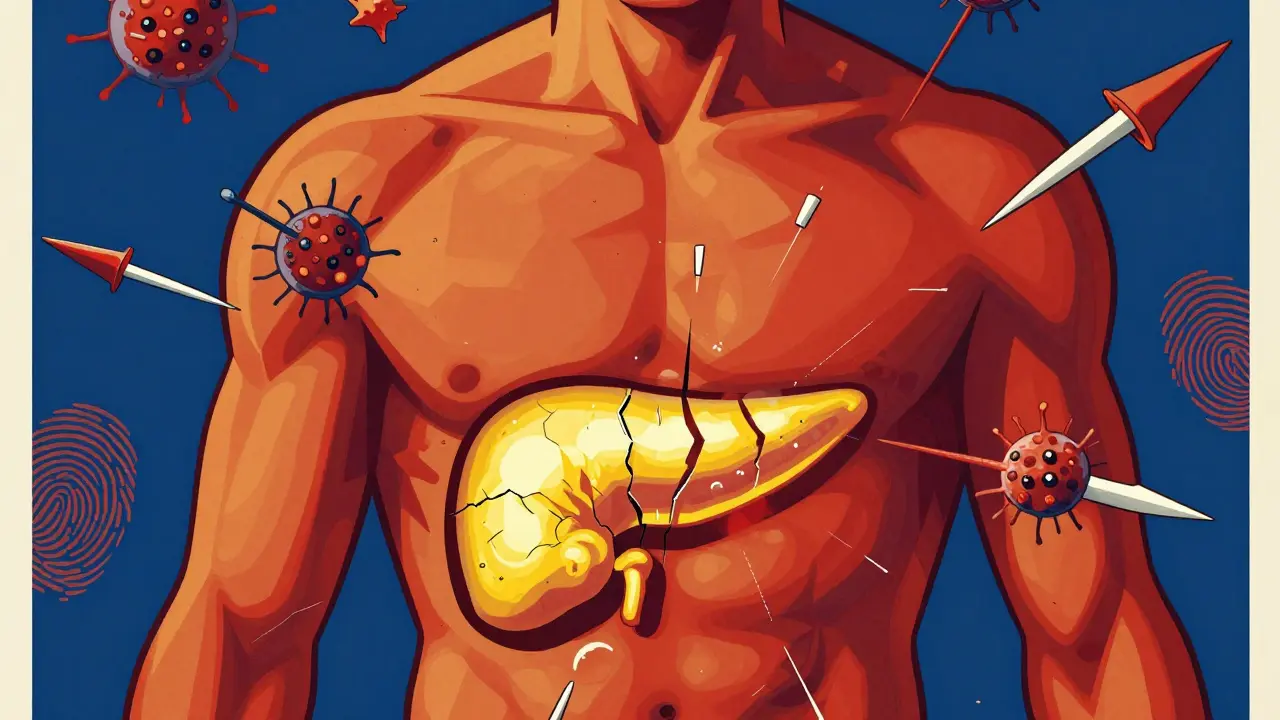
When your immune system turns against your own pancreas, life changes overnight. Type 1 diabetes isn’t just about high blood sugar-it’s the result of your body’s T cells attacking and destroying the insulin-producing beta cells in your pancreas. This isn’t a lifestyle mistake. It’s an autoimmune disease, and it’s happening in about 1.25 million Americans right now, with kids under 14 being diagnosed at a rate of nearly 25 new cases per 100,000 each year. The damage starts quietly, often years before symptoms show up. By the time you’re thirsty, peeing constantly, or losing weight, you’ve already lost most of your ability to make insulin.
How the Immune System Attacks the Pancreas
Your pancreas has two jobs: making digestive enzymes (exocrine) and insulin (endocrine). Type 1 diabetes targets only the endocrine part-the islets of Langerhans where beta cells live. The immune system mistakes these cells as invaders. Autoantibodies form against insulin itself, GAD65, IA-2, and ZnT8. These aren’t random markers-they’re the fingerprints of the attack. CD8+ T cells invade the islets, a process called insulitis, and kill beta cells one by one.
Genetics play a big role. If you carry the HLA-DR3/DR4 gene combo, your risk jumps 20 to 30 times higher than average. But genes alone don’t cause it. Something triggers the switch. Enteroviruses, especially coxsackievirus B, show up in the blood of many newly diagnosed patients. One study found a 58% higher chance of developing type 1 diabetes after detecting this virus. It’s not the virus itself-it’s how your immune system responds to it that sets off the chain reaction.
And here’s something surprising: the beta cells aren’t just passive victims. Research from Indiana University suggests they may actually help start the fight. When stressed-by viruses, inflammation, or metabolic overload-they release signals that attract immune cells. This shifts the whole model from “innocent bystander” to “active participant.” That’s why treatments that only block the immune system often fail. You need to calm the attack and protect the cells.
Three Stages Before Diagnosis
Type 1 diabetes doesn’t appear out of nowhere. It follows a clear three-stage progression, defined by the TrialNet consortium:
- Stage 1: You have two or more autoantibodies, but your blood sugar is still normal. About 0.4% of the general population is here. Most don’t know it.
- Stage 2: Blood sugar starts to rise, but you still feel fine. No symptoms. About 0.15% of people are in this stage. This is the window for intervention.
- Stage 3: Symptoms hit-fatigue, thirst, weight loss. Insulin is now essential. This is where most people are diagnosed.
The time between Stage 1 and Stage 3 varies. Kids often progress in under three years. Adults? It can take over 12 years. That’s why some adults are misdiagnosed with type 2 diabetes. They’re actually LADA-Latent Autoimmune Diabetes in Adults. About 12% of adults diagnosed with type 2 actually have type 1. And giving them metformin instead of insulin? That’s dangerous.
Managing Blood Sugar: The New Standard
There’s no cure yet. So management is everything. The American Diabetes Association’s 2023 guidelines say you need three things: insulin, monitoring, and precision.
Insulin therapy isn’t optional. You must replace what your body can’t make. Most people use either multiple daily injections (MDI) or an insulin pump. A typical starting dose is 0.5 units per kilogram of body weight per day-split evenly between basal (long-acting) and bolus (rapid-acting). Insulin glargine U-300 or degludec for basal. Aspart, lispro, or glulisine for meals. You don’t just inject-you calculate. Carbs. Activity. Stress. Illness. All change your needs.
Continuous glucose monitoring (CGM) is now standard. Devices like the Dexcom G7 (approved in 2022) give you real-time numbers, trends, and alerts. The DIAMOND trial showed CGM users dropped their HbA1c by 0.4-0.6% and had 40-50% fewer low blood sugar events. That’s not a small win. It’s life-changing.
Artificial pancreas systems like Tandem’s Control-IQ are taking over. These closed-loop systems link your CGM to your pump and auto-adjust insulin every 5 minutes. In a 2022 JAMA study, users spent 71-74% of the day in target range (70-180 mg/dL). People on MDI? Only 51-55%. That’s the difference between feeling okay and feeling free.

The New Frontier: Disease-Modifying Therapies
For the first time, we have treatments that don’t just manage symptoms-they slow the disease.
Teplizumab (brand name Tzield), approved by the FDA in November 2022, is the first drug proven to delay type 1 diabetes onset. In the PROTECT trial, it pushed diagnosis back by nearly 2.5 years in people with Stage 2 disease. It works by targeting the immune cells that kill beta cells. It’s not a cure. But it buys time. And time means better outcomes.
Other promising drugs are in trials. Abatacept (a rheumatoid arthritis drug) reduced beta-cell decline by 59% in recent-onset patients. Verapamil, a blood pressure pill, preserved 30% more insulin production in a 2022 Cell Metabolism trial. And then there’s Vertex’s VX-880-a stem cell-derived islet transplant. In a 2023 NEJM study, 89% of 12 patients became insulin-independent after 90 days. It’s early, but it’s real.
When the Pancreas Gets More Than Just Beta Cells
Most people think type 1 diabetes only affects insulin production. But in about 1 in 300 cases, the immune system also attacks the exocrine pancreas-the part that makes digestive enzymes. That’s autoimmune pancreatitis (AIP). It’s rare, but it happens.
AIP has two types. Type 1 is linked to high IgG4 levels and responds well to steroids. Type 2 is tied to inflammatory bowel disease. When both T1D and AIP occur together, you need two specialists: an endocrinologist and a gastroenterologist. Steroids help the pancreas make enzymes again-but they spike blood sugar. So insulin doses often need to go up.
If you’ve had type 1 for years and suddenly have bloating, diarrhea, or unexplained weight loss, ask about pancreatic enzyme insufficiency. About 5-10% of long-term type 1 patients develop it. Enzyme replacement therapy can fix it. But only if someone thinks to look.

What’s Next: The Gut-Pancreas Link
Researchers are now looking at your gut. A 2022 Nature Microbiology study found that 67% of people with type 1 diabetes have less of a gut bacterium called Faecalibacterium prausnitzii. This bug makes butyrate, a short-chain fatty acid that calms inflammation. Lower levels? Faster beta-cell loss.
Could probiotics or fiber-rich diets help? Early trials are testing this. It’s not a treatment yet-but it’s another piece of the puzzle. The future of type 1 diabetes care won’t be one drug. It’ll be a combo: immunotherapy to stop the attack, beta-cell protectors to save what’s left, and gut support to reduce inflammation.
Living Well With Type 1 Diabetes
Yes, it’s lifelong. Yes, it’s demanding. But it’s manageable. People with type 1 diabetes are living longer, healthier lives than ever before. The key? Consistency, not perfection.
Use your CGM. Don’t ignore trends. Adjust insulin for exercise, illness, stress. Eat regular meals. Track carbs. Sleep well. Stress management isn’t optional-it affects blood sugar as much as food.
And if you’re newly diagnosed? Don’t believe the myths. You can still run marathons, travel, have kids, and live a full life. The tools are here. The science is advancing. And you’re not alone.
Is type 1 diabetes the same as autoimmune pancreatitis?
No. Type 1 diabetes is an autoimmune attack on the insulin-producing beta cells in the pancreas. Autoimmune pancreatitis (AIP) is a separate condition where the immune system attacks the exocrine part of the pancreas, which makes digestive enzymes. They’re different targets, different symptoms, and different treatments. But in rare cases-about 1 in 300-both can happen together, requiring care from both an endocrinologist and a gastroenterologist.
Can type 1 diabetes be reversed?
Not yet. But it can be delayed. Teplizumab (Tzield) is the first FDA-approved drug shown to delay the onset of type 1 diabetes in people with Stage 2 disease by nearly 2.5 years on average. Research into stem cell transplants and immune therapies is showing promise, but no treatment currently restores full insulin production long-term. Management, not reversal, remains the standard.
Why do some adults get misdiagnosed with type 2 diabetes?
Because type 1 diabetes in adults-called LADA (Latent Autoimmune Diabetes in Adults)-progresses slowly. Many have enough insulin left to avoid immediate symptoms, so doctors assume it’s type 2. But LADA patients have autoantibodies and low C-peptide levels, meaning their bodies can’t make insulin. Giving them metformin instead of insulin delays proper treatment and increases risk of complications like DKA.
How does CGM improve type 1 diabetes management?
CGM gives real-time glucose readings and shows trends, not just snapshots. This helps prevent dangerous highs and lows. Studies show CGM users lower their HbA1c by 0.4-0.6% and cut hypoglycemic events by 40-50%. It also allows for smarter insulin dosing, better meal planning, and faster responses to illness or exercise. For many, it’s the difference between constant worry and confident living.
Are there any new drugs for type 1 diabetes besides insulin?
Yes. Teplizumab (Tzield) is the first FDA-approved disease-modifying drug for Stage 2 type 1 diabetes-it delays diagnosis by over two years. Other drugs like abatacept and verapamil are in late-stage trials and show promise in preserving insulin production. Stem cell-derived islet transplants, like Vertex’s VX-880, have restored insulin independence in early trials. These aren’t cures yet, but they’re the first real shift away from just replacing insulin.
What should I do if I have type 1 diabetes and new digestive symptoms?
Don’t ignore bloating, diarrhea, or unexplained weight loss. About 5-10% of long-term type 1 patients develop exocrine pancreatic insufficiency, meaning their pancreas can’t make enough digestive enzymes. This can be checked with a fecal elastase test. If confirmed, pancreatic enzyme replacement therapy (PERT) can fix it. It’s often overlooked, but treating it improves nutrient absorption, energy, and overall health.
Kristen Russell
January 3, 2026 AT 02:42Just found out my niece is Stage 1 - no symptoms yet. This post gave me hope. Teplizumab is real, and it’s not sci-fi anymore. We’re getting there.
Sally Denham-Vaughan
January 3, 2026 AT 03:02My husband’s been T1D for 22 years. He’s still hiking, cooking, and yelling at his CGM when it beeps at 3 a.m. It’s not perfect, but it’s doable. And yeah, sleep matters more than you think.
Matthew Hekmatniaz
January 5, 2026 AT 00:10The gut-pancreas link is fascinating. I’ve seen patients with low Faecalibacterium prausnitzii respond to high-fiber diets - not cure, but stabilization. It’s not magic, but it’s biology we can’t ignore anymore.
Dusty Weeks
January 6, 2026 AT 02:52why do they keep calling it ‘autoimmune’? what if it’s just the toxins in our food + 5G + vaccines? 🤔 i mean… look at the numbers. it’s too fast. something’s being hidden. 💉🌍
Liam George
January 7, 2026 AT 15:17Let’s be real - the pharmaceutical industry doesn’t want a cure. They want lifelong insulin sales. Teplizumab? A Band-Aid. Stem cell transplants? Too expensive to scale. Verapamil? A repurposed BP pill they’re ignoring because it’s off-patent. This whole narrative is engineered to keep us dependent. The science is there - but the system won’t let it breathe.
And don’t get me started on how they label LADA as type 2 to avoid liability. It’s not negligence - it’s profit-driven obfuscation.
sharad vyas
January 7, 2026 AT 23:19In India, many still think diabetes is from eating too much sugar. But this post shows it’s deeper - body attacking itself. I wish more doctors here understood. My cousin was misdiagnosed for two years. He needed insulin, not just diet advice.
Bill Medley
January 8, 2026 AT 19:45While the science presented is compelling, it is imperative to emphasize that the management of Type 1 Diabetes remains grounded in evidence-based protocols. The integration of CGM and closed-loop systems represents a significant advancement in clinical care.
Ann Romine
January 9, 2026 AT 04:12Wait - so if beta cells are actively signaling immune cells… does that mean they’re not just victims? That changes everything. I’ve been reading about this for years, but no one ever said it like that.