
 Feb, 23 2026
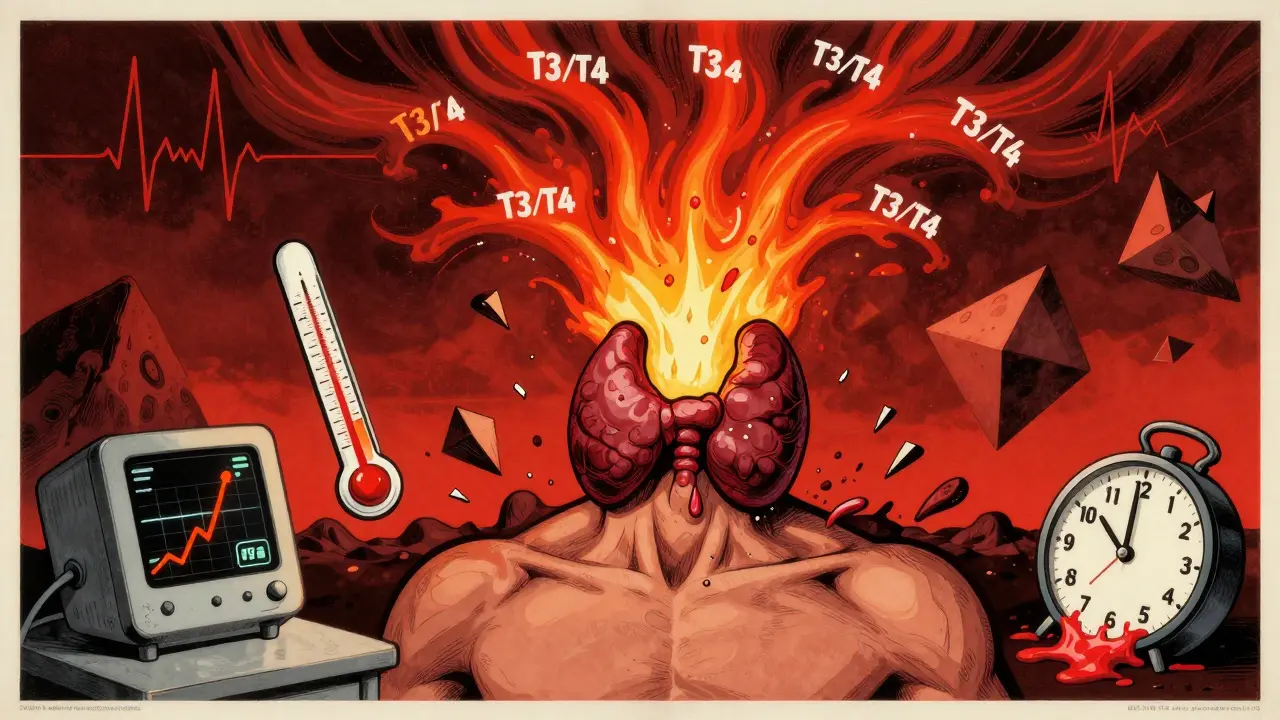
Thyroid storm isn't just a bad case of an overactive thyroid. It's a medical emergency that can kill you within hours if not treated immediately. Imagine your body’s metabolism going into overdrive-your heart racing at 180 beats per minute, your temperature spiking to 106°F, your mind slipping into confusion or coma. This isn't science fiction. It's thyroid storm, and it happens when untreated or poorly controlled hyperthyroidism suddenly spirals out of control.
What Exactly Is Thyroid Storm?
Thyroid storm, also called thyrotoxic crisis, is the most extreme form of hyperthyroidism. It's rare-only about 0.2 cases per 100,000 people each year-but deadly. While about 1.2% of people in the U.S. have hyperthyroidism, only 1 to 2% of those will ever develop thyroid storm. But when it does happen, the body doesn't just feel unwell-it starts shutting down.
Normally, the thyroid gland makes just enough hormones-T3 and T4-to keep your metabolism running smoothly. In thyroid storm, it dumps out massive amounts of these hormones all at once. That sends your cells into overdrive. Your heart pounds, your liver struggles, your brain fogs over, and your body can't cool itself. Without urgent treatment, survival rates drop to near zero.
How Do You Know It’s Thyroid Storm and Not Just Severe Hyperthyroidism?
The difference between regular hyperthyroidism and thyroid storm is speed and severity. Hyperthyroidism builds over weeks: weight loss, shaky hands, anxiety, heat intolerance. Thyroid storm hits like a storm-within hours.
The diagnostic criteria from the Japan Thyroid Association (widely used today) require two things: confirmed high T3 and T4 levels, plus a mix of severe symptoms. You don’t need every symptom, but you need a dangerous combination:
- Fever between 104°F and 106°F (40-41.1°C), with heavy sweating
- Heart rate over 140 bpm-sometimes over 180
- High blood pressure, especially systolic above 180 mmHg
- Severe gastrointestinal issues like vomiting, diarrhea (seen in 50-60% of cases)
- CNS changes-agitation, delirium, seizures, or coma (present in 90% of cases)
- Jaundice and liver enzyme spikes (bilirubin over 3 mg/dL)
If someone with known Graves’ disease or untreated hyperthyroidism suddenly develops fever, confusion, and a racing heart, assume thyroid storm until proven otherwise. Delay means death.
What Triggers Thyroid Storm?
Thyroid storm doesn’t come out of nowhere. It’s triggered by a stressor in someone who already has uncontrolled hyperthyroidism. The most common triggers:
- Untreated or poorly managed hyperthyroidism-accounts for 60-70% of cases
- Infection-especially pneumonia or sepsis (20-30% of cases)
- Surgery or trauma-even minor procedures like dental work can trigger it if thyroid levels aren’t controlled
- Stopping thyroid medication-patients who skip doses or quit treatment entirely
- Postpartum period-thyroiditis after childbirth is a known trigger
- Radioactive iodine therapy-rarely, 1-2% of cases occur days after treatment
- Heart attack, stroke, or pulmonary embolism
Even emotional stress or a punch to the neck can set it off. The body’s stress response releases hormones that push the already overactive thyroid into full crisis mode.
How Is It Treated in the ICU?
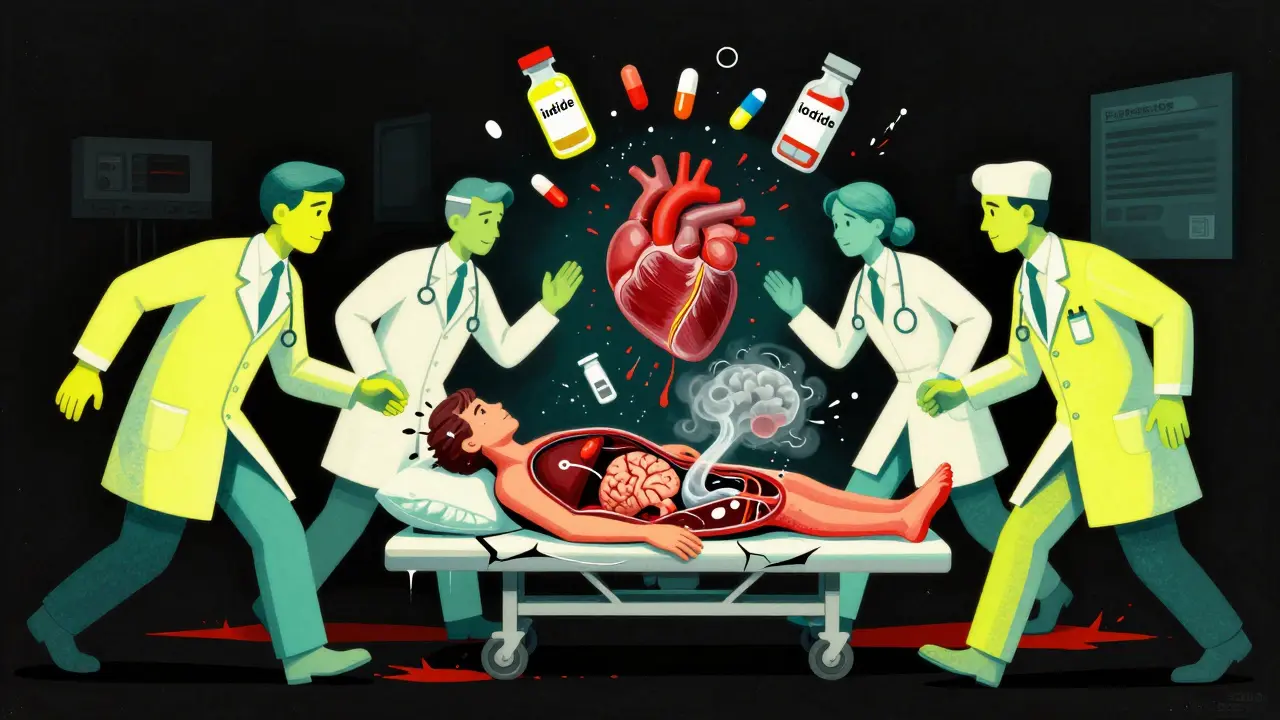
Time is everything. Every hour without treatment lowers survival chances. The goal? Stop hormone production, block hormone action, and support failing organs-all at once.
Step 1: Block hormone production
Methimazole (60-80 mg loading dose) or propylthiouracil (PTU) (600-1,000 mg) is given immediately. PTU is preferred in the first 24 hours because it also blocks T4 from converting to the more powerful T3 hormone.
Step 2: Block hormone release
One hour after antithyroid drugs, potassium iodide (500 mg every 6 hours) or sodium iodide (1 g daily) is given. This stops the thyroid from dumping out more hormones. Don’t give this before antithyroid drugs-it can make things worse.
Step 3: Control the heart and symptoms
Propranolol is the go-to beta-blocker. It’s given orally or IV: 60-80 mg every 4-6 hours, or 1-2 mg IV every 5 minutes until heart rate drops below 140. It doesn’t fix the hormone problem, but it saves lives by slowing the heart and reducing tremors, anxiety, and sweating.
Step 4: Lower fever
Acetaminophen is used. NSAIDs like ibuprofen are avoided-they can harm the liver, which is already stressed. Cooling blankets and ice packs are applied if temperature exceeds 104°F.
Step 5: Protect the adrenal glands
Hydrocortisone (100 mg IV every 8 hours) is given. High stress can crash adrenal function, and steroids also help block T4-to-T3 conversion.
Step 6: Support failing organs
IV fluids (2-3 liters of saline) to fix dehydration. Continuous heart monitoring. Mechanical ventilation if the patient is comatose. Vasopressors if blood pressure crashes. Liver and kidney function are watched closely-jaundice and rising creatinine mean trouble.
Some patients need plasmapheresis-a blood-filtering treatment that removes excess thyroid hormones. A 2021 study showed it worked in 78% of cases that didn’t respond to standard treatment. It’s not routine, but it’s a life-saver when everything else fails.
What’s the Survival Rate?
Without treatment, thyroid storm is almost always fatal. With treatment, survival jumps to 75-80% if care starts within 6 hours. But if treatment is delayed more than 24 hours, survival drops to 20%.
Prognosis depends on how bad the symptoms are:
- Systolic BP below 90 mmHg → 50% mortality
- Temperature above 105.8°F (41°C) → 40% mortality
- Coma → 35% mortality
- Age over 60 → higher risk of death
- Heart disease → 2.3 times higher risk of death
The Burch-Wartofsky scoring system helps doctors predict severity. A score above 45 confirms thyroid storm. Each point increase raises death risk by 5%. A score of 60? That’s a 70% chance of dying.
What Happens After Surviving?
Survivors don’t just walk out of the ICU cured. Most need long-term care.
- ICU stay averages 7.8 days
- Total hospital stay is around 14 days
- 68% need mechanical ventilation for an average of 5.2 days
- 41% need vasopressors to keep blood pressure up
Neurological recovery follows a pattern: agitation fades in 24-48 hours, confusion improves in 72 hours, and full mental clarity takes 7-14 days. But the thyroid problem? That’s usually permanent.
85% of survivors need lifelong thyroid hormone replacement because the root cause-Graves’ disease or toxic nodules-is treated with radioactive iodine or surgery. Only 15% can stay off medication long-term. And if they skip follow-up? Recurrence risk jumps from 2-3% to 25-30%.
How Can It Be Prevented?
Most thyroid storms are preventable. If you have hyperthyroidism:
- Take your meds every day-no exceptions
- Get regular blood tests-TSH, free T3, free T4
- Treat infections early-don’t wait for fever to hit
- Let your doctor know before any surgery or dental work
- Don’t ignore symptoms like rapid heartbeat, sweating, or weight loss
- Women who’ve had babies in the last 6 months should be monitored for postpartum thyroiditis
Public awareness programs, like the American Association of Clinical Endocrinologists’ Thyroid Storm Awareness initiative, have already cut delayed diagnoses by 18%. Education saves lives.
What’s Next in Treatment?
Research is moving fast. A 2023 study in the Journal of Intensive Care Medicine is testing IL-6 inhibitors-drugs used in cytokine storms-to calm the body’s overactive immune response during thyroid storm. Early results are promising, but it’s still experimental.
For now, the best tools remain speed, accuracy, and aggressive multi-drug therapy. The ICU is the frontline. Every minute counts.
Can thyroid storm happen to someone without known thyroid disease?
Yes, but it’s rare. Most cases occur in people already diagnosed with hyperthyroidism, especially Graves’ disease. However, some people have undiagnosed thyroid issues-especially after pregnancy, illness, or stress. In about 5-10% of cases, thyroid storm is the first sign someone has an overactive thyroid.
Is thyroid storm the same as thyroiditis?
No. Thyroiditis is inflammation of the thyroid that can cause temporary hyperthyroidism as stored hormones leak out. It’s usually mild and self-limiting. Thyroid storm is a full-blown metabolic crisis from uncontrolled, excessive hormone production. Thyroiditis can trigger thyroid storm in rare cases, but they’re not the same.
Why is propylthiouracil (PTU) used instead of methimazole in the first 24 hours?
PTU has a dual action: it blocks thyroid hormone production and stops the body from converting T4 into the more active T3 hormone. In thyroid storm, T3 is the main driver of symptoms. So in the first critical day, PTU gives a faster, more complete shutdown. After 24 hours, methimazole is usually switched to because it’s safer for long-term use.
Can you survive thyroid storm without ICU care?
Almost certainly not. The condition causes multi-organ failure-heart, liver, brain, kidneys. Outside the ICU, you can’t get the intensive monitoring, IV medications, ventilator support, or rapid response team needed to reverse the crisis. Survival rates drop from 80% with timely ICU care to under 20% without it.
How long does recovery take after thyroid storm?
Physical recovery from the acute episode takes days to weeks. Most patients are out of the ICU in 7-10 days. But long-term recovery means lifelong management. You’ll need regular thyroid hormone replacement, blood tests, and follow-up with an endocrinologist. Full metabolic stability can take 3-6 months. Returning to normal energy levels and weight takes time-even after the crisis is over.