
 Mar, 11 2026
Thyroid Medication Timing Calculator
Your Medication Routine
How It Affects You
Recommended
Take your thyroid medication 30-60 minutes before breakfast with water only. Wait at least 1 hour before eating or drinking anything besides water.
Why this matters: Levothyroxine needs to be absorbed in an empty stomach. Food, coffee, and certain supplements can reduce absorption by up to 40%, which may push your TSH levels into the under-treated range.
Taking thyroid medication like levothyroxine isn’t just about popping a pill. It’s about when you take it, what you eat before or after, and even what else you’re taking that day. Get it wrong, and your TSH levels can swing wildly - leaving you tired, sluggish, or worse. For millions of people managing hypothyroidism, small mistakes in timing or routine can undo months of stable treatment. This isn’t theoretical. It’s measurable. It’s real. And it’s happening to people right now.
Why Timing Matters More Than You Think
Levothyroxine, the most common thyroid hormone replacement, works by replacing the T4 your body no longer makes. But it doesn’t just work if you swallow it. It needs to be absorbed - and that happens almost entirely in the upper part of your small intestine. That area is picky. It needs an empty stomach, the right pH, and no interference.
Studies show that taking levothyroxine with food cuts absorption by up to 40%. One 2009 study in the Journal of Clinical Endocrinology & Metabolism tracked 65 patients. Those who took their pill on an empty stomach had an average TSH of 1.06 mIU/L. Those who took it with breakfast? Their TSH jumped to 2.93 mIU/L - a 176% increase. That’s not a minor fluctuation. That’s enough to push someone from well-controlled to clearly under-treated.
Even coffee - a morning ritual for many - can reduce absorption by 36%. A 2017 study in Thyroid found that drinking coffee within an hour of taking the pill made a measurable difference. Milk, soy, and high-fiber foods like oatmeal or bran cereal? They do the same. Calcium supplements? Down 27-36%. Iron? Down 39%. These aren’t rumors. These are numbers from peer-reviewed studies.
What Happens When You Take It With Food
Let’s say you’re rushing out the door. You grab your pill, swallow it with your coffee, then eat breakfast 10 minutes later. You feel fine. You’ve done this for years. But your body isn’t getting what it needs.
Levothyroxine is a drug with a narrow therapeutic window. That means the difference between the right dose and too much or too little is tiny. A TSH level of 1.5 might mean you’re perfectly stable. A TSH of 4.2? That’s hypothyroidism again - fatigue, weight gain, brain fog, cold intolerance. One patient on Drugs.com shared: “I accidentally took it with coffee for two weeks. My TSH jumped from 1.8 to 4.3. I felt terrible. The fatigue came back instantly.”
That’s not an outlier. A 2021 GoodRx survey of 15,000 patients found 33% had taken levothyroxine with breakfast at least once. Of those, 33% said they didn’t notice any change. But that doesn’t mean their body didn’t react. TSH levels don’t always cause obvious symptoms right away. By the time you feel it, your thyroid function may have been off for months.
Is Evening Dosing a Viable Alternative?
For years, the rule was simple: take it in the morning, 30-60 minutes before breakfast. But more recent research is challenging that.
A 2020 systematic review of 12 studies with over 1,000 patients found that taking levothyroxine at bedtime - at least 3-4 hours after eating - led to lower TSH and higher free T4 levels compared to morning dosing. Another 2017 study in the Indian Journal of Endocrinology and Metabolism followed 86 patients for three months. They switched from morning to evening dosing. No significant change in TSH. No drop in effectiveness.
Why does this happen? One theory: your stomach is more empty at night. You’ve had hours without food. Your body isn’t digesting other things. Your pH is more stable. And for some people, especially those with digestive issues or busy mornings, bedtime dosing is simply easier to stick to.
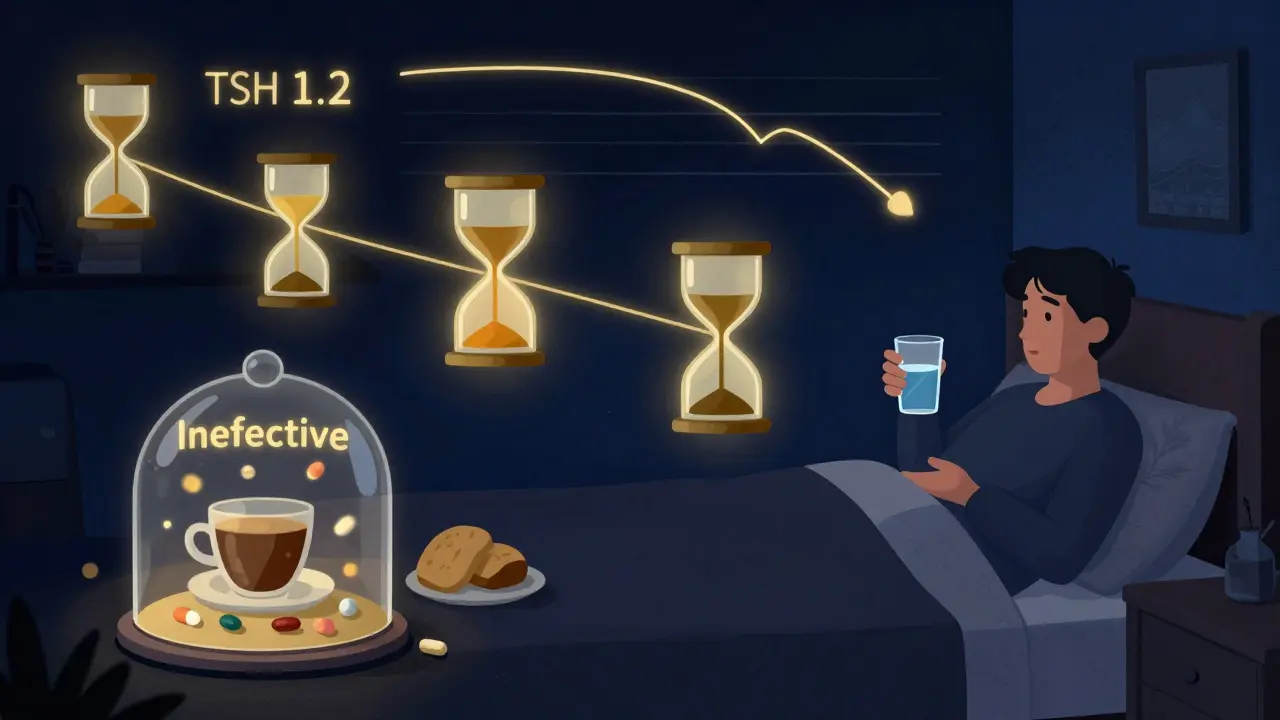
One patient on ThyroidChange.com wrote: “Switching to bedtime dosing stabilized my TSH after years of erratic morning results. I’ve held at 1.2 for 18 months.” That’s not luck. That’s consistency.
Still, not everyone responds the same. Some studies show no benefit. Others show worse absorption at night. The key? Consistency. If you switch from morning to night, monitor your TSH. Don’t assume it’s fine. Get tested 6-8 weeks after the change.
What You Must Avoid
Here’s a quick list of substances that interfere with levothyroxine absorption - and how long to wait:
- Calcium supplements - wait 4 hours
- Iron supplements - wait 4 hours
- Antacids, proton pump inhibitors (like omeprazole) - wait 4 hours
- Soy products - wait 4 hours
- Fiber supplements - wait 4 hours
- Multivitamins with minerals - wait 4 hours
- Coffee - wait at least 60 minutes
- Milk or soy milk - wait 60 minutes
Even a multivitamin taken 30 minutes after your pill can knock absorption down by 20-30%. That’s why many endocrinologists recommend taking supplements at dinner or bedtime - at least 4 hours after your thyroid medication.
Special Cases: Pregnancy, Cancer, and Older Adults
Not everyone gets the same advice. Some groups need stricter rules.
Pregnant women: Thyroid hormone is critical for fetal brain development. The American Thyroid Association says to take levothyroxine on an empty stomach, 30-60 minutes before breakfast. TSH targets are tighter - under 2.5 mIU/L in the first trimester. No exceptions.
Thyroid cancer patients: These patients need TSH suppressed below 0.1 mIU/L. Even small drops in absorption can mean the difference between cancer control and recurrence. Consistency isn’t optional here. Every pill must be absorbed.
Elderly patients: Many take calcium for osteoporosis or iron for anemia. That’s a problem. A 2022 study found 43% of women over 60 take calcium daily. If they take it with their thyroid pill, absorption crashes. The solution? Space them out. Take thyroid meds in the morning, calcium at night. Or vice versa - as long as there’s a 4-hour gap.
How to Build a Routine That Works
It’s not about perfection. It’s about consistency.
Here’s what works for real people:
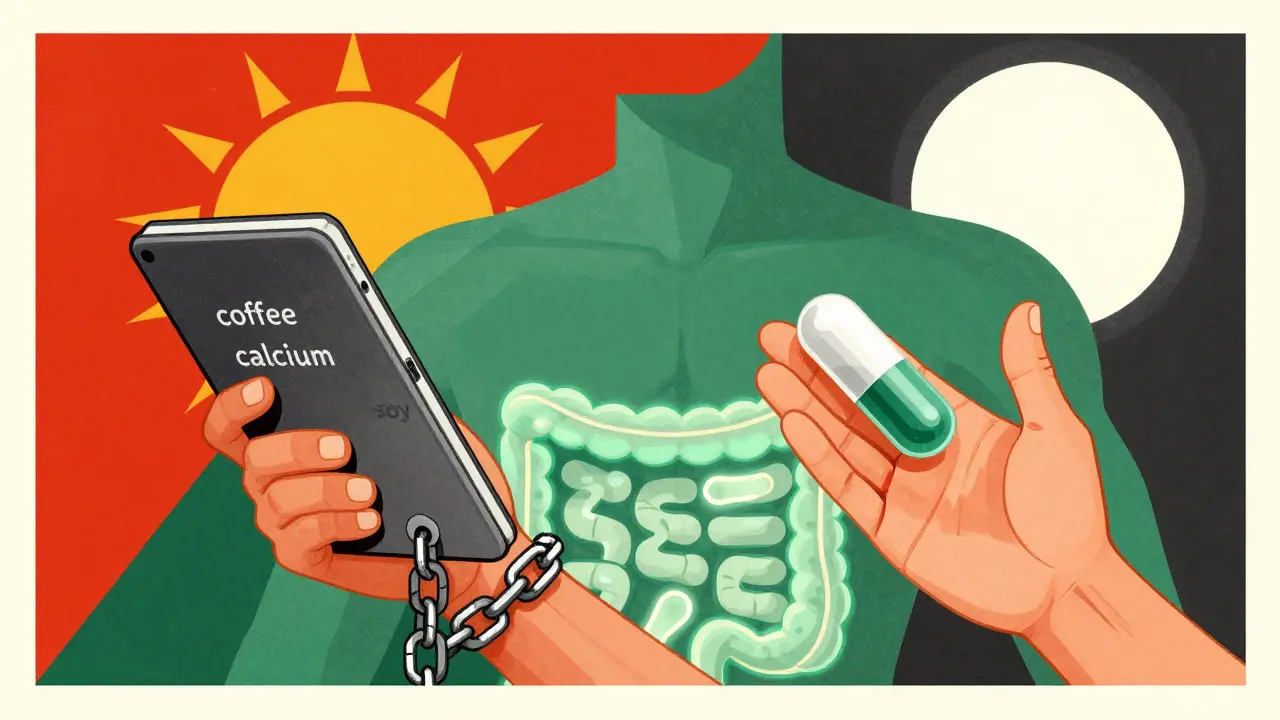
- Set a daily alarm - not just for the pill, but for the 30-60 minute wait before eating. A 2022 study found smartphone reminders improved adherence by 38%.
- Place your pill where you’ll see it - next to your toothbrush, keys, or coffee maker. Out of sight = out of mind.
- Use a pillbox - but don’t just fill it weekly. Check it daily. A 2023 survey found 22% of patients forgot doses because they didn’t track them.
- Write it down - keep a log. Note when you took it, what you ate, and how you felt. You might spot patterns your doctor misses.
- Test before you change - if you’re thinking of switching from morning to night, get a TSH test first. Then test again 6-8 weeks after the change.
Some manufacturers, like Synthroid, now recommend turning the bottle upside down after taking the pill. It’s a small trick - but it helps you remember you’ve taken it.
The Future: New Formulations That Don’t Care About Food
There’s hope on the horizon. In 2017, the FDA approved Tirosint-SOL, a liquid form of levothyroxine. Unlike tablets, it doesn’t interact with food. A 2019 study showed no difference in absorption whether taken with or without food.
And it’s not just liquid. A new delayed-release tablet is in phase 3 trials (NCT04567821). Early results from the 2023 American Thyroid Association meeting show 92% of patients maintained stable TSH levels even when taking the pill with meals.
But here’s the catch: these new formulations are still rare. Only 11% of prescriptions are for non-traditional forms. That means 89% of people are still taking the old tablets - and still need to follow the rules.
What You Should Do Right Now
Check your routine. Ask yourself:
- Do I take my pill with coffee or breakfast?
- Do I take calcium, iron, or a multivitamin within 4 hours of my thyroid dose?
- Have I had a TSH test in the last 6 months?
- Do I take my pill at the same time every day?
If you answered “no” to any of these, it’s time to adjust. Don’t wait for symptoms to return. Don’t assume your doctor knows your habits. Most don’t. Bring your routine to your next appointment. Ask: “Is my timing affecting my TSH?”
Thyroid medication isn’t just about the dose. It’s about the timing, the food, the supplements, the coffee. It’s a daily ritual - and getting it right can mean the difference between feeling okay and feeling like yourself again.
Can I take levothyroxine with water and then eat right away?
No. Even if you take it with water, eating immediately after can cut absorption by up to 40%. The American Thyroid Association recommends waiting 30-60 minutes after taking levothyroxine before eating or drinking anything besides water. This gives your body time to absorb the hormone in an empty stomach.
Is it okay to take thyroid medication at night?
Yes - if you do it right. Studies show taking levothyroxine at bedtime, at least 3-4 hours after your last meal, can improve absorption and lower TSH levels. This works best for people who struggle with morning routines, have digestive issues, or take supplements that interfere with absorption. But don’t switch without testing: get your TSH checked 6-8 weeks after changing your routine.
Does coffee really affect thyroid medication?
Yes. A 2017 study in the journal Thyroid found that drinking coffee within an hour of taking levothyroxine reduces absorption by 36%. Even if you take your pill with water, drinking coffee 10 minutes later can interfere. Wait at least 60 minutes after taking your pill before drinking coffee.
What if I forget to take my thyroid pill in the morning?
If you remember within a few hours, take it then - even if you’ve eaten. If it’s later in the day, skip the dose and take your next one the next day. Don’t double up. Missing one dose occasionally won’t wreck your levels, but doing it often will. Use reminders or pillboxes to stay on track.
How often should I get my TSH checked if I change my timing?
The American Association of Clinical Endocrinologists recommends checking your TSH 6-8 weeks after changing your dosing time. That’s how long it takes for your body to stabilize. Once your levels are steady, you can go back to annual testing - unless your doctor advises otherwise.
Devin Ersoy
March 12, 2026 AT 09:29Let me just say this - the whole 'take it on an empty stomach' thing is a cult. I've been taking my levothyroxine with my damn coffee and oatmeal for 12 years. My TSH? Steady as a rock. 1.4. Every. Single. Time. The studies? Probably funded by pharmaceutical companies selling $300/month liquid formulations. Wake up. Your body isn't a lab rat. It adapts. It evolves. I'm not 'non-compliant' - I'm just not a slave to guidelines written by people who've never missed breakfast because their kid threw up on their shirt.
Scott Smith
March 13, 2026 AT 23:47While the data on absorption interference is robust, the real issue is adherence. People don’t fail because they’re careless - they fail because the system is designed for people with perfect routines and no jobs, kids, or anxiety. I’ve had patients who take their pill at 2 a.m. because they’re up with a newborn. That’s not 'wrong.' That’s survival. The goal isn’t rigid timing - it’s sustainable consistency. A pill taken at 11 p.m. with a 4-hour gap is better than a pill skipped because the timing was 'perfect' but the context wasn’t.
Emma Deasy
March 14, 2026 AT 00:11It is, without a shadow of a doubt, a matter of profound physiological consequence - not merely a suggestion, not a gentle recommendation, but a non-negotiable biochemical imperative. The pharmacokinetics of levothyroxine are exquisitely sensitive to gastric pH, food matrix interactions, and competitive binding with divalent cations. To ignore this is not merely negligence - it is a form of self-sabotage masked as rebellion. The 40% absorption drop? That’s not a 'maybe.' That’s a documented, statistically significant, peer-reviewed, clinically observable phenomenon - and to dismiss it is to misunderstand the very nature of endocrine regulation.
Lorna Brown
March 14, 2026 AT 16:33What if the real problem isn’t timing - but the fact that we treat a hormone replacement like a magic bullet? We don’t talk about the emotional toll of this ritual. The guilt when you forget. The shame when you eat breakfast before the 30-minute window. The anxiety of a TSH test that feels like a moral exam. Maybe we need to stop framing this as 'compliance' and start asking: How do we make this sustainable for humans - not lab models? What if the answer isn’t stricter rules - but more compassionate systems?
Rex Regum
March 16, 2026 AT 08:35Oh, so now we’re just supposed to accept that Big Pharma wants us to take pills at 5 a.m. and avoid coffee like it’s the devil? Newsflash - the FDA doesn’t care about your sleep schedule. They care about profit margins. Liquid levothyroxine? $800 a month. Regular tablets? $4. They don’t want you to succeed - they want you to upgrade. Wake up. Your thyroid doesn’t need a ritual. It needs a functional dose. And if you’re taking 100mcg and feeling fine - who the hell are they to say you’re wrong?
Kelsey Vonk
March 16, 2026 AT 23:18I switched to bedtime dosing last year and it changed my life. No more rushing in the morning. No more coffee guilt. No more wondering if I ate too soon. My TSH dropped from 3.1 to 1.1 and I haven’t felt this clear-headed since college. I know it’s not for everyone - but for me? It was the missing piece. I wish someone had told me sooner. You’re not broken if your routine looks different. You’re just figuring it out. 💛
Emma Nicolls
March 18, 2026 AT 20:51Jimmy V
March 19, 2026 AT 20:05Emma Nicolls - you’re not alone. But here’s the truth: 40% absorption loss isn’t a 'maybe.' It’s a 40% drop in hormone delivery. That’s not 'fine.' That’s subclinical hypothyroidism. Your body compensates - until it doesn’t. Then you get the fatigue, the weight gain, the depression. Don’t gamble with your thyroid. This isn’t about perfection. It’s about protecting your brain, your heart, your energy. If you’re feeling okay - good. But you might be okay *despite* the interference - not because of it. Get tested. Then adjust. No excuses.
Sabrina Sanches
March 21, 2026 AT 13:32Thank you for this. I’ve been taking my pill at night for 18 months. TSH stable. No more morning panic. I used to feel guilty about not following the 'rules' - until I read the studies. The science doesn’t say 'morning only.' It says 'consistent and fasting.' Bedtime works. Your routine is valid. You’re not failing. You’re adapting. And that’s strength.