
 Dec, 12 2025
When you pick up a prescription, you might not notice the difference between the brand-name pill and the generic version. Same size, same color, same name on the label. But here’s the real question: is it safe?
What therapeutic equivalence actually means
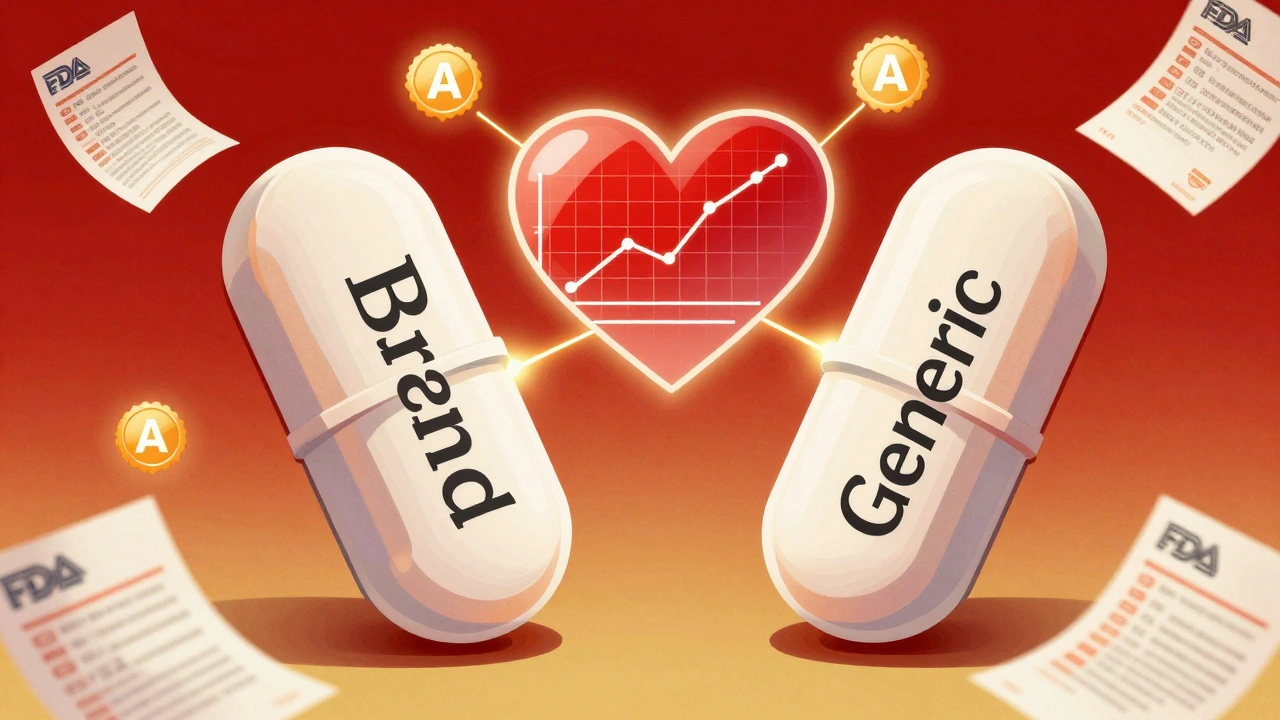
Therapeutic equivalence isn’t just a fancy phrase used by pharmacists. It’s a science-backed guarantee that a generic drug will work the same way as the brand-name version-no more, no less. The U.S. Food and Drug Administration (FDA) defines it clearly: two drugs are therapeutically equivalent if they contain the same active ingredient, in the same strength and dosage form, and they deliver that ingredient into your body at the same rate and amount. That’s it. No guesswork. No assumptions.This isn’t about price. It’s not about marketing. It’s about whether your blood pressure medicine, your thyroid pill, or your antibiotic will do exactly what it’s supposed to do when you take it. The FDA uses a strict system called the Orange Book to rate every approved drug. If a generic drug gets an ‘A’ rating-like AB, AC, or AD-it means the FDA has tested it and confirmed it performs just like the original. That’s the gold standard for patient safety.
The three rules behind therapeutic equivalence
There are three non-negotiable requirements for a drug to be rated therapeutically equivalent:- Pharmaceutical equivalence: The generic must have the same active ingredient, strength, dosage form (tablet, capsule, injection), and route of administration (oral, topical, etc.) as the brand. Inactive ingredients like dyes or fillers can differ, but those don’t affect how the drug works.
- Bioequivalence: This is where the real testing happens. The generic must release the drug into your bloodstream at nearly the same speed and to the same extent as the brand. The FDA requires the average absorption levels (measured by AUC and Cmax) to fall within 80% to 125% of the brand’s. That’s not a wide margin-it’s tight enough to catch even small differences.
- Identical clinical effect: The drug must produce the same results in patients. If it lowers cholesterol, reduces pain, or controls seizures just as effectively, it passes. The FDA doesn’t rely on theory alone-they look at real-world data and clinical studies.
These aren’t just checkboxes. They’re safety layers. One failure, and the drug gets a ‘B’ rating. That means it’s not recommended for automatic substitution. You’d need your doctor’s approval to switch.
Why this matters for patient safety
Imagine you’re on warfarin, a blood thinner with a narrow therapeutic index. That means the difference between a safe dose and a dangerous one is tiny. A 5% change in how your body absorbs the drug could lead to a stroke or a bleed. For drugs like this, the FDA doesn’t use the standard 80-125% range. It demands a tighter 90-110% window. That’s not arbitrary. It’s based on decades of patient outcomes.Therapeutic equivalence prevents the kind of harm that comes from uncertainty. Without it, patients might switch to a generic that doesn’t absorb the same way-leading to uncontrolled seizures, high blood pressure, or rejection of transplanted organs. In 2022, a UnitedHealthcare survey of over 12,500 patients found that 87% saw no change in how their medication worked after switching to an FDA-approved generic. Only 3.2% reported problems directly tied to the switch. Most of those cases turned out to be anxiety, not actual drug failure.
Compare that to therapeutic interchange-switching between different drugs in the same class, like swapping one statin for another. A 2019 JAMA study found that therapeutic interchange led to 32% more adverse events than switching to a therapeutically equivalent generic. Why? Because you’re changing the active ingredient. With therapeutic equivalence, you’re not changing the drug-you’re changing the brand.
What the Orange Book tells you (and what it doesn’t)
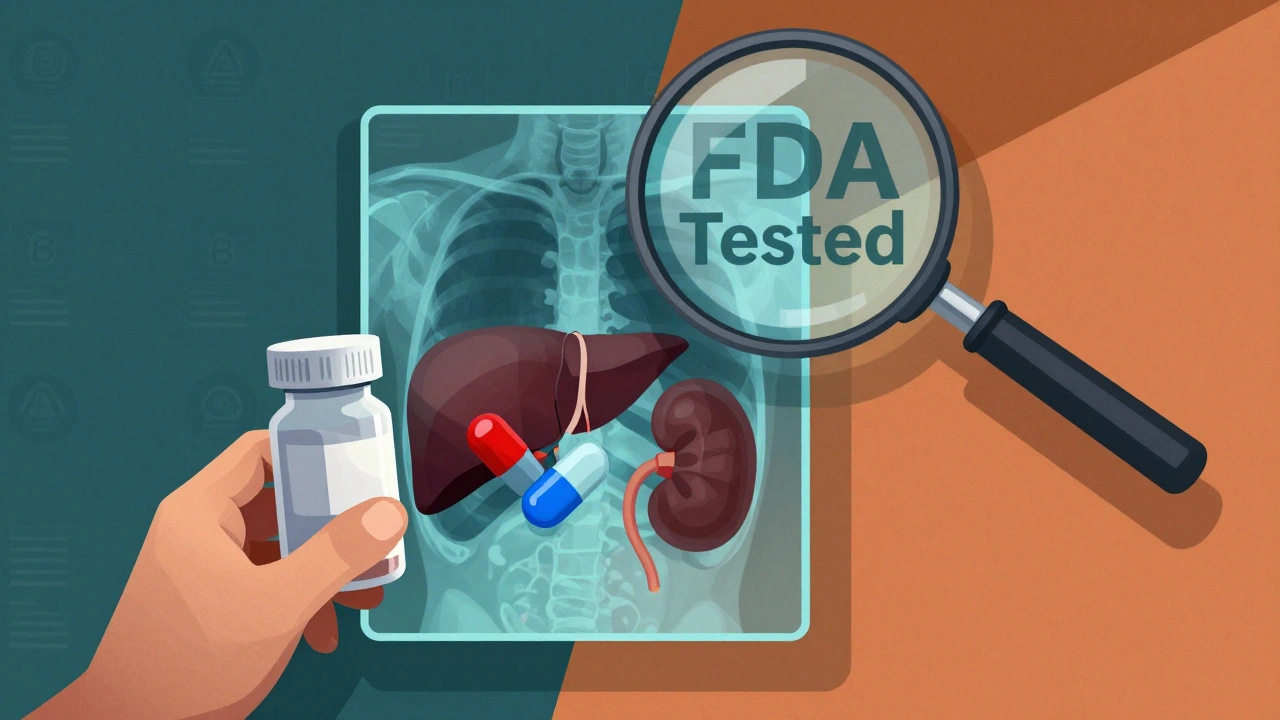
The FDA’s Orange Book is the go-to reference for pharmacists and prescribers. As of October 2023, it lists over 13,000 drug products with their therapeutic equivalence ratings. Each entry has a two-letter code:- A = Therapeutically equivalent. Safe to substitute.
- B = Not equivalent. Don’t substitute without approval.
The second letter adds detail-like whether it’s an extended-release tablet (X) or a liquid formulation (L). But here’s what most people miss: the Orange Book doesn’t rate everything. Complex drugs like inhalers, topical creams, and some injectables are harder to test. The FDA admits that standard bioequivalence methods don’t always work for these. That’s why new guidance came out in November 2023 to expand how these products are evaluated. Until then, pharmacists must be extra cautious.
What happens when you switch
In 49 U.S. states, pharmacists can automatically swap a brand-name drug for a therapeutically equivalent generic unless the doctor says “do not substitute.” That’s the law. But in 11 states, the prescriber must write “dispense as written” on the prescription to block the switch.Most patients never notice the change. The pill looks different, sure. Maybe it’s white instead of blue. Maybe it’s round instead of oval. But the active ingredient? Identical. The absorption? Verified. The outcome? The same.
Still, some patients report feeling different after a switch. A Reddit thread from 2021 collected 47 stories of people who said their generic medication didn’t work as well. But when investigators checked the Orange Book, only 3 of those cases involved an ‘A’-rated drug. The rest were either ‘B’-rated products or switches between different drug classes-something entirely different from therapeutic equivalence.
The Institute for Safe Medication Practices reviewed 127 adverse event reports linked to generic substitution between 2018 and 2022. Only 17 involved products with confirmed therapeutic equivalence. The rest were due to miscommunication, dosing errors, or patient anxiety. That’s important. It shows that the system works-but human factors still matter.
Who decides-and how
The FDA’s Center for Drug Evaluation and Research (CDER) handles all therapeutic equivalence evaluations. They don’t just rely on lab data. They look at clinical studies, post-market reports, and even patient feedback. Dr. Janet Woodcock, former head of CDER, put it plainly: “The FDA’s therapeutic equivalence determinations provide assurance that generic drugs perform the same way as brand name drugs in the body.”The American Medical Association backs this up. Their 2022 policy update confirmed that therapeutically equivalent generics deliver identical clinical outcomes. Even experts who are cautious, like Dr. Jerry Avorn from Harvard, agree: the system is sound. He just reminds doctors to pay extra attention when prescribing drugs like levothyroxine-where even small changes can affect thyroid levels in sensitive patients.
Cost savings without compromise
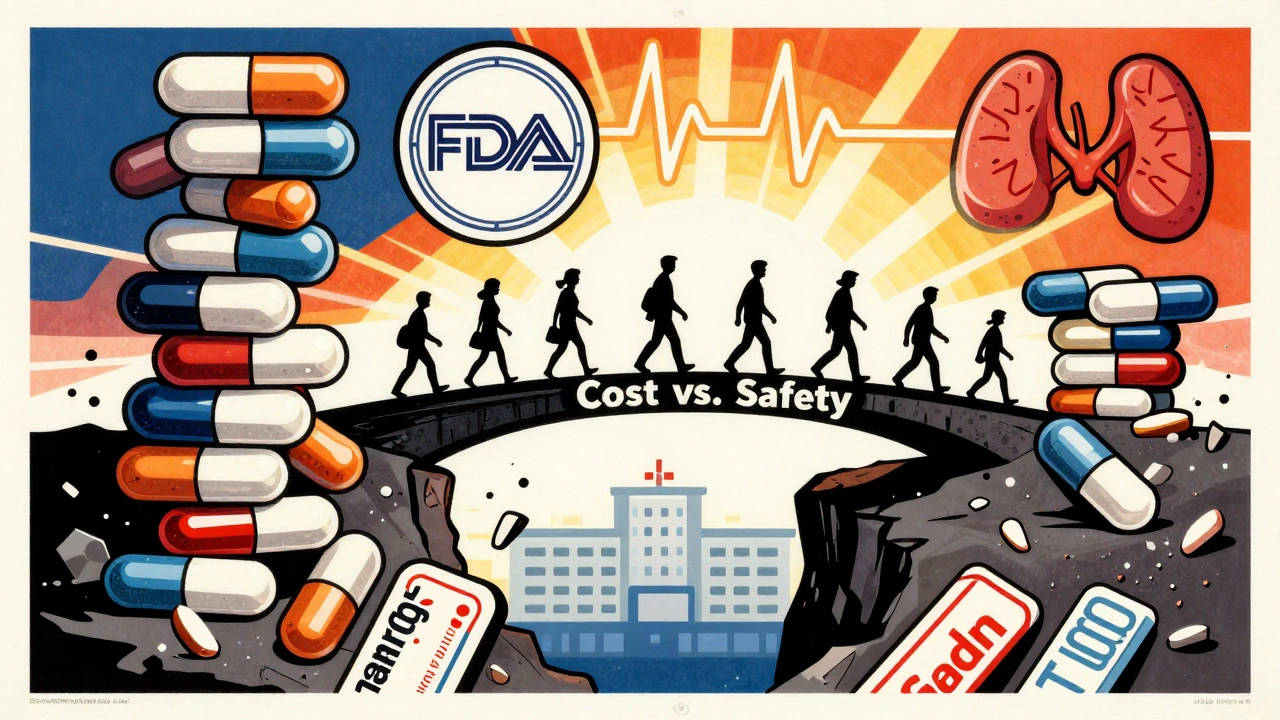
Therapeutic equivalence isn’t just about safety. It’s about access. In 2022, 90.7% of all prescriptions filled in the U.S. were generics. Yet they made up only 58% of total drug spending. That’s how much money this system saves. Since 2009, generic drugs have saved the U.S. healthcare system over $1.7 trillion.That’s not a drop in the bucket. That’s enough to cover the cost of care for millions of people who otherwise couldn’t afford their meds. And it’s all possible because of therapeutic equivalence. Without it, doctors would have to prescribe only expensive brand-name drugs. Patients would skip doses. Hospitals would see more complications. The system would collapse under cost.
What’s next
The FDA is working on new tools to improve therapeutic equivalence for complex drugs. They’ve partnered with MIT on a $2.3 million project using artificial intelligence to predict which formulation changes might affect absorption. They’re also investing $65 million through GDUFA III to refine testing methods for inhalers, topical creams, and other tricky products.And while biosimilars-generic versions of biologic drugs like insulin or cancer treatments-are gaining ground, they’re not covered by the same Orange Book system. They have their own ‘interchangeability’ designation, which is stricter and requires additional clinical data.
But the core principle stays the same: if a drug is labeled therapeutically equivalent, you can trust it. Your health isn’t a gamble. It’s a science.
What you can do
If you’re switching to a generic:- Check the Orange Book online (FDA.gov/OrangeBook) to confirm the ‘A’ rating.
- Don’t assume all generics are the same-stick with the same manufacturer if you notice a change in how you feel.
- Talk to your pharmacist. They can tell you if your drug is rated ‘A’ or ‘B’.
- If you feel different after switching, don’t ignore it. Report it to your doctor. It might be anxiety-but it might also be something real.
Therapeutic equivalence isn’t perfect. But it’s the best system we have. And for millions of people, it’s the difference between getting treatment-and going without.
Are generic drugs really as safe as brand-name drugs?
Yes, if they’re rated therapeutically equivalent by the FDA. The FDA requires generics to have the same active ingredient, strength, dosage form, and bioavailability as the brand. They must pass strict testing to prove they work the same way in the body. Over 90% of prescriptions in the U.S. are generics, and studies show they deliver the same clinical results with the same safety profile.
What does an ‘A’ rating mean in the FDA Orange Book?
An ‘A’ rating means the drug is considered therapeutically equivalent to the brand-name version. It’s been tested and approved for substitution without a doctor’s permission. The second letter (like AB or AC) gives more detail about the formulation, but the ‘A’ is what matters for safety and interchangeability.
Can I switch between different generic brands?
Yes-if both are rated ‘A’ by the FDA. But some patients report feeling different when switching between generic manufacturers, even if both are approved. This is rare, but it can happen due to minor differences in inactive ingredients or manufacturing. If you notice a change in how you feel, stick with the same generic brand and tell your doctor.
Why are some drugs not rated as therapeutically equivalent?
Some drugs, like inhalers, topical creams, and certain injectables, are too complex to test with standard bioequivalence methods. The FDA may rate these as ‘B’ if there’s uncertainty about whether they work the same. For these, substitution isn’t automatic. Your doctor must approve any switch.
What should I do if I think my generic drug isn’t working?
Don’t stop taking it. Contact your doctor right away. Keep track of when you started the new version and what symptoms you’re noticing. Your pharmacist can check the FDA Orange Book to confirm the rating. In most cases, the issue isn’t the drug’s effectiveness-it’s anxiety, timing, or another factor. But if it’s a narrow therapeutic index drug like warfarin or levothyroxine, even small changes matter. Always report concerns.
Sheldon Bird
December 12, 2025 AT 22:51Just wanted to say thanks for laying this out so clearly. I’ve been on generics for years and never knew how strict the FDA testing was. Knowing it’s not just a cheap copy but a scientifically verified match? Huge relief. 🙌
Jennifer Taylor
December 13, 2025 AT 10:33lol sure, the FDA says it’s safe… but have you ever seen the factories these generics come from? I’ve got a cousin who works at a pharma plant in India and he says they use ‘recycled’ fillers sometimes. And don’t get me started on how the FDA ‘inspects’-they show up once every 3 years and the company cleans up like it’s a TV show. 🤭
Jade Hovet
December 15, 2025 AT 02:03omg yes!! i switched to generic levothyroxine last year and felt like a zombie for 2 weeks 😭 then i went back to brand and boom-energy back. my pharmacist said it’s still an A rating but maybe different fillers? i’m just gonna stick with the same brand now. 🙏 #genericstruggles
nithin Kuntumadugu
December 16, 2025 AT 13:15Oh please. You think the FDA cares about patient safety? They’re just another arm of Big Pharma. Generics are made in China by companies that bribe inspectors. The 80-125% bioequivalence window? That’s a joke. A 25% swing in absorption could mean death for someone on warfarin. And yet they let pharmacists swap without consent? This is medical negligence disguised as ‘cost savings.’ 🤡
John Fred
December 16, 2025 AT 23:06As a clinical pharmacist, I can confirm: A-rated generics are rock solid. Bioequivalence studies are brutal-fasting, fed, crossover designs, multiple timepoints. We’ve seen cases where a patient’s INR spiked after switching generics, but it was always a B-rated product or a mislabeled bottle. The system works. Trust the data, not the Reddit anecdotes. 💊📊
Harriet Wollaston
December 18, 2025 AT 02:33I’m so glad someone finally explained this in plain terms. My mom was terrified to switch from her brand-name blood pressure med-thought she’d have a heart attack. We looked up the Orange Book together, found the ‘AB’ rating, and she’s been fine for 18 months now. She even saved $40/month. 🥹
Himmat Singh
December 18, 2025 AT 05:11It is my solemn duty to inform you that the concept of therapeutic equivalence is a fallacy rooted in reductionist pharmacology. The human body is not a test tube. Variations in gut microbiota, epigenetic expression, and metabolic polymorphisms render the notion of ‘identical clinical effect’ scientifically untenable. The FDA’s metrics are grossly inadequate for complex physiological systems. This is not safety-it is statistical arrogance.
Alvin Montanez
December 19, 2025 AT 21:39Let’s be real-this whole ‘generic = safe’ narrative is propaganda pushed by insurance companies and pharmacy benefit managers. I’ve seen patients on generics for years, then suddenly develop rashes, tremors, or depression. They’re told it’s ‘anxiety’ or ‘placebo effect.’ But when you dig into the FDA’s own adverse event reports, you’ll find dozens of cases where the only variable was the switch to a new generic. And who gets blamed? The patient. Not the manufacturer. Not the pharmacist. Not the FDA. Always the patient. That’s not safety. That’s systemic gaslighting.
And don’t even get me started on the fact that the same generic manufacturer can change their formula twice a year and still keep the ‘A’ rating. There’s no requirement to notify patients. No tracking. No transparency. Just ‘trust us.’
Lara Tobin
December 21, 2025 AT 19:46I used to panic every time my pharmacy switched my generic. I’d call my doctor, cry, check the pill color… then realize I was fine. Turns out, I just hated the new shape. 😅 But I’m glad the system’s there for people who really need it. My brother’s insulin is still brand-only-costs a fortune, but he can’t risk it. So I get it.
Jamie Clark
December 22, 2025 AT 01:24You’re all missing the point. This isn’t about safety-it’s about control. The FDA’s Orange Book is a tool to lock patients into a corporate-approved system. The real threat isn’t a bad generic-it’s the erosion of patient autonomy. You think you’re choosing safety? No. You’re being herded into the cheapest option, whether it’s right for you or not. The system rewards conformity, not individual biology. Wake up.
Keasha Trawick
December 22, 2025 AT 06:52Okay but imagine if your car’s engine had a ‘therapeutic equivalence’ rating-same horsepower, same fuel type, same manufacturer… but the spark plugs were made by a different factory with slightly different ceramic coating. Would you drive it? 🚗💥 The FDA’s 80-125% window is like saying ‘your engine’s fine as long as it doesn’t explode within 5% of the original’s RPM.’ That’s not equivalence-that’s a gamble with your life. And don’t tell me ‘most people are fine.’ I’m not most people.
Also-why are inhalers and creams not included? Because they’re ‘too complex’? That’s not a reason, that’s a surrender. We’re letting pharmaceutical companies off the hook for drugs that go straight into your lungs or bloodstream. That’s wild.
Bruno Janssen
December 23, 2025 AT 20:50...I switched to a generic last month. I didn’t feel different. But I still stare at the pill. Wondering. Waiting. Hoping it’s not going to kill me. I don’t say anything. No one asks. I just take it. Again. Again. Again.
Scott Butler
December 23, 2025 AT 22:49Look, I get it. You’re all worried about generics. But let’s not forget: this is AMERICA. We don’t need foreign-made pills. If you want safety, buy the brand. Pay the extra $20. Stop letting China and India dictate your health. This isn’t about science-it’s about national pride. And if you can’t afford the brand? Then maybe you shouldn’t be on the med at all.