
 Nov, 29 2025
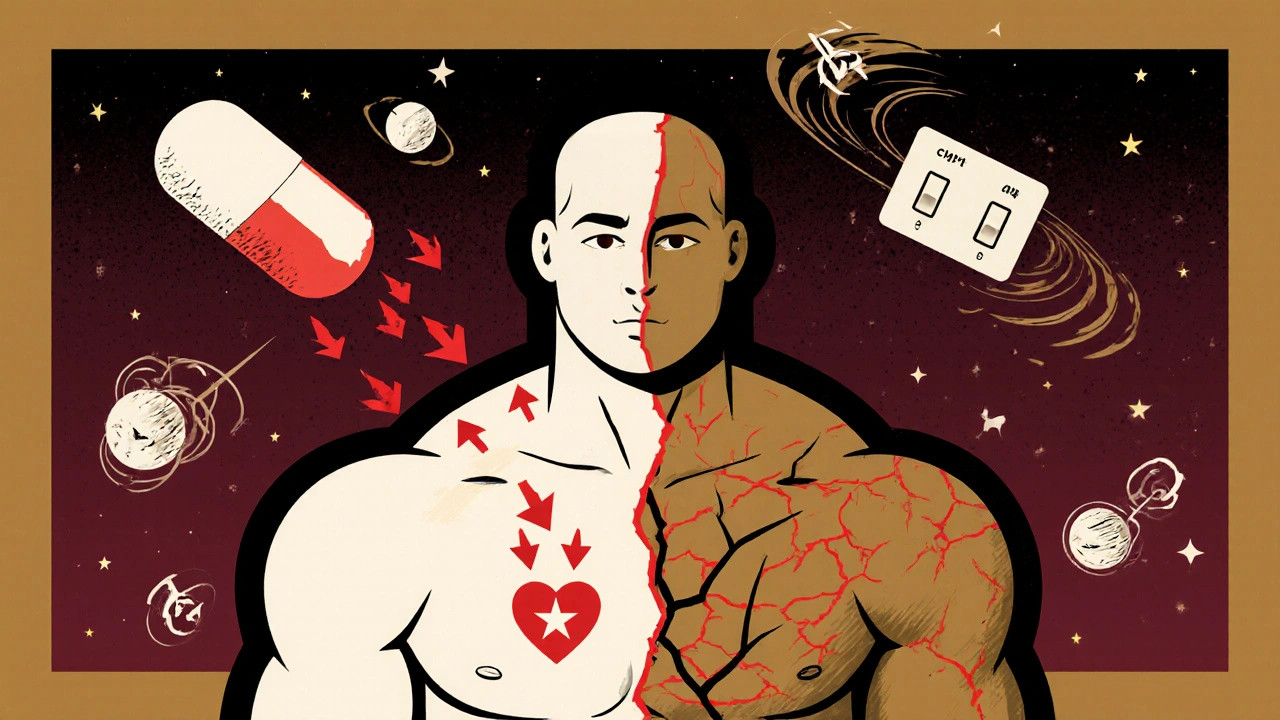
Imagine you’re taking a statin to keep your cholesterol in check, and then you get a stubborn fungal infection-maybe a yeast infection or toenail fungus. Your doctor prescribes an antifungal like fluconazole or itraconazole. Sounds straightforward, right? But here’s the hidden risk: mixing certain statins with certain antifungals can trigger a dangerous reaction that could land you in the hospital with severe muscle damage.
Why This Interaction Matters More Than You Think
Statins are among the most prescribed drugs in the world. Over 300 million people take them yearly to lower cholesterol and prevent heart attacks. Antifungals like fluconazole and itraconazole are just as common, used for everything from athlete’s foot to life-threatening fungal infections. The problem? Many of these drugs don’t just coexist-they collide inside your body. The culprit is a group of liver enzymes called CYP450, especially CYP3A4. This enzyme breaks down statins like simvastatin, lovastatin, and atorvastatin. But azole antifungals-itraconazole, ketoconazole, voriconazole, and even fluconazole to a lesser extent-shut down CYP3A4 like flipping a switch. When that happens, your statin doesn’t get cleared from your bloodstream. It builds up. And when it builds up too much, it starts eating away at your muscle tissue. This isn’t theoretical. In 2016, a case report in BMJ Case Reports documented a patient whose simvastatin levels spiked fivefold after starting itraconazole. Within days, he developed rhabdomyolysis-muscle cells breaking down so badly that his creatine kinase (CK) levels hit over 15,000 U/L. Normal is under 200. His kidneys nearly failed. He spent weeks in the hospital.Which Statins Are Safe? Which Are Not?
Not all statins are created equal when it comes to drug interactions. Your risk depends entirely on which one you’re taking.- High-risk statins: Simvastatin, lovastatin, and atorvastatin. These are metabolized almost entirely by CYP3A4. Taking them with itraconazole or ketoconazole is like pouring gasoline on a fire. Simvastatin exposure can jump by up to 10 times. That’s why the FDA explicitly bans combining simvastatin with itraconazole.
- Moderate-risk statin: Fluvastatin. It’s broken down by CYP2C9, which fluconazole can also block. The interaction isn’t as severe, but it still raises your risk of muscle damage.
- Low-risk statins: Pravastatin and rosuvastatin. These barely touch the CYP450 system. They’re cleared mostly through the kidneys. If you need an antifungal and you’re on a statin, switching to one of these two is the safest move.
The Surprising Upside: Statins Might Help Fight Fungi
Here’s the twist: while these drugs can be dangerous together, they might also work better together. Both statins and azole antifungals interfere with sterol production-just in different ways. Statins block HMG-CoA reductase. Azoles block CYP51A1. Together, they can cripple fungal cell walls. Studies from 2012 and 2023 show that low doses of statins like fluvastatin and atorvastatin make antifungals like fluconazole and voriconazole much more effective against stubborn fungi like Candida auris, a drug-resistant superbug that’s surged 200% since 2022. In lab tests, adding just 0.04μg/ml of fluvastatin to fluconazole cut the amount of antifungal needed to kill yeast by over half. That’s not just interesting-it’s potentially life-saving for patients with resistant infections. Researchers are now running clinical trials (like the NIH’s STATIN-AF trial) to see if combining these drugs could become a new treatment strategy. But here’s the catch: you can’t just start taking statins to fight a fungal infection. The doses used in studies are carefully controlled. Taking extra statins on your own? That’s how you get rhabdomyolysis.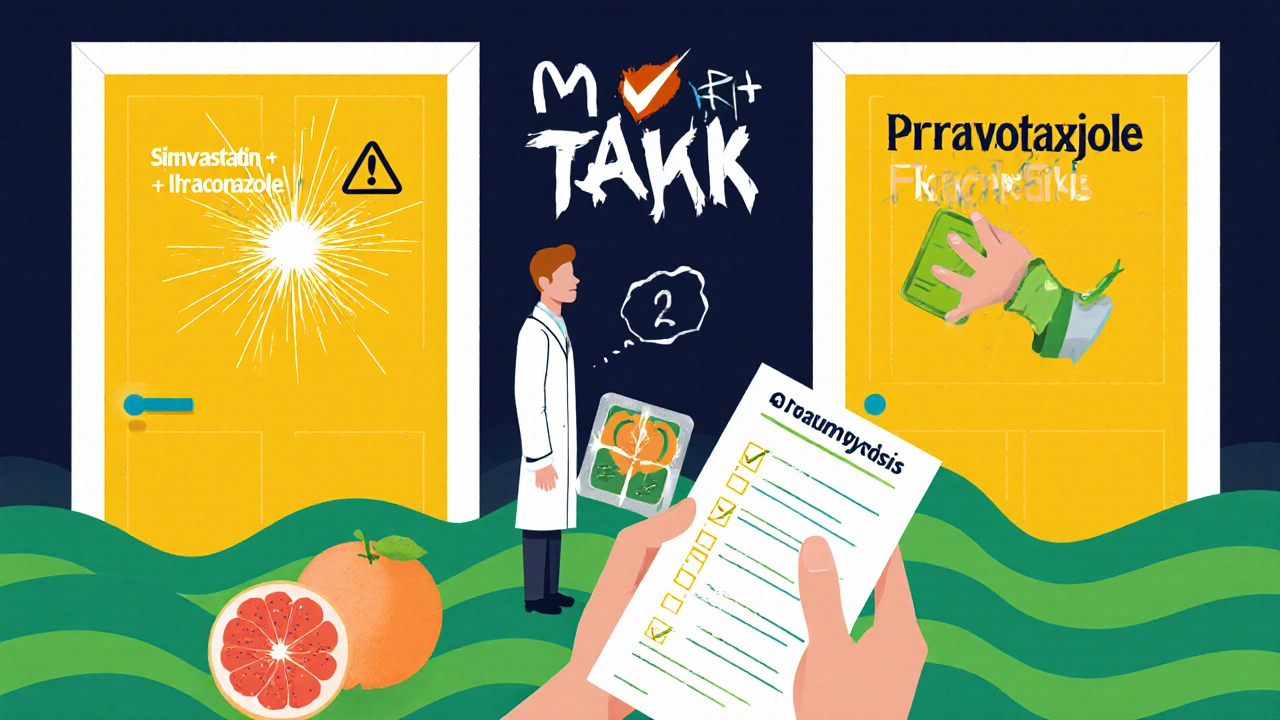
What You Should Do Right Now
If you’re on a statin and your doctor prescribes an antifungal, don’t panic-but don’t assume it’s safe either. Here’s what to do:- Check your statin name. If it’s simvastatin, lovastatin, or atorvastatin, ask if there’s a safer alternative. Don’t wait for your doctor to bring it up-most don’t.
- Ask about topical options. For toenail fungus or skin yeast, topical antifungals (creams, sprays, nail lacquers) are 70% effective and don’t enter your bloodstream. No interaction risk.
- Request a switch. If you need an oral antifungal, ask if you can switch to pravastatin or rosuvastatin. The transition takes 3-5 days. Your cholesterol won’t spike if you do it right.
- Know the warning signs. Muscle pain, weakness, or dark urine (like cola-colored) are red flags. Stop your statin and call your doctor immediately. These symptoms can mean rhabdomyolysis.
- Bring a list. Always show your pharmacist or doctor your full medication list-prescription, OTC, even supplements. Many patients don’t realize that grapefruit juice also blocks CYP3A4 and can make things worse.
Why Doctors Miss This
You’d think this would be common knowledge. But a 2023 study in JAMA Internal Medicine found only 42% of primary care doctors could correctly identify the high-risk statin-azole combinations. That’s less than half. Part of the problem is time. Doctors are rushed. Another part is that many assume “if it’s on the label, it’s covered.” But drug labels don’t always make it obvious. Simvastatin’s FDA warning says “contraindicated with itraconazole”-but if you’re on fluconazole for a yeast infection, you might not even think to check. Pharmacists are catching more of these errors. One pharmacist on Reddit said they’d caught 12 dangerous combinations in just one quarter-mostly simvastatin and itraconazole for toenail fungus. That’s not rare. That’s routine.
What’s Changing
The good news? Systems are catching up. In 2024, Epic Systems-the electronic health record platform used by most U.S. hospitals-rolled out automated alerts that flag statin-azole interactions in real time. If your doctor tries to prescribe simvastatin with itraconazole, the system pops up a warning. That’s a huge step forward. Regulators are too. The FDA updated simvastatin labeling in January 2022. The EMA did the same in March 2023. These aren’t just footnotes-they’re legal requirements. Prescribing these combinations now carries serious liability. And research is moving fast. Scientists aren’t just trying to avoid bad interactions-they’re trying to harness the good ones. If we can safely combine statins and antifungals to fight resistant fungi like Candida auris, we might have a new weapon against a growing public health threat.Bottom Line: Don’t Guess. Ask.
This interaction isn’t something you can ignore. It’s not rare. It’s not theoretical. It’s happening right now to people just like you. If you’re on a statin and need an antifungal:- Don’t assume it’s safe.
- Don’t wait for symptoms.
- Don’t stop your statin without talking to your doctor.
Erin Nemo
November 30, 2025 AT 22:11Just got prescribed fluconazole for a yeast infection and I’m on simvastatin. I literally almost skipped my appointment because I thought it was fine. Thanks for this post-saved me from a hospital trip.
Bonnie Youn
December 1, 2025 AT 13:56YES. I’m a nurse and I’ve seen this exact scenario-patient on simvastatin, gets antifungal for athlete’s foot, ends up in ER with CK over 20k. No one asked about meds. No one checked. This needs to be shouted from the rooftops. Switch to rosuvastatin. It’s that simple. Don’t wait for symptoms. Your muscles will thank you.
Rachel Stanton
December 2, 2025 AT 02:08The CYP3A4 interaction is textbook, but what’s rarely discussed is how polypharmacy compounds this. Patients on statins are often on PPIs, beta-blockers, even OTC supplements like red yeast rice-which also inhibits CYP3A4. The real risk isn’t just fluconazole-it’s the entire cocktail. Always map your full med list with a pharmacist. They’re the unsung heroes here.
Amber-Lynn Quinata
December 3, 2025 AT 22:23Why do people still take simvastatin? It’s like driving a car with no seatbelt and saying ‘I’ve never had an accident.’ It’s not luck-it’s negligence. If your doctor prescribes it without checking interactions, find a new doctor. And yes, grapefruit juice? Also a no. Stop pretending you’re too busy to read labels. Your life isn’t that complicated.
elizabeth muzichuk
December 4, 2025 AT 01:01My mom died from rhabdomyolysis after a simple toenail fungus script. They didn’t warn her. The pharmacist didn’t flag it. The doctor didn’t care. This isn’t medical advice-it’s a funeral waiting to happen. Why is this still not mandatory? Why do we let people die from paperwork?
ariel nicholas
December 4, 2025 AT 15:53Scotia Corley
December 6, 2025 AT 09:24It is regrettable that the general populace remains largely unaware of the pharmacokinetic implications of CYP450 inhibition. The CYP3A4 enzyme system is not a trivial pathway, and its suppression by azole antifungals represents a clinically significant perturbation of drug metabolism. One must exercise due diligence in pharmacological decision-making.
Karandeep Singh
December 7, 2025 AT 01:17Lauryn Smith
December 7, 2025 AT 05:25Hey, if you’re on a statin and need an antifungal, just ask your doctor about pravastatin or rosuvastatin. It’s not hard. And if they say ‘it’s fine,’ ask to speak to the pharmacist. They’ll tell you the truth. You’re not being annoying-you’re being smart. Your body deserves that.
Suzanne Mollaneda Padin
December 8, 2025 AT 20:09As someone from a country where pharmacy access is limited, I’ve seen patients take oral antifungals with statins and just hope for the best. Topical options are a game-changer. If you can use a cream or nail lacquer-do it. It’s safer, cheaper, and just as effective for most cases. Don’t let cost or convenience make you gamble with your muscles.
Kenny Leow
December 9, 2025 AT 16:27Interesting how the science is shifting-from ‘avoid at all costs’ to ‘maybe we can use this.’ The same drugs that nearly kill you might one day save you from superbugs. Medicine is messy, but that’s also where the breakthroughs happen. Just don’t experiment on yourself. Let the trials do the heavy lifting.
Alexander Williams
December 11, 2025 AT 00:06The CYP3A4-mediated interaction is well-documented, but the pharmacodynamic synergy in antifungal potentiation is far more nuanced. The non-linear dose-response curves and tissue-specific bioavailability of statins introduce significant confounders in clinical translation. The STATIN-AF trial design must account for mitochondrial toxicity thresholds.
Debbie Naquin
December 12, 2025 AT 01:42It’s ironic. We weaponize metabolism to kill fungi, then accidentally kill muscle. The same biological logic that lets us survive also lets us self-destruct. Maybe the real question isn’t which statin to use-but whether we should be interfering with sterol pathways at all. Evolution didn’t design us for this kind of chemical ballet.
Kelly Essenpreis
December 13, 2025 AT 03:19