
 Dec, 15 2025
Going back to work with chronic pain isn’t about pushing through the discomfort. It’s about making smart, practical changes so you can do your job without making your pain worse. If you’ve been out due to ongoing pain-whether from back issues, arthritis, nerve damage, or long COVID-you’re not alone. Over 50 million adults in the U.S. live with chronic pain, and many of them want to keep working. The good news? Most accommodations cost little or nothing. The key is knowing what to ask for, how to ask for it, and when to involve your doctor.
What Counts as a Workplace Accommodation?
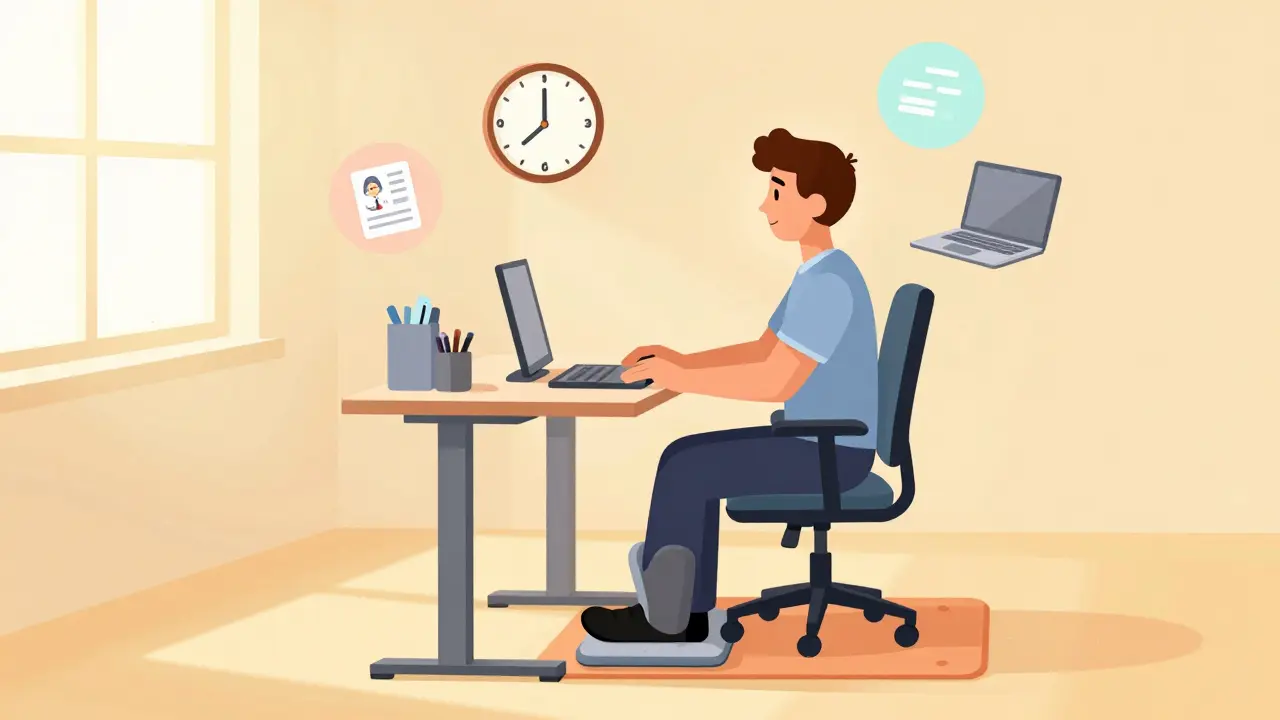
An accommodation isn’t a favor. It’s a legal right under the Americans with Disabilities Act (ADA) if your pain limits major activities like sitting, standing, walking, or concentrating for long periods. The Equal Employment Opportunity Commission (EEOC) confirms that chronic pain lasting more than three months can qualify as a disability if it affects your ability to work. Accommodations fall into four main types:- Physical changes: Adjustable desks, ergonomic chairs, cushioned mats, footrests, or heated pads.
- Time-based adjustments: Flexible hours, extra breaks (5-15 minutes every 1-2 hours), or working from home.
- Environmental tweaks: Moving your desk closer to the bathroom, lowering lighting for light sensitivity, or adjusting room temperature if cold or heat worsens your pain.
- Task modifications: Shifting minor duties (like filing or answering phones) to someone else, reducing lifting requirements, or switching from standing tasks to seated ones.
Many people assume accommodations mean expensive gear. But the Job Accommodation Network (JAN) found that 56% of solutions cost nothing. A simple change-like letting you take a five-minute stretch break every hour-can make a huge difference.
How to Start the Conversation With Your Employer
Asking for help feels risky. You might fear being seen as weak, lazy, or replaceable. But here’s the truth: employers who ignore reasonable accommodations face legal consequences. And most don’t want to lose experienced staff. Start by documenting your condition. Get a note from your doctor that includes:- Your diagnosis (e.g., degenerative disc disease, fibromyalgia, neuropathy)
- How it affects your work (e.g., “I cannot sit for more than 45 minutes without increased pain”)
- Recommended accommodations (e.g., “A sit-stand desk and 10-minute breaks every 90 minutes”)
Don’t just say, “I need help.” Say exactly what you need. Vague requests like “I need pain relief” get denied. Specific ones like “I need a heated seat cushion that plugs into a standard outlet” get approved 89% of the time, according to federal employee data.
Put your request in writing. Email your manager and HR. Say something like:
“I’m writing to formally request accommodations under the ADA due to my chronic back pain. My doctor has confirmed that sitting for long periods worsens my symptoms. I’m requesting an adjustable standing desk and 10-minute breaks every 90 minutes to manage discomfort. I’m happy to discuss alternatives if needed.”
Keep a copy. This starts the legal “interactive process”-a requirement under the ADA where your employer must respond in good faith. Federal agencies have 10 business days to reply. Private employers don’t have a set deadline, but delaying too long can be seen as a violation.
What If They Say No?
Sometimes, employers say accommodations会造成“undue hardship.” That means it’s too expensive or disruptive for their size. But this defense is often misused. The EEOC says undue hardship depends on company size. For a small business with 10 employees, a $500 desk might be too much. For a company with 500 employees? Not even close. And remember: if the cost is under $300 (the median cost for most accommodations), it’s rarely considered undue hardship. If your request is denied, ask for the reason in writing. Then:- Offer alternatives. If they say no to a standing desk, suggest a cushioned stool or a chair with lumbar support.
- Use JAN’s free consultation service. They help employees and employers find solutions. Over 82% of their cases are resolved without lawsuits.
- Check your state laws. California requires accommodations for employers with just 5 employees. New York, Washington, and others have similar protections.
Don’t quit yet. Many people leave jobs because they don’t know their rights. But 78% of employees who get personalized accommodations stay in their roles. Generic fixes-like just giving everyone a chair-only work 42% of the time.
Gradual Return: A Better Way Back
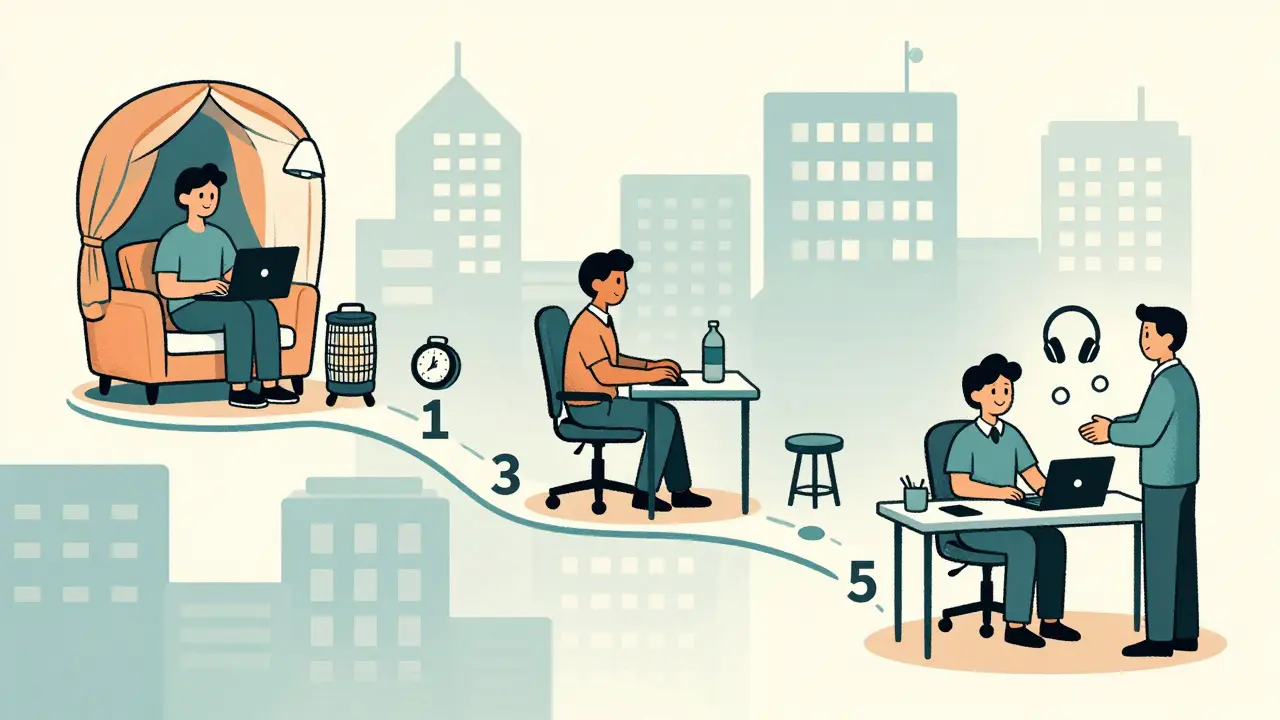
Jumping back to full-time hours after months off often backfires. Research shows employees who return gradually-starting at 20-50% of their normal hours-have 63% higher long-term retention than those who return full-time right away. A graduated return might look like:- Week 1-2: Work 4 hours/day, 3 days/week, from home
- Week 3-4: Increase to 6 hours/day, 4 days/week, with breaks built in
- Week 5+: Return to full schedule, with accommodations already in place
This gives your body time to adjust. It also lets your employer see you’re still productive. Supervisors who see you working-on your terms-are far more likely to support ongoing accommodations.
Why Coworker Support Matters
It’s not just about desks and breaks. Culture plays a big role. If your team is understanding, you’re 2.3 times more likely to have your accommodations approved and maintained. Talk to trusted coworkers. Let them know what you’re going through-not to get sympathy, but to build allies. If someone notices you’re struggling, they might offer to help with a task or cover for you during a break. That kind of informal support often makes the difference between staying and leaving.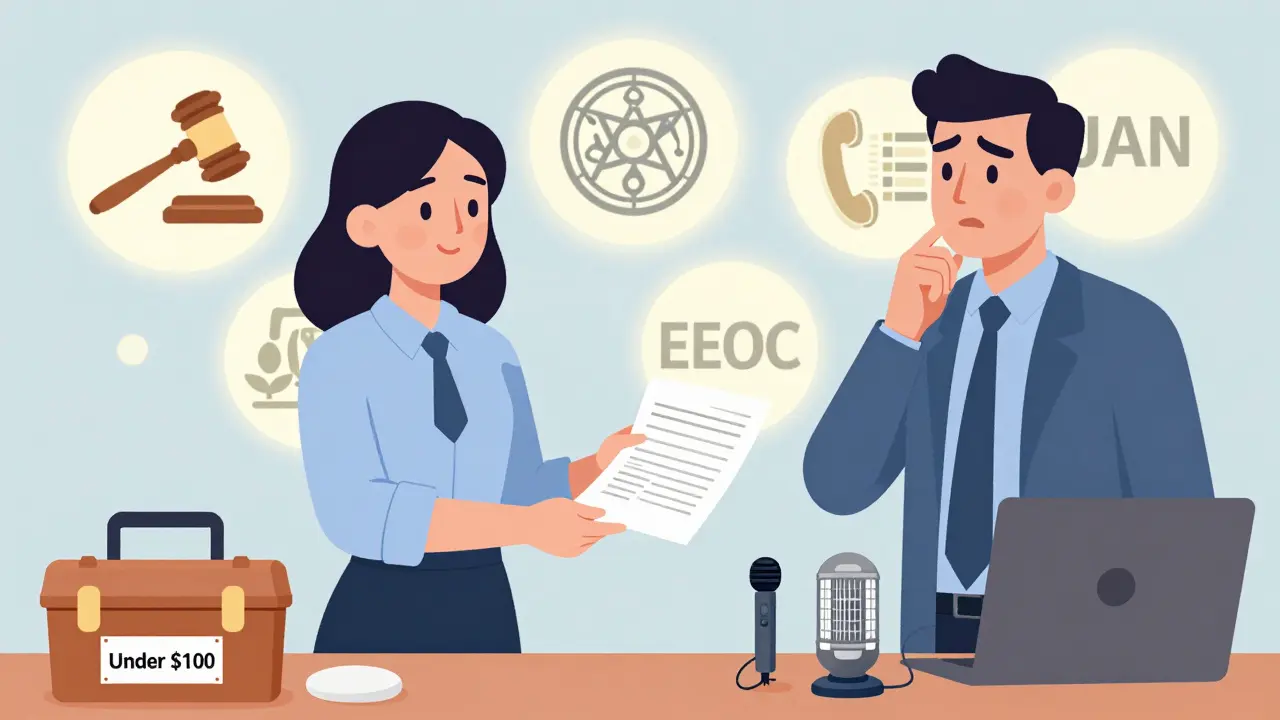
What to Avoid
Here are common mistakes that hurt your chances:- Waiting too long to ask: 62% of people delay requesting accommodations out of fear. The longer you wait, the harder it is to prove your pain is work-related.
- Not using your doctor: Your employer can ask for medical documentation. If you don’t provide it, they’re not obligated to act.
- Accepting the first “no”: Many denials are based on misunderstanding, not policy. Push back politely and with evidence.
- Thinking accommodations are temporary: Pain flares come and go, but your condition doesn’t disappear. You’re entitled to ongoing support.
Tools and Resources You Can Use
You don’t have to figure this out alone:- Job Accommodation Network (JAN): Free, confidential advice for employees and employers. Visit askjan.org or call 1-800-526-7234.
- Equal Employment Opportunity Commission (EEOC): Learn your rights at eeoc.gov. They handle complaints if your employer refuses to comply.
- Occupational therapists: Many can assess your workspace remotely and recommend low-cost fixes. Ask your doctor for a referral.
- State disability agencies: In California, the Civil Rights Department offers free guidance. Other states have similar offices.
Some tools cost less than $100: a footrest, a gel cushion, voice-to-text software, or a small space heater. These aren’t luxuries-they’re tools, like a keyboard or mouse.
Final Thought: You Deserve to Work Without Suffering
Chronic pain doesn’t make you less capable. It just means you need the right setup to do your job. Employers who invest in accommodations don’t just avoid lawsuits-they keep skilled workers, reduce turnover, and boost morale. If you’re ready to return to work, start with your doctor. Get the paperwork. Write your request. Be specific. Use JAN if you need help. You’re not asking for special treatment. You’re asking for a fair chance to work-and that’s not just reasonable. It’s your right.Can I be fired for asking for accommodations?
No. Under the ADA and Rehabilitation Act, it’s illegal to fire, demote, or punish someone for requesting reasonable accommodations. Employers who do this can be sued. If you’re threatened or retaliated against, contact the EEOC immediately.
Do I need to tell my boss about my diagnosis?
No. You only need to explain how your condition affects your work. You don’t have to say you have fibromyalgia or arthritis. You can say, “I have a chronic pain condition that limits my ability to sit for long periods.” Your medical details stay private unless you choose to share them.
What if my job requires standing or lifting?
Even physically demanding jobs can be adjusted. You might get a stool to rest on during breaks, a mechanical lift to help with heavy items, or a schedule that rotates tasks so you’re not standing for hours. Employers must reassign marginal duties-not core ones-if possible. For example, if you’re a retail worker, you might rotate between the register and stocking shelves instead of standing at the door all day.
Can I work from home permanently?
Possibly. If your job can be done remotely and your pain makes commuting or being in the office difficult, telecommuting is a common and effective accommodation. The EEOC has ruled in multiple cases that remote work can be a reasonable accommodation for chronic pain. You’ll need to show you can perform your duties from home and that it doesn’t create an undue hardship for your employer.
Does FMLA help with accommodations?
No. FMLA gives you up to 12 weeks of unpaid, job-protected leave for medical reasons. But it doesn’t require your employer to make changes to your job once you return. That’s where the ADA comes in. FMLA gets you time off. ADA gets you the tools to stay working.
Are there accommodations for invisible pain like nerve pain or fatigue?
Yes. Many chronic pain conditions don’t show up on X-rays or blood tests, but that doesn’t make them less real. Accommodations for invisible pain include flexible scheduling, reduced distractions (like a quiet workspace), permission to lie down during breaks, or using noise-canceling headphones. The key is documenting how symptoms impact your ability to focus, sit, or move-regardless of whether they’re visible.
sue spark
December 15, 2025 AT 16:13Been living with fibro for 8 years and this is the first time I’ve seen someone actually get it
Tiffany Machelski
December 16, 2025 AT 17:16i didnt know you could ask for a heated seat cushion like its a normal thing like coffee maker lol
SHAMSHEER SHAIKH
December 17, 2025 AT 06:30Dear Colleagues, I must emphasize with the utmost sincerity that the ADA is not merely a suggestion-it is a solemn legal obligation that every employer, regardless of size, must honor with integrity and compassion. The accommodations outlined herein are not privileges, but rights-enshrined in law to preserve dignity, productivity, and human worth in the workplace. To deny them is not merely negligent; it is morally indefensible.
Arun ana
December 18, 2025 AT 11:06My boss let me use a standing desk and I cry every time I use it 😭
Kayleigh Campbell
December 20, 2025 AT 04:13So what you’re saying is if I beg for a footrest and a nap pod, I’m not lazy-I’m just legally entitled to not die at my desk? Cool. I’ll file the paperwork after my third coffee.
Dave Alponvyr
December 21, 2025 AT 00:51They say no? Ask again. Then again. Then call the EEOC. Done.
Cassandra Collins
December 21, 2025 AT 01:32Wait so this is just a government plot to get everyone working from home? I knew it. They’re replacing jobs with foam cushions and voice-to-text software. Next they’ll give us pain-free spinal implants. Who’s funding this? Big Pharma? The WHO? The Illuminati?
Joanna Ebizie
December 21, 2025 AT 01:57Ugh why do people think they deserve special treatment? Just suck it up and work. I’ve had back pain since 1998 and I never asked for a damn cushion.
Elizabeth Bauman
December 22, 2025 AT 16:01As an American woman who’s paid her taxes since 1987, I find it outrageous that anyone would question the right of a fellow citizen to sit down at work. This isn’t socialism-it’s basic decency. If you can’t afford a $60 chair, maybe you shouldn’t be running a business. #MakeAmericaWorkAgain
Dylan Smith
December 23, 2025 AT 11:24I asked for a chair with lumbar support and my manager said no because we don’t have a budget so I just started working from the couch in my basement and now I’m on Zoom all day and no one notices I’m not in the office and honestly I think this is the best thing that’s ever happened to me
Mike Smith
December 24, 2025 AT 02:04It is imperative to recognize that workplace accommodations are not concessions, but rather strategic investments in human capital. The retention rate of 78% among employees who receive tailored support is not merely a statistic-it is a testament to the enduring value of empathy in organizational leadership. Employers who prioritize accessibility do not merely comply with the law-they cultivate loyalty, resilience, and excellence.
Aditya Kumar
December 25, 2025 AT 09:08Why bother? I just quit. Too much paperwork. Too many emails. I’m on disability now. Easier.
Colleen Bigelow
December 25, 2025 AT 19:24They say ‘invisible pain’-but what if it’s all just anxiety? What if people are just faking it because they don’t want to work? I’ve never needed a heated cushion and I’m still productive. Maybe we should stop coddling people who can’t handle real life.
Billy Poling
December 25, 2025 AT 23:38It is my considered opinion, based upon a comprehensive review of the statutory framework governing workplace accommodations under Title I of the Americans with Disabilities Act of 1990, as amended by the ADA Amendments Act of 2008, that the procedural requirements for initiating the interactive process must be strictly adhered to, including but not limited to the submission of medical documentation that is contemporaneous, clinically validated, and specifically tied to the functional limitations enumerated in the EEOC’s interpretive guidance, as codified in 29 C.F.R. § 1630.2(o)(3). Failure to comply with these procedural prerequisites may result in the forfeiture of statutory protections, particularly where the employer has demonstrated a good-faith effort to accommodate but has been obstructed by insufficient or ambiguous medical input.