
 Mar, 16 2026
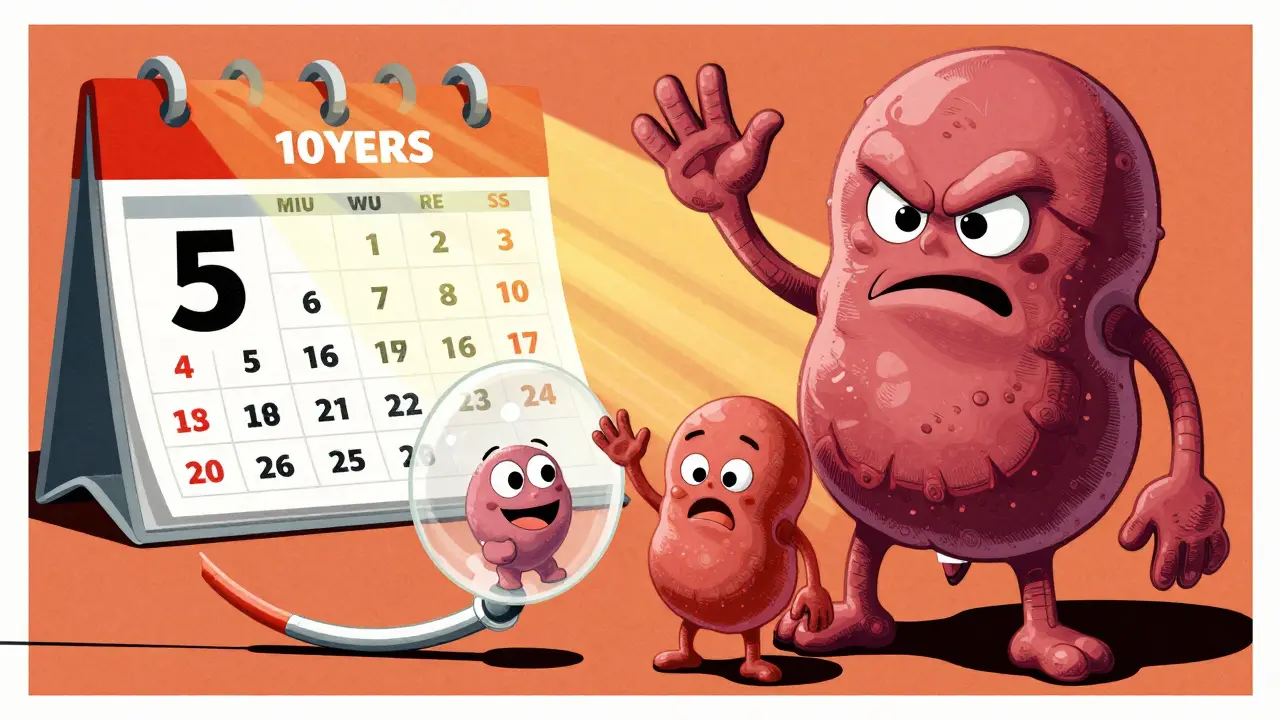
After a colonoscopy finds polyps, many people assume they’ll need another one in five years-maybe even sooner. But that’s not always true. The truth is, colonoscopy timing after polyp removal depends on what kind of polyps you had, how many, how big they were, and even how well your bowel was cleaned. Getting it wrong can mean unnecessary procedures, extra cost, or worse-missing a real risk. The good news? Science has gotten smarter about this. Guidelines updated in 2020 now let many people wait longer than they used to. And some people might even need to come back sooner.
Not All Polyps Are the Same
Polyps aren’t just polyps. They fall into different categories, and each one carries a different risk. The two main types you’ll hear about are adenomas and serrated polyps. Adenomas are the classic precancerous growths. Serrated polyps-like sessile serrated lesions (SSLs)-are trickier. They look flat and harmless, but can turn into cancer faster than you’d expect. Then there are hyperplastic polyps, which are usually harmless… unless they’re big or in the wrong spot.
Size matters. A 5-mm adenoma is very different from a 15-mm one. So does number. One small polyp? Low risk. Five? That’s a red flag. And histology-what the pathologist sees under the microscope-is critical. High-grade dysplasia, villous features, or serrated patterns change everything. If a polyp was removed in pieces (piecemeal resection), that also raises concern. The goal isn’t just to count polyps. It’s to assess your personal risk of developing colon cancer in the next few years.
What the Guidelines Say Now (2020 USMSTF)
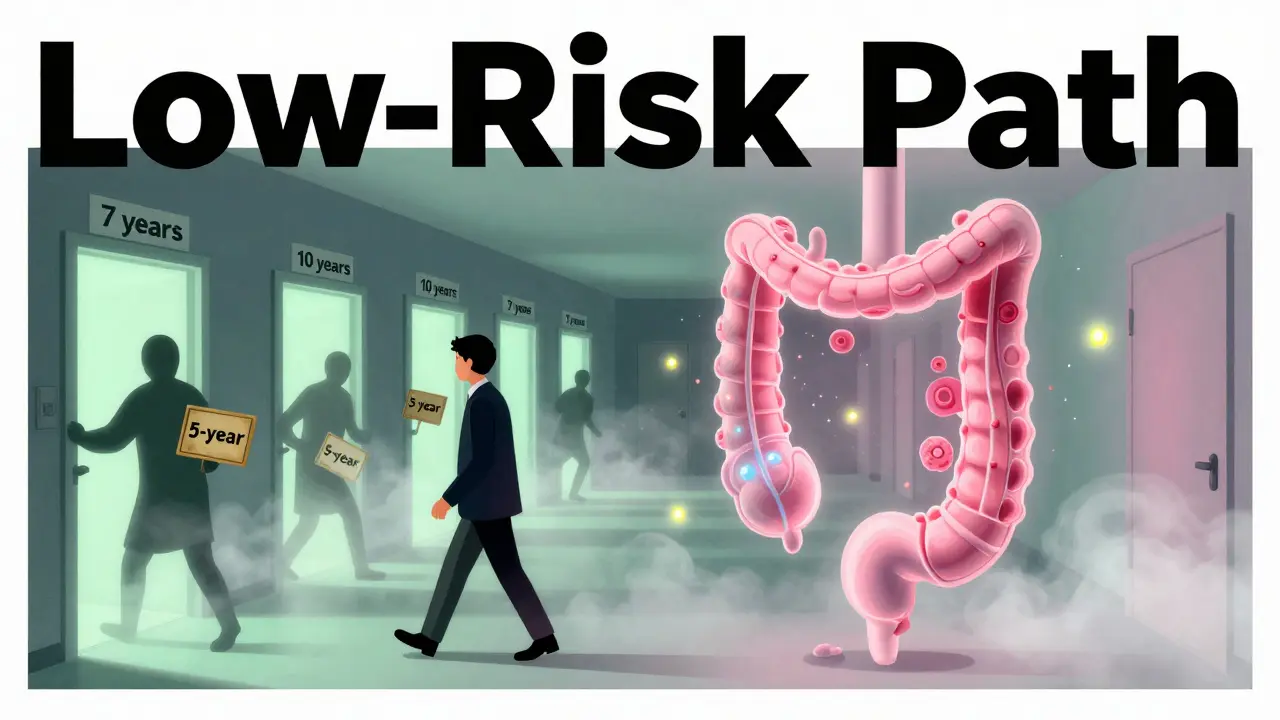
The most widely followed guidelines in the U.S. come from the US Multi-Society Task Force on Colorectal Cancer (USMSTF). Their 2020 update made big changes. For example, if you had just one or two small adenomas (under 10 mm), you used to be told to come back in 5 years. Now? You can wait 7 to 10 years. Why? Because studies showed people with these low-risk findings have almost the same cancer risk as someone with a completely normal colonoscopy. That’s a major shift.
Here’s how the current U.S. guidelines break it down:
- 1-2 small adenomas (≤10 mm) → 7-10 years
- 3-4 adenomas (all under 10 mm) → 3-5 years
- 5 or more adenomas (any size) → 3 years
- Any adenoma ≥10 mm → 3 years
- Adenoma with high-grade dysplasia or villous component → 3 years
- 1-2 sessile serrated lesions (SSLs) <10 mm → 5-10 years
- 3-4 SSLs <10 mm → 3-5 years
- 5 or more SSLs → 3 years
- SSL ≥10 mm → 3 years
- Hyperplastic polyp ≥10 mm → 3-5 years (use 3 years if there’s uncertainty)
- Piecemeal resection of any polyp ≥20 mm → 6 months
Notice how the 7-10 year window for low-risk cases is new. It’s based on data from over 100,000 patients tracked over 10+ years. One study showed cancer-free survival was 99.3% for people with normal colonoscopies and 98.7% for those with 1-2 small adenomas. That’s not a meaningful difference.
Why European Guidelines Are Different
If you’re in Europe, your doctor might tell you something different. The European Society of Gastrointestinal Endoscopy (ESGE) recommends longer intervals for low-risk cases-sometimes more than 10 years for 1-4 small adenomas. Why? Because their data shows most colon cancers after a colonoscopy happen because a polyp was missed the first time, not because new ones grew fast. So if your colon was well-prepared and the exam was thorough, they argue you don’t need to come back for a decade.
Another difference: ESGE says 3-6 months after piecemeal removal of large polyps (≥20 mm). The U.S. says 6 months. That’s a narrower window. And for serrated polyps, ESGE is still updating its guidelines-expected by late 2024-which may shorten intervals for certain types.
These differences aren’t random. They reflect different healthcare systems, screening rates, and how often endoscopists miss lesions. In the U.S., colonoscopy quality varies more between doctors. That’s why the guidelines err on the side of caution in some cases.

Real-World Problems: Doctors Don’t Always Follow the Rules
Here’s the ugly truth: most doctors still recommend 5-year follow-ups-even when the guidelines say 7-10. A 2020 study at a Veterans Affairs hospital found that 81.4% of gastroenterologists who knew the updated guidelines still recommended 5-year intervals for low-risk adenomas. Why? Fear.
Some doctors worry about malpractice lawsuits. Others don’t trust their own skills or assume the patient’s prep was poor. Some just don’t remember the new numbers. A 2022 survey of 347 U.S. gastroenterologists found only 37.2% could correctly identify all the risk categories. Serrated polyps were the biggest blind spot-only 28.5% got those right.
Patients get confused too. The American Cancer Society says “most patients need a colonoscopy in 3 years,” which sounds like a rule. But it’s not. It’s a generalization that applies to higher-risk cases. Primary care doctors often pass this on without context, leading to unnecessary procedures.
One gastroenterologist in a VA clinic told his patients: “I recommend 10 years for 1-2 tiny polyps (1-4 mm), but 7 years for 1-2 small ones (5-9 mm).” That’s not in the official guidelines. It’s his compromise. And he’s not alone.
Tools That Help: Polyp.app and EHR Alerts
There’s a growing effort to fix this. Tools like Polyp.app is a free, web-based calculator built by gastroenterologists at Massachusetts General Hospital. You plug in the number, size, and type of polyps found, and it tells you exactly when to return. As of mid-2023, over 12,400 clinicians use it. It’s simple, accurate, and updated yearly.
Electronic health record systems like Epic and Cerner now have built-in prompts. If your doctor documents a 7-mm adenoma during your colonoscopy, the system might pop up: “Recommended surveillance: 7-10 years.” It’s not perfect, but it helps.
These tools matter because they turn complex rules into clear actions. And they’re especially useful for non-specialists-like nurse practitioners or primary care doctors-who manage follow-up care.
What About Future Changes?
The future of colonoscopy surveillance isn’t just about counting polyps. It’s about molecular testing. Right now, researchers are testing blood and stool tests that look for DNA methylation patterns linked to cancer risk. These could tell you whether your polyp history means you’re at low, medium, or high risk-not just based on what was seen, but what’s happening at the cellular level.
Trials like NCT04567821 and NCT03987099 are already underway. Dr. Samir Gupta from UC San Diego says we’re moving toward a future where your surveillance interval is personalized: “Endoscopic findings + biomarkers + family history = your custom timeline.”
That’s exciting. But it’s not here yet. For now, you still need to rely on what was removed-and what your doctor knows about the guidelines.
What You Should Do
After your colonoscopy, get the pathology report. Don’t just trust the doctor’s verbal summary. Ask: “What kind of polyps were removed? How big were they? Was there any high-grade dysplasia?” Write it down.
Then, ask: “According to the 2020 USMSTF guidelines, when should I come back?” If they say “5 years,” ask if that’s still correct. Mention that low-risk cases now go to 7-10 years. Many doctors will pause and check.
If you had serrated polyps, make sure your doctor understands the difference between hyperplastic and sessile serrated lesions. If they don’t, ask for a referral to a specialist.
And if you’re unsure? Use Polyp.app. It’s free. It’s reliable. And it’s based on the same guidelines your doctor should be using.
When to Worry
You should come back sooner if:
- You had a large polyp (10 mm or bigger) removed
- You had 3 or more adenomas
- You had a serrated polyp ≥10 mm
- The polyp was removed in pieces
- Your bowel prep was poor
- You have a family history of colon cancer
If any of these apply, don’t wait. Stick to the 3-year or even 6-month schedule. These aren’t arbitrary. They’re based on real cancer risk.
When You Can Wait
You can safely wait 7-10 years if:
- You had 1-2 small adenomas (≤10 mm)
- You had 1-2 small sessile serrated lesions (<10 mm)
- Your colon was clean and the exam was complete
- You have no family history of colon cancer
Even if you’re 70 or 75, if your risk is low, you can still wait. Age alone doesn’t change the interval-it’s about the polyps.
Do I really need to wait 7-10 years if I had one small polyp?
Yes, if it was a small adenoma (≤10 mm) and you had only one or two. Studies show your risk of colon cancer in 10 years is nearly identical to someone with a normal colonoscopy. Waiting longer reduces unnecessary procedures and cost without increasing risk. This is backed by data from over 100,000 patients tracked for more than a decade.
Why do some doctors still say 5 years?
Many doctors learned the old guidelines and haven’t updated their practice. Others fear legal risk or worry about missing something. Some don’t fully understand the new categories, especially with serrated polyps. It’s a gap between evidence and practice-not because the science is wrong, but because change takes time.
What if I had a hyperplastic polyp? Do I need a repeat colonoscopy?
Usually not-if it’s small and in the right location. But if it’s 10 mm or larger, or if the pathologist isn’t sure it’s not a sessile serrated lesion, then you need a repeat in 3-5 years. Hyperplastic polyps are usually harmless, but size and location matter. If there’s any doubt, treat it like a serrated lesion.
Can I skip my next colonoscopy if I feel fine?
Feeling fine doesn’t mean you’re cancer-free. Colon cancer often has no symptoms until it’s advanced. Surveillance colonoscopies aren’t about how you feel-they’re about catching precancerous growths before they turn dangerous. Skipping a recommended follow-up increases your long-term risk, even if you feel perfectly healthy.
Is there a test I can do instead of a colonoscopy for follow-up?
For surveillance after polyp removal, no. Stool tests like FIT or Cologuard are great for initial screening, but they’re not accurate enough to monitor known polyp history. If you’ve had polyps, you need a colonoscopy to check for new or missed growths. Imaging like CT colonography isn’t recommended for surveillance either. Colonoscopy remains the gold standard.
Laura Gabel
March 17, 2026 AT 03:02jerome Reverdy
March 17, 2026 AT 22:28Andrew Mamone
March 18, 2026 AT 12:49Prathamesh Ghodke
March 18, 2026 AT 14:26Gaurav Kumar
March 19, 2026 AT 06:59Nicole Blain
March 20, 2026 AT 12:14Srividhya Srinivasan
March 21, 2026 AT 02:42Kathy Underhill
March 22, 2026 AT 20:34Stephen Habegger
March 23, 2026 AT 14:17Justin Archuletta
March 24, 2026 AT 07:03