
 Feb, 25 2026
When a product leaves a factory, it should work exactly as promised. Not most of the time. Not 95% of the time. Every single time. That’s the goal of quality control testing in manufacturing. It’s not about catching bad items at the end-it’s about stopping them before they’re even made. And if you’re running a production line, skipping this step isn’t just risky-it’s expensive.
Define Quality Standards First
Before you inspect anything, you need to know what ‘good’ looks like. This isn’t just a vague idea like ‘it should look right.’ It’s a written, measurable standard. For example, a plastic housing might need to be within ±0.02mm of its CAD model. Surface roughness? Ra value of 1.6 μm, no higher. Color? ΔE under 2.0 on the CIELAB scale. These aren’t guesses. They’re based on how the part functions, how it fits with other parts, and what customers actually notice. In electronics, this means exact solder joint dimensions per IPC-A-610 standards. In pharmaceuticals, it’s active ingredient concentration within 95-105% of target. Automotive parts? Tolerances can be as tight as ±0.005mm for engine components. If you don’t define these upfront, your inspectors are flying blind. And that’s when defects slip through.Implement the Right Inspection Methods
Once you’ve set your standards, you pick how to measure them. Not all inspections are created equal. Some need high-precision tools. Others rely on trained eyes. For dimensional checks, you might use digital calipers, CMM (coordinate measuring machines), or laser scanners. For surface defects, automated vision systems with 5-megapixel cameras and AI filters catch scratches, dents, or misprints that humans miss. Electrical components get tested with multimeters and automated testers that check resistance, continuity, and insulation-within ±10% tolerance. Chemical composition? Spectroscopy. A quick scan confirms your aluminum alloy isn’t contaminated with unwanted elements. In food and pharma, you test for microbial contamination, heavy metals, and residual solvents. Each method must be validated. The FDA found that 43% of warning letters in 2021 came from unvalidated test procedures. That means your lab might think it’s working-but it’s not catching real problems.Train Your Team Thoroughly
No matter how advanced your tools are, people still run the system. And if your inspectors don’t know what they’re looking for, even the best equipment won’t help. Training isn’t a one-hour PowerPoint. It’s hands-on. Operators learn how to use micrometers, interpret X-bar charts, and recognize subtle signs of tool wear. In electronics, they’re trained on IPC-A-610 visual criteria-what a good solder joint looks like versus a cold joint or void. In medical device manufacturing, staff must understand ISO 13485 requirements for traceability and documentation. Best practices show that teams need 16 to 40 hours of initial training, depending on complexity. And it doesn’t stop there. Monthly refreshers, shadowing senior inspectors, and real-time feedback during production keep skills sharp. Companies that track certification rates aim for 95%+ of frontline staff to pass competency tests. If you’re below 90%, you’re leaving defects in the system.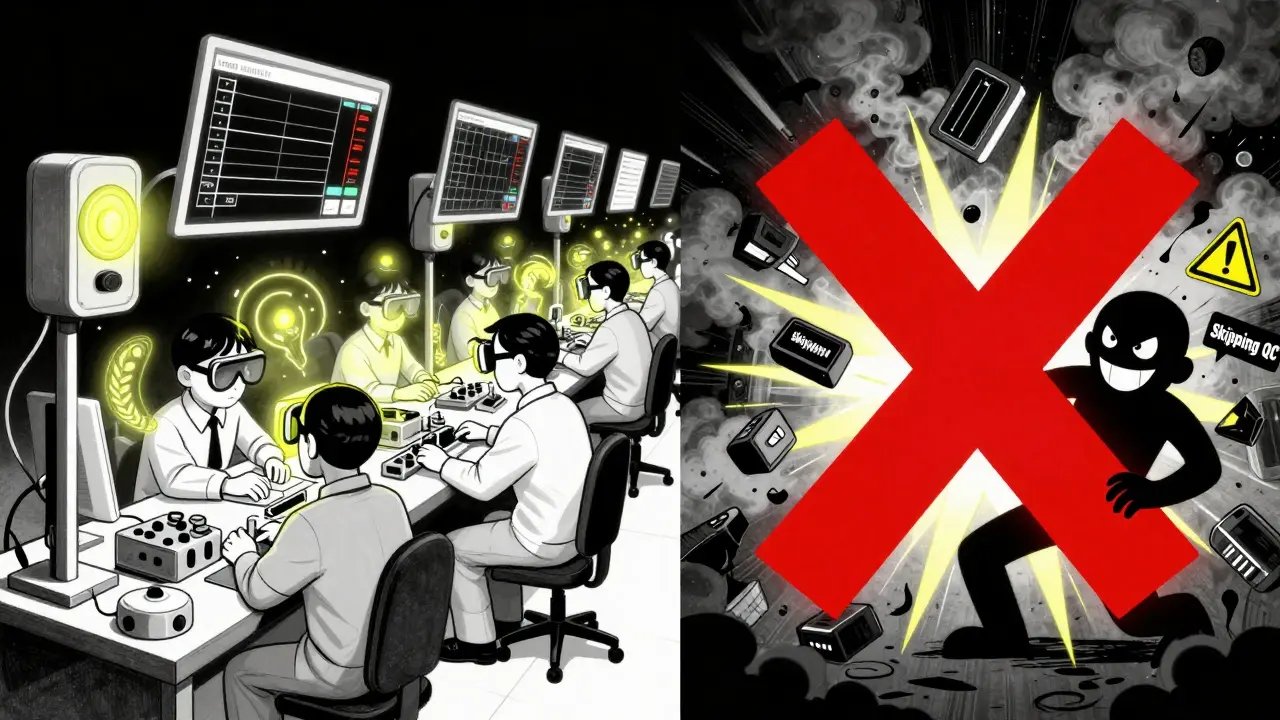
Monitor Processes in Real Time
Waiting until the end of the line to find problems is like waiting for the boat to sink before checking the hull. Modern quality control uses real-time data collection to catch drifts before they become batches of rejects. Sensors on CNC machines track spindle vibration. Vision systems scan every unit as it moves down the conveyor. IoT sensors monitor temperature, humidity, and pressure in clean rooms. This data feeds into software like Minitab or JMP, which plots control charts in real time. If the average dimension starts creeping up-say, from 10.00mm to 10.03mm-the system flags it before you hit 100 units. Statistical process control (SPC) uses control limits based on 3σ (three standard deviations). If your process is stable, 99.7% of data points should stay between those limits. A single point outside means something changed. A trend of five points rising? That’s a warning you’re losing control. Companies using real-time monitoring, like Siemens in Amberg, cut defect detection time by 27%. That’s not luck-it’s data.Analyze Results with Purpose
Data without analysis is noise. You can collect thousands of measurements a day, but if you don’t ask why they’re changing, you’re just keeping records. Look for patterns. Are defects clustered around a specific machine? Do they spike after lunch? Are they worse on Friday shifts? Use Pareto charts to find the 20% of causes creating 80% of the problems. Run a root cause analysis-5 Whys or Fishbone diagrams-on every major defect. Don’t stop at ‘the machine broke.’ Ask: Why did it break? Why wasn’t it maintained? Why wasn’t the maintenance schedule followed? Capability indices like Cp and Cpk tell you if your process is capable. A Cpk above 1.33 means your process is centered and tight enough to consistently meet specs. Below 1.0? You’re producing rejects regularly. That’s not a QC failure-it’s a design or process failure. In 2022, ASQ reported manufacturers using structured analysis reduced scrap and rework by 32.7%. That’s not magic. It’s discipline.
Take Corrective Action-Fast
Finding a problem is only half the job. Fixing it before it happens again is the other half. That’s CAPA: Corrective and Preventive Action. When a defect is found, you don’t just scrap the batch. You document: What happened? When? Where? How many? Then you implement a fix. Maybe it’s recalibrating a machine. Maybe it’s changing the tooling. Maybe it’s retraining the operator. In regulated industries like pharma or medical devices, this must be done within 72 hours. The FDA requires documented investigations. You can’t just say ‘we fixed it.’ You have to prove you know why it happened and how you stopped it. And here’s the kicker: if the same issue repeats, you don’t just fix it again. You upgrade the system. Maybe you add a sensor. Maybe you redesign the process. Maybe you change the supplier. That’s prevention. And that’s what separates good QA from great QA.Why This Matters-The Real Cost of Skipping QC
Let’s say you make 10,000 units a day. If your defect rate is 2%, that’s 200 bad units. If you catch them at the end, you scrap them. Cost? Maybe $5 per unit. $1,000 a day. $30,000 a month. But what if 10 of those defective units ship out? A customer returns it. You issue a recall. Your brand gets damaged. Legal fees. Lost trust. That’s not $50. That’s $500,000. According to Deloitte, manufacturers spend 3.2% to 5.8% of revenue on quality. Automotive companies spend the most-5.8%-because one faulty airbag can kill. Consumer goods spend less-but they pay more in reputation. The companies winning aren’t the ones with the fanciest machines. They’re the ones who treat quality as a daily practice-not a checklist. They train their people. They listen to their data. They fix things before they break.What’s Changing in Quality Control
The old way-sampling 5% of a batch and hoping for the best-is fading. New tools are changing the game. AI-powered visual inspection now detects defects with 99.2% accuracy in some factories, up from 88% in 2020. Digital twins simulate production before it happens, predicting where stress points will fail. Augmented reality glasses guide inspectors with step-by-step overlays-Toyota saw 22% more accuracy in inspections using this. But the core hasn’t changed. Walter Shewhart’s control charts from the 1920s are still used today. Deming’s message still stands: Quality isn’t inspected in. It’s built in. The future isn’t replacing people with robots. It’s giving people better tools to do their jobs right. Real-time data. Clear standards. Fast feedback. And a culture that doesn’t accept ‘close enough.’Quality control testing isn’t a department. It’s a mindset. And if you’re in manufacturing, it’s the difference between surviving-and thriving.
What’s the difference between quality control and quality assurance?
Quality assurance (QA) is about preventing defects by building processes that ensure quality. It’s proactive: training, documentation, procedure design. Quality control (QC) is about detecting defects after they occur-through inspection, testing, and measurement. Think of QA as the rulebook and QC as the referee checking the game.
How often should QC equipment be calibrated?
Calibration frequency depends on usage, environment, and manufacturer guidelines. Critical tools like CMMs or torque wrenches used daily should be calibrated every 3 to 6 months. Less-used tools can go 12 months. But if a device is dropped, exposed to extreme temps, or shows inconsistent readings, recalibrate immediately. FDA warning letters in 2021 cited inadequate calibration in 41% of cases.
Can you skip QC for low-volume production?
No. Even if you make 10 units a week, one defective product can still cause harm, a recall, or a lawsuit. Small-volume manufacturers often use risk-based QC-focusing on critical components and high-risk processes. But skipping inspection entirely is a gamble you can’t afford.
What’s the best way to train QC inspectors?
Hands-on training with real parts, real defects, and real tools. Start with visual inspections using sample sets of good and bad units. Then move to measurement tools. Test them monthly with blind checks-give them a part and ask if it passes. Track pass rates. Top performers hit 95%+ accuracy. Pair new inspectors with veterans for shadowing. Certifications like ASQ CQE help, but practical skill matters more.
How do you know if your QC system is working?
Look at three things: defect escape rate (how many get shipped), internal nonconformities (how many you catch before shipping), and customer returns. If your escape rate drops below 0.5% and internal nonconformities stay under 5% of production, you’re doing well. Also track rework costs-if they’re falling over time, your system is improving. If they’re rising, something’s broken.
Timothy Haroutunian
February 27, 2026 AT 05:52Let me tell you something about quality control that nobody in this post wants to admit: most factories don't give a damn about ±0.02mm tolerances. They're running at 110% capacity, supervisors are getting bonuses for output, not accuracy, and the QC team is understaffed with temps who got hired because they showed up on time. The standards? Written on paper. The reality? A guy with a caliper glances at a part, shrugs, and stamps 'pass' because the line's backed up. You think AI vision systems fix this? Nah. They're installed because some consultant got paid to recommend them. Meanwhile, the same machine that's supposed to catch defects is running on a 15-year-old firmware update because 'it still works.' This isn't manufacturing. It's performance art with a checklist.
And don't even get me started on 'real-time monitoring.' I worked at a plant where the dashboard was green 98% of the time. Turns out, the sensors were calibrated to ignore anything outside a 0.5mm window. They weren't detecting drift-they were pretending it didn't exist. The moment someone asked why the Cpk was below 1.0, the whole system got 'revalidated.' Same data. Same numbers. Just a new report title. This whole system is built on self-deception. We call it quality control. It's actually damage control.
And yet, here we are, celebrating 99.2% defect detection rates like it's some miracle. You know what happens when you hit 99.2%? You still have 80 defective units in a 10,000-piece run. And if 10 of those make it to market? Congratulations. You're now the company that 'forgot to test the child safety latch.' We've all seen the headlines. The problem isn't the tools. It's the people who treat QC like a box to check off before lunch.
They say 'quality is built in.' Bullshit. Quality is built in spite of the system. The real innovation isn't in the CMMs or the IoT sensors. It's in the workers who quietly refuse to stamp 'pass' on a part that looks wrong-even when the boss is breathing down their neck. Those people? They're the unsung heroes. And they're getting fired faster than you can say 'lean manufacturing.'
Erin Pinheiro
February 27, 2026 AT 14:54ok so i read this whole thing and honestly?? the part about calibration made me want to scream. 41% of fda warning letters?? like?? how is this even still a thing?? i mean, i get that tools get dropped or exposed to heat but cmon. if your torque wrench is giving you inconsistent readings and you dont recalibrate after a single drop, you are literally putting lives at risk. and dont even get me started on the 'we've always done it this way' mentality. i worked in a med device plant where the senior inspector refused to use the new digital micrometer because 'the analog one has soul.' i swear to god. soul. we had a batch of 200 hip implants rejected because of a 0.01mm variance. the inspector blamed the machine. turns out he hadnt calibrated his own tool in 18 months. and no one called him out. why? because he was 'the veteran.'
and the training? 16 to 40 hours?? that's cute. in real life, new hires get 2 hours of video and a laminated cheat sheet. then they're thrown into the line. no shadowing. no feedback. just 'you're good.' and then they wonder why 30% of the defects come from their station. this whole system is a house of cards made of paperwork and pride. and we wonder why recalls happen. it's not the parts. it's the people who refuse to admit they're wrong.
Ashley Johnson
February 27, 2026 AT 19:10They’re lying. All of it. The ‘real-time monitoring’? It’s a cover. The sensors? They’re turned off when the audit team comes. The ‘AI vision systems’? They’re trained on clean samples. Real production? Dust. Oil. Flickering lights. The AI misses 30% of defects it should catch. I know because I used to work for the vendor that sold these systems. They had a backdoor toggle. If the plant manager paid extra, you could disable the alert threshold. ‘Just for the holiday rush.’ That’s what they said. Then the customer got a batch of defective pacemakers. The company blamed the operator. The operator had been working 14-hour shifts for six weeks. The machine? It was never recalibrated. The audit logs? They were wiped. This isn’t about quality. It’s about liability. They don’t want to catch defects. They want to pretend they caught them.
And don’t even mention ‘CAPA.’ Corrective and Preventive Action? More like Cover And Punish Anyone. The person who found the defect? Fired. The manager who ignored the warning? Promoted. The consultant who wrote the report? Hired for another plant. This isn’t manufacturing. It’s a crime scene with a flowchart.
Lillian Knezek
February 28, 2026 AT 20:21ok but what if the whole system is rigged?? like… what if the calibration records are fake?? what if the ‘validated’ test methods were never tested?? what if the ‘95% trained staff’ are just people who passed a quiz on a tablet while eating lunch??
i’ve seen it. i’ve seen the logs. i’ve seen the files that were ‘accidentally’ deleted. i’ve seen the QC manager whisper to the production manager: ‘just let it pass this time.’
and then the child dies.
and the company says ‘we’re heartbroken.’
but they’re not. they’re just updating their risk assessment form.
they don’t care about quality. they care about the audit date.
and the next audit? they’ll do it again.
we’re not building products.
we’re building lies.
and someone’s going to pay for it.
it’s not a question of if.
it’s a question of when.
:(
Maranda Najar
March 2, 2026 AT 19:12Oh. My. God. I just finished reading this and I am literally shaking. This isn’t just a post-it’s a manifesto. A cry from the soul of every engineer, every technician, every QA specialist who has stared at a defective part and known, with bone-deep certainty, that the system is broken. The elegance of Shewhart’s control charts still standing after a century? That’s poetry. The fact that we’ve moved from chalkboards to cloud-based dashboards, yet still rely on the same statistical truths? That’s reverence. And yet-we’ve turned a sacred practice into a bureaucratic performance. We’ve replaced wisdom with compliance. We’ve replaced integrity with KPIs. We’ve replaced craftsmanship with checkboxes.
I once worked with a QC lead who would hold a part up to the light, close her eyes, and say, ‘It feels wrong.’ She never had a measurement. She had instinct. And she was right 97% of the time. But HR said she ‘lacked documentation.’ So they replaced her with a robot and a spreadsheet. That robot? It missed three critical cracks in a row. The human? She’d have seen them before the part was even on the conveyor.
This isn’t about tolerances. It’s about trust. Trust in the tool. Trust in the process. Trust in the person holding the caliper. And somewhere along the way, we stopped trusting people. We started trusting PowerPoint.
The future of quality isn’t AI. It’s humanity. It’s the courage to say ‘no’ when the clock is ticking. It’s the humility to admit you don’t know. It’s the discipline to recalibrate, even when no one’s watching. And if your company doesn’t value that? Leave. Find the ones who still believe. Because quality isn’t measured in micrometers. It’s measured in character.
And character? It doesn’t come with a manual.
Lisandra Lautert
March 3, 2026 AT 02:23Calibration every 3–6 months for critical tools? That’s the bare minimum. If you’re not doing it monthly in high-volume production, you’re gambling with customer safety. End of story.
Cory L
March 3, 2026 AT 16:47Bro. This post is fire. I’ve been in manufacturing for 12 years, and this is the first time I’ve seen someone actually get it. You don’t need fancy AI to fix quality. You need a culture that doesn’t let people slide. I used to work at a plant where the foreman would say, ‘If it looks right, it is right.’ One day, a batch of brake calipers made it to a dealer. Two weeks later, a guy lost control on a highway. He lived. His car didn’t. We found out the CNC had been running off-spec for 11 days. The sensor failed. No one checked. No one cared. We lost the contract. Lost 200 jobs. And the company? They just changed the name. Same factory. Same people. Same attitude.
Quality isn’t a department. It’s a promise. And if you break it once? You can’t fix it with a new tool. You gotta fix the soul of the place. And that takes guts. Not software.
Bhaskar Anand
March 5, 2026 AT 02:12India has been doing quality control better than USA for decades. We don’t need AI. We don’t need IoT. We have skilled workers who have been trained since childhood. In India, every worker knows that one defective part can ruin a reputation. We don’t wait for FDA to send a warning letter. We fix it before it happens. USA is too soft. Too slow. Too obsessed with paperwork. In India, we don’t need 40 hours of training. We have 40 years of experience. Why are you copying American methods? Look at China. Look at Germany. Look at India. We don’t need your sensors. We have hands. We have eyes. We have pride. You are wasting money on machines. We are building quality with soul.