
 Apr, 27 2026
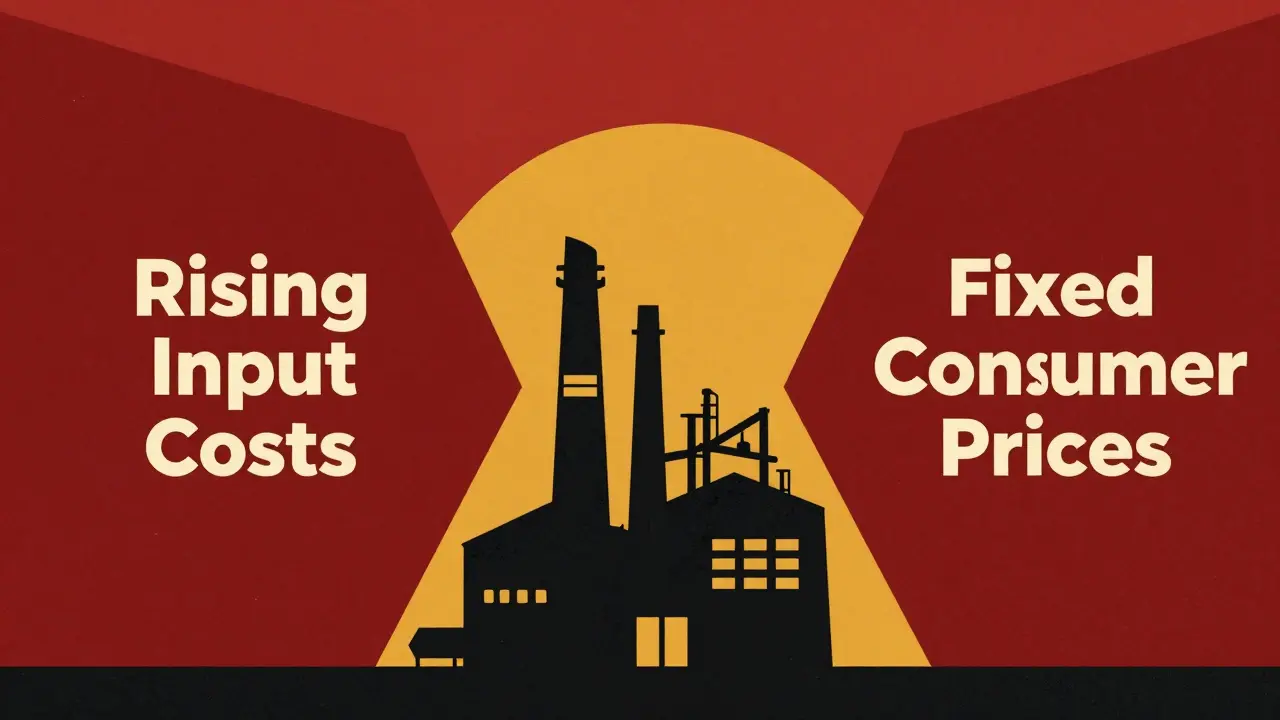
Imagine running a business where the cost of your raw materials jumps 23% in six months, but your customers refuse to pay a penny more for the finished product. That is the reality for thousands of factories right now. We are seeing a perfect storm of manufacturer financial strain is a state of economic distress where rising input costs and supply chain gaps outpace a company's ability to raise prices , leading to a dangerous squeeze on profit margins.
This isn't just a bad patch; it's a structural crisis. Between geopolitical tensions and protectionist trade policies, the cost of doing business has spiraled. When tariffs spike and critical components like semiconductors disappear from the market, manufacturers can't just "pivot" overnight. They are caught between a rock and a hard place: absorb the costs and risk bankruptcy, or pass them to the consumer and risk losing every single customer to a cheaper competitor.
The Margin Squeeze: Why Profits are Vanishing
For most manufacturers, the biggest headache is margin compression. This happens when the cost to make a product rises faster than the price the market is willing to pay. According to a survey by the Manufacturers Alliance, 86% of executives now cite rising input costs as their primary financial pressure point. We are talking about a massive surge in the price of steel, rare earth metals, and electronics components.
Take the automotive sector as an example. The shortage of semiconductors-the tiny chips that run everything from brakes to dashboards-has caused production delays averaging 17 days per vehicle. When you combine these delays with raw material costs growing at 2.7% annually, the financial hit is staggering. Some CEOs have reported absorbing over 5% of their margins just to keep their prices stable for the consumer.
The Tariff Trap and Price Pass-Through
Tariffs were supposed to protect domestic industry, but for many, they've become a tax on production. In 2025, effective tariff rates jumped from around 2.4% to over 10% in some sectors. This created a massive bill for companies importing raw materials. The big question is: who pays for it?
The St. Louis Federal Reserve found that while some costs are passed to consumers, the pass-through is only partial. In a competitive market, if you raise your prices by 10% because of a tariff, but your competitor doesn't, you lose. This forces manufacturers to eat the cost. In fact, estimates show that only 61-80% of new tariff costs actually make it into the final consumer price, leaving the rest to eat away at the manufacturer's bottom line.
| Sector | Primary Pressure Point | Input Cost Absorption Limit | Key Constraint |
|---|---|---|---|
| Consumer Goods | Consumer Price Sensitivity | 0.7% | High demand elasticity |
| Industrial Equipment | Raw Material Volatility | 1.8% | B2B contract cycles |
| Automotive | Component Shortages | Moderate | Semiconductor lead times |
| Electronics | Material Concentration | Low | Rare earth metal supply |
Breaking the Cycle: Strategic Survival Tactics
If the old way of pricing is dead, what's the new way? The most successful companies are moving away from "cost-plus" pricing-where you just add a percentage to your cost-and moving toward revenue growth management. This is a framework that balances strategic pricing with operational efficiency.
Companies using these dynamic pricing algorithms have seen their margin erosion drop significantly. One electronics manufacturer reported reducing their margin loss from 8.3% down to 2.1%, even while facing a 15.7% increase in raw material costs. It's not about raising prices across the board; it's about knowing exactly which products can handle a price hike and which ones must stay low to keep the customer base.
Beyond pricing, there is the push for nearshoring. By moving production closer to home, companies are trying to slash the risks associated with global shipping and geopolitical volatility. While this requires huge upfront capital, the long-term goal is to stop the 14-19% month-to-month price swings seen in materials like aluminum.

The Digital Edge: Technology as a Buffer
Digital maturity is now the strongest predictor of whether a manufacturer survives this strain. This isn't just about having a website; it's about using an industrial metaverse or advanced data foundations to optimize inventory. Companies implementing these tools have reported a 12.7% reduction in inventory costs.
The problem is the learning curve. Integrating these systems takes 9 to 14 months, and it requires upskilling about 62% of the finance team to handle advanced analytics. Most struggling companies have about 1.2 employees per $100 million in revenue focusing on pricing strategy, while the winners have nearly triple that amount. The difference is clear: the companies that treat pricing as a strategic science rather than a guessing game are the ones keeping their heads above water.
Risk Management for the Next 24 Months
Looking ahead to 2026 and 2027, the outlook is mixed. Raw material costs are projected to grow by another 2.9%. If you are a CFO or a business owner, the "wait and see" approach is a recipe for disaster. The most resilient firms are adopting a "dual-sourcing" strategy-never relying on a single country or supplier for a critical component.
To avoid further financial strain, consider this checklist for your operational audit:
- Tariff Impact Protocols: Do you have a weekly review of effective tariff rates, or are you finding out about them when the invoice arrives?
- Sourcing Diversification: What percentage of your critical materials come from a single geopolitical region? If it's over 50%, you are at high risk.
- Pricing Agility: How long does it take to change a price in your system? If it takes weeks, you are losing money every day the market shifts.
- Digital Foundation: Are your sales and finance teams looking at the same data, or are they working in silos?
What is the main cause of current manufacturer financial strain?
The strain is caused by a combination of rising input costs (like steel and semiconductors), volatile tariff rates that increase production costs, and a high level of consumer price sensitivity that prevents manufacturers from raising their own prices to compensate.
How do tariffs specifically impact the bottom line?
Tariffs act as a cost increase for imported raw materials. Because competitive pressures often prevent companies from passing 100% of these costs to consumers (often only 61-80% is passed through), the manufacturer must absorb the remaining cost, which directly reduces their profit margin.
Why are some sectors more vulnerable than others?
Consumer-facing industries are more vulnerable because their customers are highly sensitive to price changes. Industrial equipment manufacturers, by contrast, can often absorb slightly higher input costs (up to 1.8% vs 0.7% for consumer goods) before they are forced to change their pricing.
Can digital transformation actually help reduce costs?
Yes. Manufacturers using digital and data foundations have seen a 14.2% increase in operational efficiency. Specifically, those using industrial metaverse applications for supply chain optimization have reduced inventory costs by an average of 12.7%.
What is a 'dual-sourcing' strategy?
Dual-sourcing is the practice of procuring critical materials from two or more different suppliers, often in different geographic regions. This prevents a total production shutdown if one supplier faces a political crisis, natural disaster, or tariff spike.
Angela Cook
April 28, 2026 AT 03:36About damn time we stop relying on foreign junk and bring every single factory back to American soil where they belong! These tariffs are exactly what we need to force companies to stop being cowards and actually invest in our own workers instead of chasing pennies in some overseas sweatshop.
lalit adesara
April 29, 2026 AT 22:27Purely a failure of vision. Globalism was a lie sold to the weak. Only the strong nations will survive the shift.
Amber McCallum
May 1, 2026 AT 06:02It's just basic energy. If your business can't handle a little price change, you weren't meant to be a boss in the first place. Simple as that.
Ryan Wilson
May 1, 2026 AT 14:23This whole corporate dance is just a dumpster fire of incompetence. These C-suite vultures spend years huffing their own fumes and ignoring the obvious rot in the supply chain, then they act shocked when the math finally catches up to their greed. It's a carnival of failures and the only thing they're actually efficient at is milking the remaining drop of blood from their workers while the ship sinks into the abyss of their own making.
Jonathan Hall
May 2, 2026 AT 13:50I truly believe that we must find a way to harmonize these competing interests because while the nationalist fervor is understandable, the sheer logistical nightmare of overnight reshoring will likely lead to a complete societal collapse if we don't approach the transition with some semblance of grace and systemic planning, even though it absolutely infuriates me that some boardrooms are still pretending that the old model of frictionless trade is coming back when it is clearly dead and buried under a mountain of geopolitical spite and incompetence.
Abhishek Charan
May 2, 2026 AT 21:28Actually, the data is completely skewed!!! 🙄 Just because a few electronics firms
Jean Robert
May 4, 2026 AT 17:58I can see how overwhelming this must feel for the people on the ground, but I truly believe that with a little bit of patience and a focus on community support, these manufacturers can find a way through this dark forest. It is so important to remember that every crisis is just a hidden opportunity for growth and if we just keep encouraging each other and staying positive, we will eventually find a more sustainable way to build things that actually lasts for the next generation.
Darrin Oneto
May 4, 2026 AT 22:57That digital stuff sounds like some real wizardry, honestly just hope it dont crash the hole system lol.
Thomas Jorquez
May 6, 2026 AT 14:33Intersting read, though the data on semiconductors seems a bit outdated given the recent shifts in Asian markets.
Justin Crice
May 7, 2026 AT 17:29The implementation of an industrial metaverse requires a sophisticated data foundation to mitigate the latency in real-time supply chain visibility. Without a robust API integration between the ERP and the digital twin, the projected reduction in inventory costs remains purely theoretical and fails to account for the high capital expenditure required for the initial deployment phase.
Raymond Lipanog
May 8, 2026 AT 01:13One must wonder if the pursuit of efficiency has eclipsed the inherent value of stability. Perhaps the current instability is not a failure of the system, but a necessary correction to remind us that the physical world cannot be managed solely through the lens of a digital spreadsheet or a short-term quarterly report, as there is a fundamental dignity in production that transcends mere profit margins.