
 Feb, 9 2026
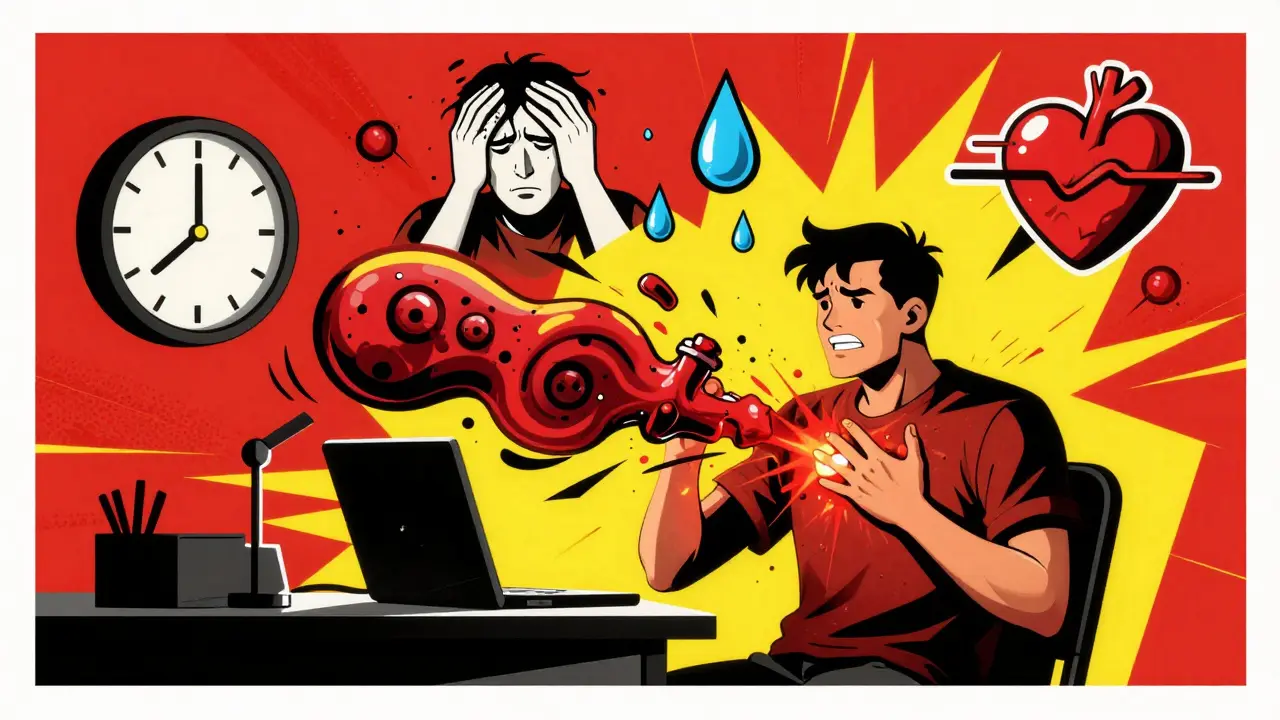
Imagine your body flooding with adrenaline for no reason. Your heart pounds, your head throbs, you sweat buckets - all while sitting quietly at your desk. For people with pheochromocytoma, this isn’t anxiety. It’s a tumor in their adrenal gland, silently pumping out stress hormones like a broken faucet. And the worst part? Most doctors miss it.
What Exactly Is a Pheochromocytoma?
A pheochromocytoma is a rare tumor that grows in the adrenal medulla - the inner part of the adrenal glands, which sit on top of each kidney. These glands normally release small amounts of epinephrine and norepinephrine to help you react to danger - like sprinting away from a car or climbing out of a cold lake. But in pheochromocytoma, the tumor churns out massive, uncontrolled doses of these hormones. Even when you’re not scared.
It’s not cancer - at least not usually. About 90% of these tumors are benign. But that doesn’t make them harmless. The hormone surge can spike blood pressure to 200/120 mmHg or higher in seconds. That’s enough to trigger a stroke, heart attack, or even sudden death. And because symptoms come in unpredictable waves, many patients are misdiagnosed for years.
The Classic Triad: Headaches, Sweating, and Racing Heart
If you’ve ever had a panic attack, you might think this sounds familiar. But pheochromocytoma has a signature pattern: the classic triad.
- Severe headaches (85-90% of cases) - often described as "the worst headache of my life," not the dull ache of tension.
- Profuse sweating (75-80%) - drenching clothes, even in cool rooms, without physical exertion.
- Palpitations or tachycardia (70-75%) - heart racing so hard you can feel it in your throat.
These aren’t constant. They come in spells - triggered by things like lifting groceries, emotional stress, or even urinating (if the tumor is in the bladder wall). Some patients get dizzy when standing up because the body can’t regulate blood pressure properly. Others lose weight, feel nauseous, or panic for no reason.
Doctors often mistake this for anxiety, migraines, or menopause. One patient told me, "I went to seven doctors over four years. They gave me Xanax. I was told to meditate. My blood pressure hit 240/130 in the ER - and they still didn’t test for the tumor until my husband insisted."
Why It Causes Dangerous High Blood Pressure
Essential hypertension - the kind most people have - is steady. Your blood pressure is always a bit high. Pheochromocytoma is different. It’s paroxysmal: sudden, violent spikes followed by normal or even low readings.
That’s why routine blood pressure checks can miss it. A patient might show 120/80 at their annual checkup - but during a spell, their pressure rockets to 220/140. If you don’t catch those spikes, you don’t catch the tumor.
Unlike kidney disease or thyroid issues, which cause high blood pressure through other mechanisms, pheochromocytoma directly overloads the body’s stress system. The result? Blood vessels constrict, heart rate surges, and organs get pounded. Over time, this can damage the heart, kidneys, and brain.
How Doctors Diagnose It - And Why Most Get It Wrong
There’s no single test. Diagnosis starts with biochemical testing - not imaging.
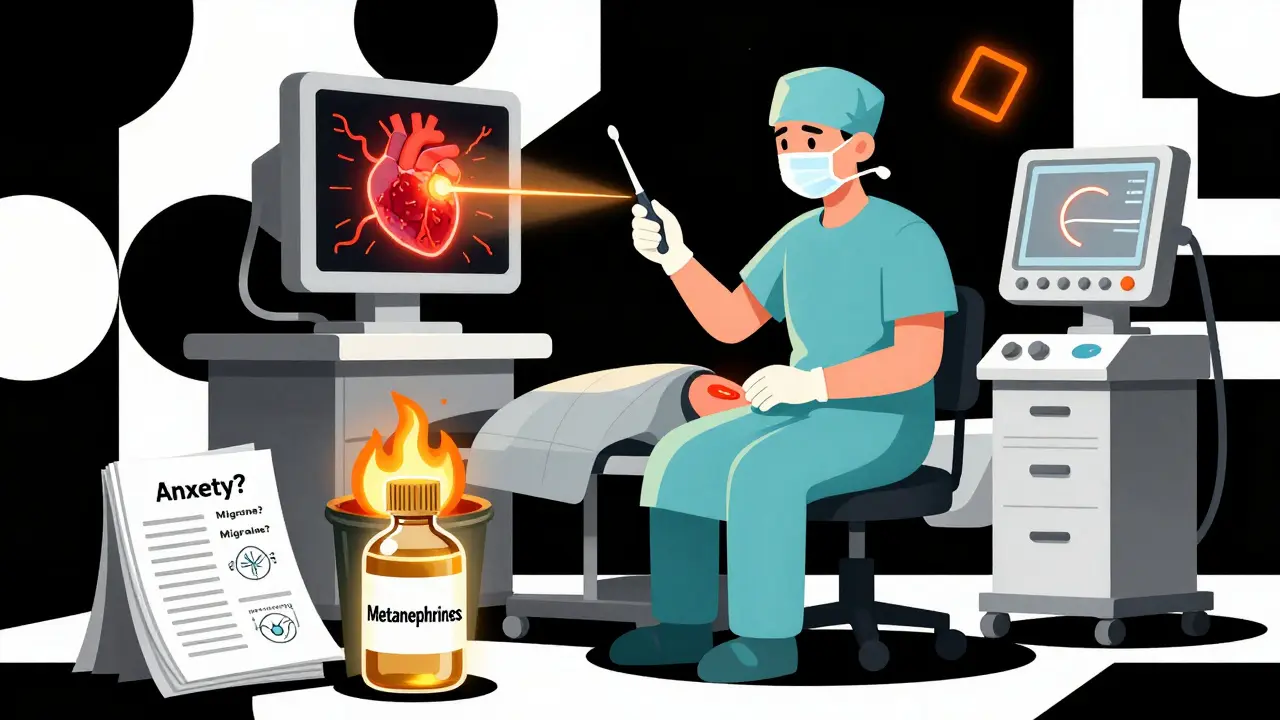
The gold standard is a 24-hour urine test for fractionated metanephrines. These are breakdown products of adrenaline and noradrenaline. When the tumor leaks hormones, metanephrines pile up in the urine. This test catches 96-99% of cases. Blood tests for plasma-free metanephrines are almost as accurate.
But here’s the catch: you must prepare properly. If you’re stressed, drinking coffee, smoking, or taking certain medications (like decongestants or antidepressants), your levels can spike - and give a false positive. That’s why some patients get unnecessary scans and anxiety. Experts say up to 20% of borderline results lead to overdiagnosis.
Imaging (CT or MRI) only comes after the blood or urine test confirms something’s wrong. Even then, 10% of these tumors aren’t even on the adrenal gland - they’re elsewhere in the abdomen or chest. Those are called paragangliomas.
And here’s the biggest blind spot: genetics. Between 35-40% of pheochromocytoma cases are linked to inherited mutations - in genes like SDHB, VHL, or RET. That means if you have it, your siblings or kids might too. Yet, many doctors still skip genetic testing. The latest guidelines say: test everyone. No exceptions.
The Only Real Cure: Surgery
Unlike other causes of high blood pressure, pheochromocytoma can be cured - with surgery.
But you can’t just operate. If you remove the tumor without preparing the body, the sudden release of stored hormones can cause a catastrophic blood pressure spike during surgery - with a 30-50% risk of death.
That’s why pre-op preparation is non-negotiable:
- Alpha-blockers - usually phenoxybenzamine - for 7-14 days. This opens up constricted blood vessels and prevents dangerous spikes.
- High-sodium diet - 200+ mEq of salt per day. The tumor causes chronic vasoconstriction, which shrinks blood volume. You need to rehydrate to avoid shock during surgery.
- Fluids - 2-3 liters of water daily. This supports blood pressure stability.
Once ready, most patients get a laparoscopic adrenalectomy - a minimally invasive removal of the adrenal gland. It takes 2-3 hours. Recovery? Most go home in 1-2 days. Many stop all blood pressure meds within 3 weeks.
One patient wrote: "My BP dropped to normal the day after surgery. I hadn’t felt this calm in 10 years."
What Happens After Surgery?
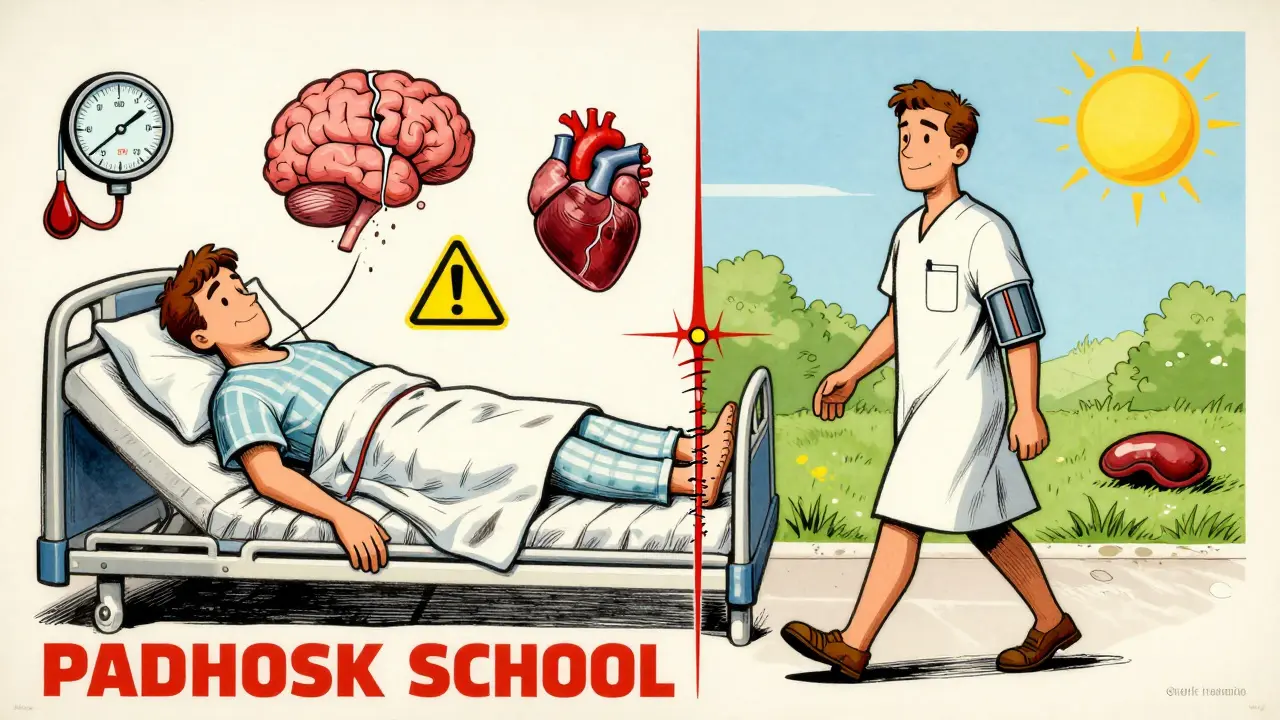
For most - the ones with a single, benign tumor - life returns to normal. Blood pressure stabilizes. Symptoms vanish. No more meds.
But not everyone is so lucky.
- Bilateral tumors - if both adrenal glands are removed, you lose your body’s ability to make cortisol and aldosterone. You’ll need lifelong steroid replacement: hydrocortisone and fludrocortisone.
- Malignant cases - about 10% of tumors spread. These require ongoing monitoring, targeted therapies like PRRT (peptide receptor radionuclide therapy), or even chemotherapy. Survival drops sharply - only about half live past 5 years.
- Chronic fatigue - 12% of patients report extreme tiredness for 6+ months after surgery. It’s not well understood, but it’s real.
And if you have a genetic mutation - especially SDHB - you need lifelong surveillance. Annual whole-body MRIs. Because new tumors can pop up elsewhere, even years later.
Why This Matters More Than You Think
Pheochromocytoma affects 1 in 200,000 people. That’s rare. But it’s also one of the few curable causes of high blood pressure. For every patient who goes undiagnosed, there’s a preventable stroke, heart failure, or death.
Primary care doctors might see one case in their entire career. So when a patient says, "I get these terrifying spells - sweating, heart racing, head splitting," don’t assume it’s anxiety. Don’t just prescribe a beta-blocker. Test the metanephrines.
And if you’re someone who’s been told "it’s all in your head" - but your body says otherwise - push for the test. Bring this article. Ask for a 24-hour urine metanephrine panel. It’s simple. It’s cheap. And it could save your life.
Can pheochromocytoma be cured without surgery?
No. Surgery is the only cure for pheochromocytoma. Medications like alpha-blockers help manage symptoms and prepare you for surgery, but they don’t remove the tumor. Without removal, the hormone surges continue, and the risk of sudden cardiovascular events remains high. Even if the tumor is small, leaving it in place is not recommended.
Is pheochromocytoma always cancerous?
No. About 90% of pheochromocytomas are benign - meaning they don’t spread. But the remaining 10% can become malignant, spreading to lymph nodes, liver, or bones. The challenge is that even benign tumors can be deadly if they cause repeated hypertensive crises. There’s no reliable way to tell if a tumor is malignant just by looking at it - so genetic testing and long-term monitoring are critical.
Can stress or caffeine trigger a pheochromocytoma attack?
Yes. Emotional stress, physical exertion, anesthesia, certain medications (like decongestants or SSRIs), and even caffeine or chocolate can trigger a hormone surge. That’s why patients are advised to avoid these triggers before diagnosis and testing. During the pre-op phase, strict avoidance is mandatory to prevent dangerous spikes.
Why do I need to eat so much salt before surgery?
The tumor causes chronic constriction of blood vessels, which reduces your body’s fluid volume by 20-30%. If you go into surgery with low blood volume, removing the tumor can cause your blood pressure to crash. Eating extra salt and drinking plenty of fluids expands your blood volume, helping your body handle the sudden drop in hormones after surgery - preventing shock.
Do I need genetic testing if I don’t have a family history?
Yes. Even if no one in your family has had pheochromocytoma, about 35-40% of cases are linked to inherited mutations. The SDHB gene mutation, for example, is found in up to 25% of patients with no family history. Genetic testing isn’t optional - it’s standard of care. It affects your treatment, your family’s health, and your long-term monitoring plan.
What happens if I don’t get treated?
Untreated pheochromocytoma can lead to sudden death. Repeated hypertensive crises can cause heart failure, stroke, kidney damage, or aortic dissection. Even if you feel fine between episodes, the damage adds up. The risk isn’t just high - it’s unpredictable. One episode could be fatal. That’s why early diagnosis and surgery are critical.
Chelsea Cook
February 10, 2026 AT 05:30So let me get this straight - we’re telling people with life-threatening hormone explosions to "just meditate"? 😂 I’ve had patients cry in my office because their ER docs laughed at their "anxiety." This isn’t a panic attack - it’s a ticking time bomb in their adrenal gland. Stop gaslighting people. Test the metanephrines. It’s a urine test. Not rocket science.
Jacob den Hollander
February 11, 2026 AT 09:03I’m a paramedic, and I’ve seen this so many times… one guy came in with a BP of 230/140, sweating through his shirt, clutching his chest - said he felt like he was "dying." We gave him nitro, benzos, the whole nine… nothing. Then his wife, crying, said, "He’s had these episodes for years. They say it’s stress." We ordered the metanephrine test… and bingo. Tumor. He’s fine now. Please, doctors - stop assuming it’s anxiety. It’s not. It’s real. And it’s curable. Just… test.
Brandon Osborne
February 12, 2026 AT 18:00YOU PEOPLE ARE OUT OF YOUR MINDS. I’ve been telling everyone for YEARS that the medical system is BROKEN. This is proof! They don’t want you to know the truth - it’s all about PROFITS. The pharmaceutical industry is paying off doctors to keep prescribing Xanax and beta-blockers instead of testing for this! Why? Because pills make money. Surgery? One-time cost. No recurring revenue. This is a cover-up. They’re letting people die so they can keep selling antidepressants! I’ve got 17 relatives who died from "mysterious hypertension" - now I know. It was this. And nobody listened. Wake up!
Marie Fontaine
February 13, 2026 AT 20:36OMG I had this!! I thought I was going crazy. Sweating in a snowstorm, heart pounding like a drum, headache like a jackhammer. Went to 5 docs. Got anxiety meds. Then one day I passed out in Target. ER doc asked if I "ever had weird headaches with sweating." I said yes. He ordered the test. Tumor. Removed. My life is NORMAL now. I didn’t know this was a thing. Thank you for posting this. Please share. Someone out there needs this.
Ken Cooper
February 14, 2026 AT 03:43soo… i just read this and i’m like… wait. my uncle had this. he was diagnosed after 7 years of "panic attacks." they gave him xanax. he lost 30 lbs. he’d pass out when he stood up. he didn’t even know what was happening. then one day he had a stroke. lucky he survived. they found the tumor during the mri. he had surgery. now he’s on lifelong meds because both adrenals were gone. i didn’t even know this was a thing. i’m telling everyone. please. if you have weird symptoms. get tested. it’s not anxiety. it’s not in your head. it’s real. and it’s treatable. don’t wait. like. at all.
MANI V
February 14, 2026 AT 16:18This is why Western medicine is failing. You people are obsessed with quick fixes. Surgery? How primitive. In my village in India, we use turmeric, neem, and chanting to balance the body’s prana. You don’t cut people open. You heal them with energy. This tumor is a sign of spiritual imbalance. Stop relying on machines and drugs. Connect with your inner self. Then you won’t need surgery. You’ll need enlightenment.
Susan Kwan
February 16, 2026 AT 10:46Wow. So the same people who dismiss chronic pain as "psychosomatic" are now dismissing this? I’m not surprised. But here’s the thing - if your body is screaming in a language you don’t understand, you don’t get to call it "anxiety" and walk away. You get tested. Period. And if your doctor doesn’t know about metanephrines? Find a new one. Your life isn’t a guessing game.
Random Guy
February 18, 2026 AT 00:28Okay but imagine this: your body is a volcano. And the doctors are like, "Hmm, maybe you’re just mad?" And then one day… BOOM. You’re dead. And they’re like, "Ohhh, we should’ve checked the urine." Like… why didn’t you just ask if I’ve ever had a headache so bad I thought I was dying? I mean. Come on.
Ryan Vargas
February 18, 2026 AT 02:53Consider the epistemological implications of this condition. The tumor is not merely a biological anomaly - it is a rupture in the Cartesian dualism of mind and body. The fact that we label this as "anxiety" reveals a deeper epistemic crisis: we refuse to accept that the body can speak in ways the mind cannot interpret. The medical establishment, in its reductionist hubris, collapses complex somatic phenomena into psychiatric categories - a form of symbolic violence. The 24-hour metanephrine test is not just a diagnostic tool - it is an act of ontological reclamation. The patient, once dismissed as "neurotic," is restored to her true state: a biological entity under siege by an unacknowledged intruder. The cure - surgery - is not merely therapeutic; it is a metaphysical reintegration. We are not treating a tumor. We are restoring the integrity of the self.
Tasha Lake
February 19, 2026 AT 14:55From a clinical standpoint, this is a textbook example of a paroxysmal catecholamine excess syndrome. The key is differentiating it from primary hypertension or panic disorder. The metanephrine levels are the gold standard because they’re stable metabolites - unlike the parent catecholamines, which have short half-lives. Also, the pre-op prep with alpha-blockers and sodium loading is critical - you’re essentially reversing the chronic volume depletion caused by persistent vasoconstriction. Without it, intraoperative catecholamine surge = cardiac arrest. This is why we do not just "pop off" the gland. It’s a high-risk procedure, but with proper prep, mortality drops below 1%. Still - too many docs skip the genetic testing. SDHB mutations? That’s a red flag for multifocal disease and malignancy risk. Always test. Always.
Brett Pouser
February 20, 2026 AT 05:24My sister had this. She’s a yoga teacher. Thought she was "overstimulated." Kept saying she felt like her body was on fire. Took 5 years. She almost died in a grocery store. Now she’s fine. I wish I’d known this sooner. If you’re reading this and you’ve ever had unexplained sweating or heart racing - even once - ask for the test. It’s easy. It’s cheap. And if you’re like me - you’ll kick yourself for not doing it sooner.
Tom Forwood
February 21, 2026 AT 00:15Just had this happen to my cousin. He’s a 32-year-old firefighter. Thought he was just stressed. Got dizzy lifting gear. Sweated through his uniform in winter. Doc gave him beta-blockers. Then one day, during training, he blacked out. BP was 250/130. They found the tumor. Surgery. Gone. Now he’s back on the job. No meds. Just… normal. I’m telling everyone I know. This isn’t rare. It’s just under-tested. If you’ve got weird symptoms - don’t ignore them. Push. Even if they laugh. Push harder.
John McDonald
February 22, 2026 AT 22:51I’m a nurse. I’ve seen this too many times. Patient comes in with "anxiety." We give them a script. They come back in six months with a stroke. We find the tumor then. It’s heartbreaking. This isn’t about being dramatic. It’s about listening. If someone says, "I feel like I’m going to die every few days" - you don’t say "take deep breaths." You order the test. Simple. That’s all. Just test. Please.
Chima Ifeanyi
February 24, 2026 AT 02:43Let’s analyze this dispassionately. The article assumes surgery is the only solution. But what if the tumor is not the root cause? What if it’s a secondary manifestation of systemic dysbiosis or chronic adrenal fatigue? The entire paradigm is flawed. Why not address gut health, cortisol rhythm, and mitochondrial function first? Surgery is reactive. Holistic intervention is proactive. This is why Western medicine is failing. You treat symptoms, not systems. This tumor is a symptom - not the disease. Fix the ecosystem, not the organ.
Camille Hall
February 24, 2026 AT 16:06I’ve worked with patients who’ve been misdiagnosed for years. One woman told me she thought she was losing her mind. She was terrified of leaving the house. After surgery? She went back to teaching kindergarten. No meds. No anxiety. Just… peace. This isn’t just about medicine. It’s about dignity. No one should be told their body is broken because the system doesn’t know how to listen. If you’re reading this - and you’ve been dismissed - you’re not crazy. You’re just unheard. Keep pushing. You deserve to be heard.