
 Jan, 26 2026
When your kidneys fail, dialysis isn’t just a treatment - it’s a lifestyle shift. And for many, doing it at home is the only way to keep living like yourself. Two main options exist: Continuous Ambulatory Peritoneal Dialysis (CAPD) and Automated Peritoneal Dialysis (APD). Both use your abdominal lining to filter blood, but how they work, what they demand from you, and how they fit into your life couldn’t be more different.
How CAPD Works - Manual Exchanges, No Machine Needed
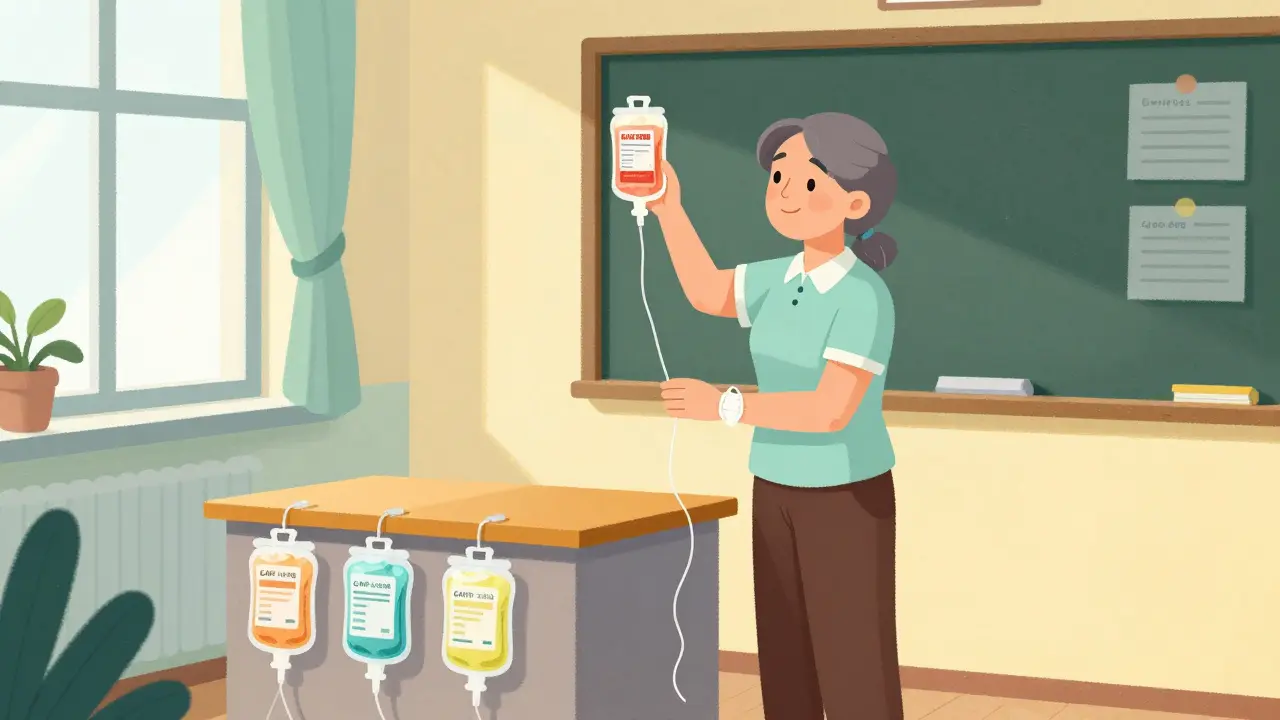
CAPD is the original home dialysis method. No machines. No electricity. Just gravity and your hands. You fill your abdomen with about 2 liters of dialysis fluid through a permanent catheter, let it sit for 4 to 6 hours, then drain it out. You repeat this 3 to 5 times a day - usually before breakfast, lunch, dinner, and before bed.
Each exchange takes 30 to 40 minutes. You’ll need a clean, quiet space - a bathroom or bedroom works. You carry the fluid bags with you. Each bag weighs 1.5 to 3 pounds, so you’re lugging around 6 to 15 pounds total during the day. Some people use small rolling carts. Others just tuck bags into backpacks or under desks.
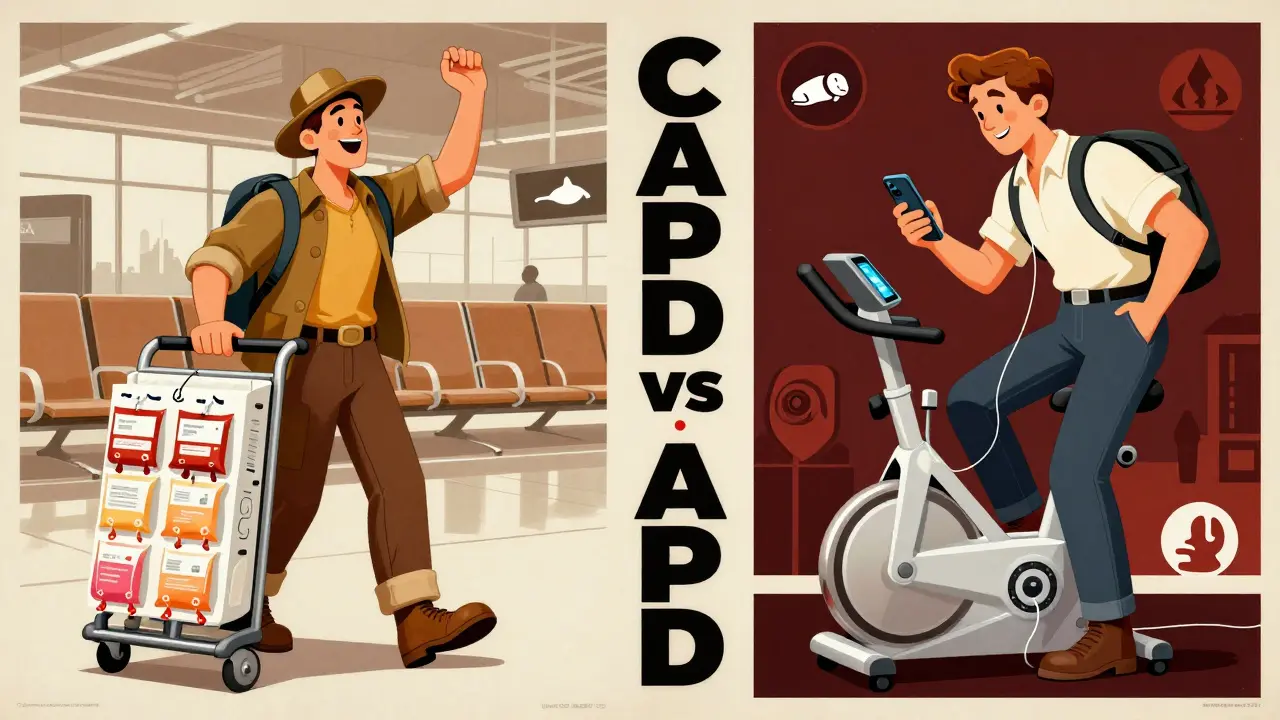
There’s no tech to break. No alarms to ignore. If you’re traveling, you can do exchanges in a hotel bathroom, an airport lounge, or even a friend’s house. That’s why many teachers, travelers, and people with irregular schedules choose CAPD. One user, a 58-year-old high school teacher, told me: "I do my exchanges during my planning period. No one even knows I’m on dialysis. I just grab a bag from my locker and go."
How APD Works - Sleep While the Machine Does the Work
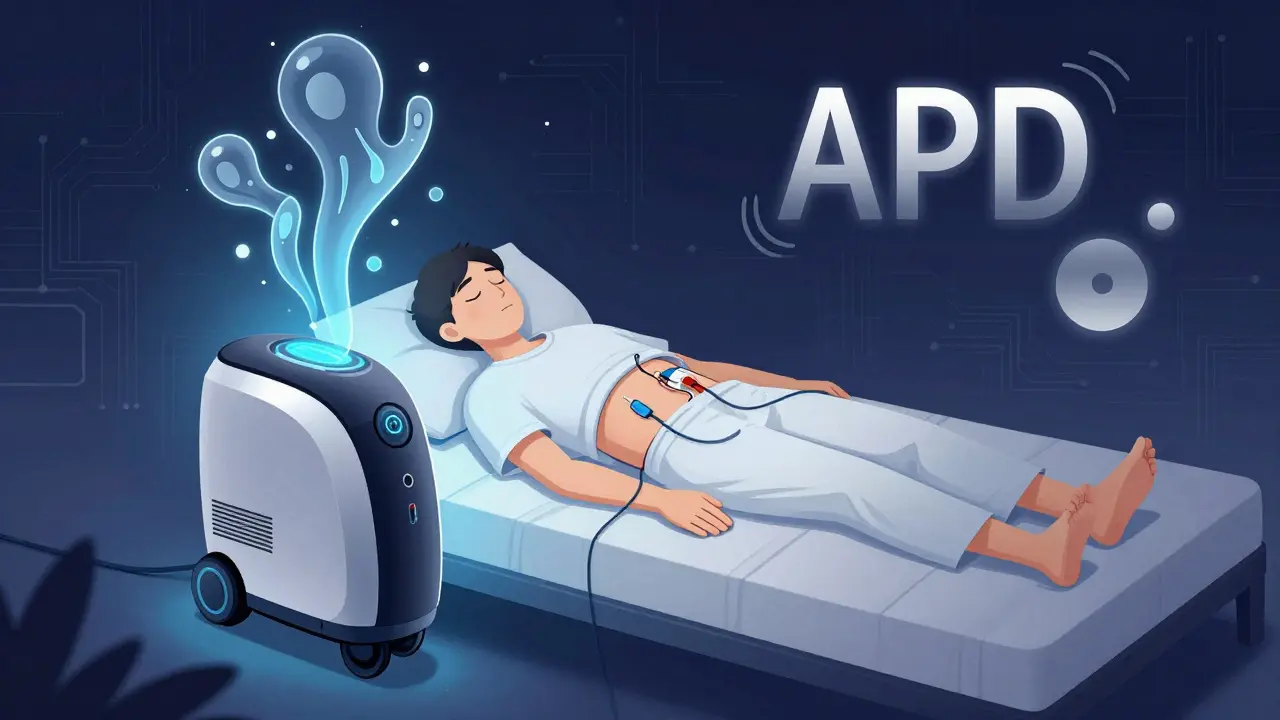
APD flips the script. Instead of doing exchanges during the day, you connect to a machine - called a cycler - at night while you sleep. The device automatically fills and drains your abdomen 8 to 10 times over 8 to 10 hours. You wake up with clean fluid in your system, no manual work needed.
The machines are compact - about the size of a small suitcase, weighing 15 to 25 pounds. You need a dedicated outlet and a small space near your bed. They’re quiet - around 35 to 45 decibels, like a library fan. But some people still hear them. One nurse on a patient forum said: "I had to buy white noise machines because the cycler kept me awake for months."
Modern cyclers have safety features: air bubble detectors, pressure sensors, and even remote monitoring. If something goes wrong - a kinked tube, low fluid - the machine stops and alerts you. Your clinic gets a notification too. That’s a big reason why APD users have fewer hospital visits for fluid overload.
Which One Is Better for Your Lifestyle?
It’s not about which is "better." It’s about which fits your life.
If you’re active during the day - working, commuting, raising kids - APD gives you back your daylight hours. You wake up ready to go. No more stopping mid-meeting to drain fluid. You can sleep longer, too. Studies show APD users get about 3.2 more hours of sleep per night than CAPD users.
If you hate machines, fear tech failures, or live somewhere with unreliable power, CAPD is simpler. No electricity? No problem. No Wi-Fi? Still works. You don’t need training on software updates or error codes. You just need clean hands and a steady routine.
But here’s the catch: CAPD requires more discipline. You have to remember to do exchanges at the right times. Miss one, and toxins build up. Do it in a dirty room? Risk of infection rises. One in every 1.5 CAPD users gets peritonitis each year - that’s a serious abdominal infection that can send you to the hospital.
APD reduces that risk by about 25%, because the machine handles the fluid flow. But if the cycler breaks down at 2 a.m.? You’re stuck. You need to know how to switch to manual exchanges fast. Not everyone can do that. That’s why training for APD takes longer - 14 to 21 days - compared to 10 to 14 for CAPD.
Cost, Insurance, and Hidden Expenses
In the U.S., Medicare covers 80% of home dialysis costs. The rest? That’s where things get messy.
CAPD supplies - bags, tubing, cleaning kits - cost about $50 to $75 a month out of pocket. APD? $75 to $100. Why the difference? You’re renting the cycler. Most clinics charge $30 to $50 a month for equipment maintenance, even if you don’t use it.
But here’s what most people don’t realize: APD can save you money long-term. Better fluid control means fewer blood pressure meds, less heart strain, and fewer hospital trips. One study found APD users had 15% to 20% lower medication costs. Medicare data shows APD patients are 18% less likely to be hospitalized for fluid overload.
Some European countries actually pay more for APD to encourage its use. In the U.S., reimbursement is the same - but that might change. With AI-powered cyclers like Baxter’s Amia now adjusting prescriptions automatically based on your weight and blood pressure, the value of APD is rising fast.
Who Should Choose CAPD?
CAPD is still the go-to for:
- People over 75 - simpler, no tech to manage
- Those with limited space - no machine needed
- People in rural areas without reliable electricity or tech support
- Those who prefer total control over their treatment
It’s also better if you still have some kidney function - more than 2 mL per minute of urine output. CAPD’s constant, gentle filtering works better with leftover kidney function than APD’s burst-style cycles.
Who Should Choose APD?
APD is the clear winner for:
- Working adults - 52% of APD users are between 18 and 64
- People who struggle with manual dexterity - arthritis, tremors, vision issues
- Those who want uninterrupted sleep and more daytime freedom
- Patients with high fluid retention or high blood pressure - APD controls these better
It’s also the better choice if you’re tech-savvy or have someone at home who can help with troubleshooting. Remote monitoring means your care team can see if you missed a cycle or had a leak - and call you before it becomes an emergency.
What About Peritonitis and Infection Risk?
Both methods carry infection risk. The peritoneal membrane is exposed to the outside world every time you connect a bag. That’s why sterile technique is everything.
CAPD has a higher infection rate: 0.68 episodes per patient per year. APD: 0.52. Why? Fewer manual touches. Fewer opportunities for contamination. The machine does the work in a sealed system. Still, 34% of people who switch from CAPD to APD do so because they got repeated peritonitis.
Training is key. The National Kidney Foundation says 80% of infections happen because of poor handwashing or dirty environments. Don’t skip the steps. Don’t rush. Wash your hands for 30 seconds. Use antiseptic. Cover your catheter when not in use. It’s boring. It’s tedious. But it saves lives.
What’s the Future Looking Like?
APD adoption is growing. In 2023, it made up 55% of home PD cases. By 2030, it’s expected to hit 65%. Why? Technology. AI. Remote monitoring. Smart cyclers that learn your body’s patterns and adjust fluid removal automatically.
Baxter’s Amia system, launched in 2021, reduced fluid overload by 31% in trials. New models coming in 2025 will connect to smartphones - reducing setup errors by 40%. That’s huge. Fewer mistakes mean fewer hospital visits.
CAPD isn’t disappearing. It’s still vital for older adults, people without stable power, or those who just don’t want a machine in their bedroom. But for most new patients under 65? APD is becoming the default.
Final Thoughts - It’s Not One Size Fits All
There’s no perfect choice. Only the right one for you.
If you’re young, busy, and want your nights to be your own - APD is likely your best bet. You’ll trade a little tech complexity for a lot of freedom.
If you’re older, prefer simplicity, or live in a place where tech support is hard to reach - CAPD gives you control without dependence.
Ask your nephrologist for a trial. Some clinics let you try both for a week. See how each feels. Talk to other patients. Read their stories. Don’t let someone else’s experience decide for you.
Home dialysis isn’t just about surviving. It’s about living. And the right method? It doesn’t just clean your blood - it gives you back your life.
Can I switch from CAPD to APD later if I change my mind?
Yes, many people switch. About 15% of CAPD users transition to APD within two years, usually because they want more daytime freedom or had repeated infections. The catheter stays in place - you just connect to a cycler instead of doing manual exchanges. Your care team will guide you through the transition, including training on the machine and adjusting your treatment schedule.
Do I need help at home for APD or CAPD?
You don’t *need* help, but it helps - a lot. For APD, having someone nearby to assist if the machine alarms or you feel unwell is a safety net. For CAPD, a family member can help with sterile technique if your hands are stiff or your vision is poor. Medicare now covers training for family members as care partners, so take advantage of it. Even if you’re independent now, things change. Having someone trained gives you peace of mind.
Can I travel with either CAPD or APD?
Both are travel-friendly, but CAPD is simpler. You can carry fluid bags in a cooler and do exchanges anywhere - hotel rooms, airports, even on a plane if you plan ahead. APD requires the cycler, which you can ship ahead or rent at your destination. Most dialysis suppliers offer international delivery. But if your flight is delayed or your cycler breaks? You’ll need to know how to do manual exchanges on the spot. That’s why CAPD gives you more flexibility when things go wrong.
Is APD noisy enough to disrupt sleep?
Modern cyclers are quiet - about as loud as a library fan. But some people are sensitive to sounds. If you’re a light sleeper, try using a white noise machine or earplugs. Some users report the machine’s rhythmic beeping or fluid flow helps them sleep. Others find it distracting. Most clinics let you test the machine at home before committing. If noise is a dealbreaker, CAPD might be better - but you’ll trade sleep for daytime interruptions.
What happens if the APD cycler breaks?
Most APD programs offer 24/7 technical support. If the machine fails, you’ll get a replacement within 24 hours - often same-day in urban areas. But you must know how to switch to manual exchanges. Your training includes this. You’ll have backup supplies on hand. Never wait for the machine to fix itself. If you miss two full cycles, call your clinic immediately. Fluid buildup and toxins can rise fast.
Can I still work full-time with either option?
Absolutely. CAPD users often schedule exchanges during breaks - lunch, between classes, before or after shifts. APD users work full-time with no interruptions. In fact, 65% of CAPD users and 78% of APD users report maintaining full-time employment. APD gives you more flexibility for unpredictable schedules, like night shifts or travel. CAPD requires more routine. Both are compatible with work - it just depends on how you structure your day.
Kathy McDaniel
January 27, 2026 AT 21:33Desaundrea Morton-Pusey
January 29, 2026 AT 17:21Kirstin Santiago
January 30, 2026 AT 16:30Paul Taylor
February 1, 2026 AT 01:08Murphy Game
February 1, 2026 AT 17:19John O'Brien
February 3, 2026 AT 11:34Kegan Powell
February 3, 2026 AT 15:17April Williams
February 4, 2026 AT 22:07Harry Henderson
February 5, 2026 AT 10:17suhail ahmed
February 7, 2026 AT 03:27Candice Hartley
February 7, 2026 AT 06:14astrid cook
February 7, 2026 AT 07:23