
 Dec, 4 2025
Most people assume that if a generic drug has the same active ingredient as the brand-name version, it’s exactly the same. But that’s not true. The pill you take might look different, taste different, or even make you feel different-not because of the medicine inside, but because of what’s on the outside. These are the inactive ingredients, and they’re not harmless fillers. For some people, they’re the reason they feel worse after switching to a generic.
What Are Inactive Ingredients, Really?
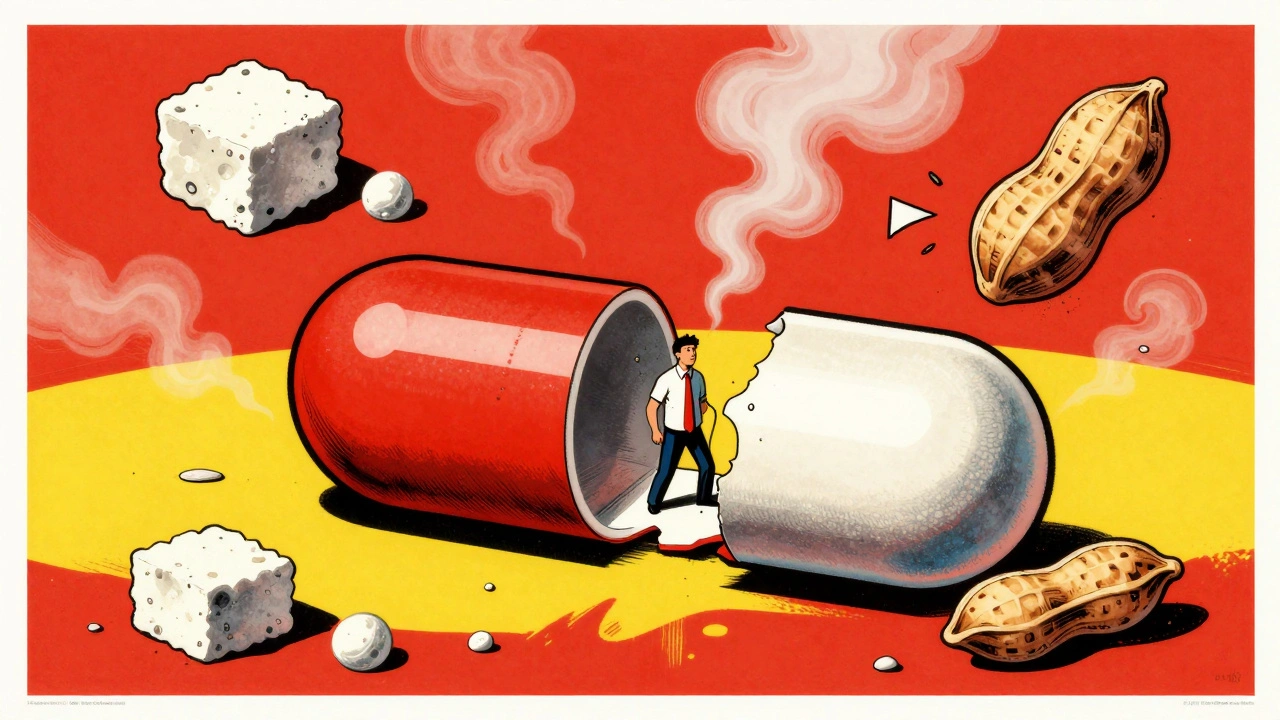
Inactive ingredients, also called excipients, are everything in a pill that isn’t the active drug. Think of them as the packaging, the glue, the flavor, the color, and the texture. They help the medicine stay stable, dissolve properly, or even taste less bitter. But here’s the catch: while the active ingredient in a generic must match the brand-name version exactly, the rest? It’s up to the manufacturer.
Here’s a shocking fact: more than half of every pill is made of these inactive ingredients. Some pills are 99% fillers. That’s not a typo. In a 100mg tablet of levothyroxine, maybe 100mg is the drug. But the rest? Lactose, cornstarch, dyes, preservatives, gluten, sugar alcohols, even peanut oil in rare cases. You’re swallowing a cocktail of chemicals you never asked for.
Why Does This Even Matter?
If you don’t have allergies or sensitivities, you probably won’t notice a thing. But if you do, switching from brand to generic can feel like a betrayal. One patient on Reddit switched from Synthroid to generic levothyroxine and started having severe stomach cramps. The cramps vanished when she switched back. That’s not in her head. That’s in the filler.
Common culprits:
- Lactose - Found in about 60% of oral medications. A problem for the 15% of people who are lactose intolerant.
- Gluten - Not always labeled. A hidden trigger for people with celiac disease.
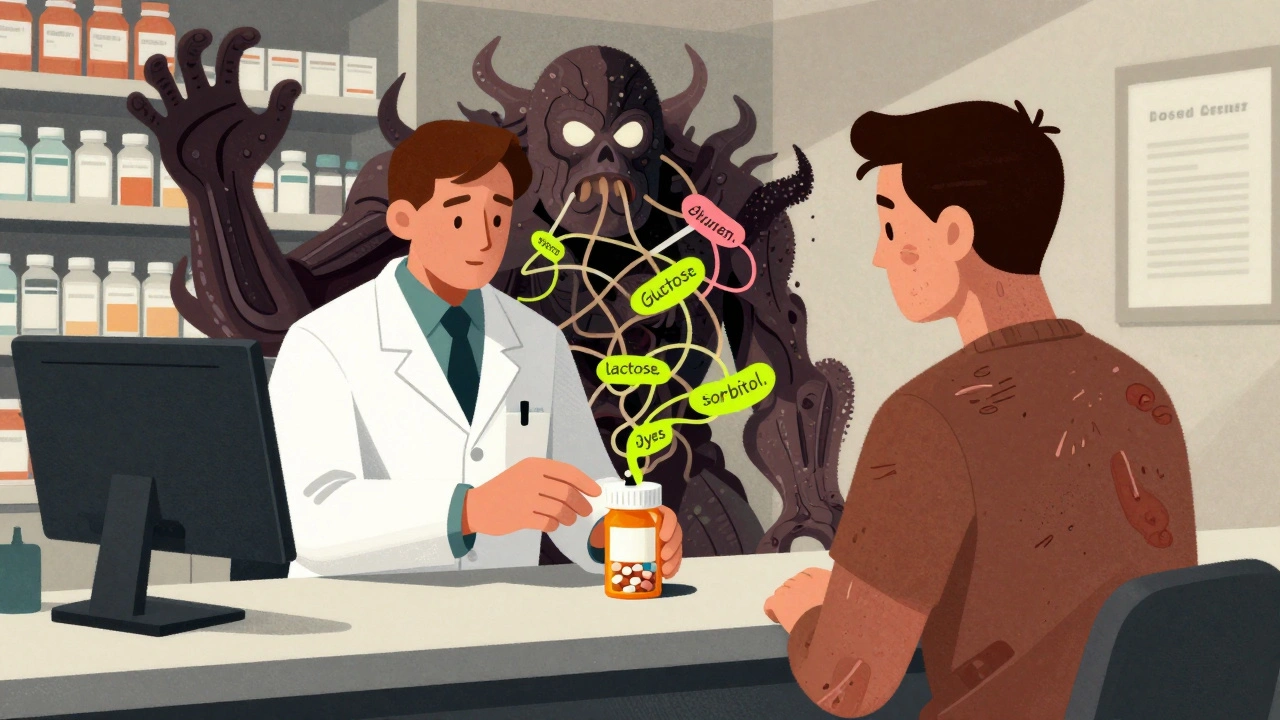
- FODMAP sugars - Like lactose, fructose, or sorbitol. These can wreck havoc on people with IBS. About 55% of medications contain them.
- Dyes - Red 40, Yellow 5, Blue 1. Linked to skin rashes and migraines in sensitive people.
- Bisulfites - Used as preservatives. Can trigger asthma attacks. These are required to be labeled, but only because they’re dangerous enough to be regulated.
And here’s the worst part: manufacturers don’t have to tell you what’s in there. Not clearly. Not in plain language. The FDA requires labeling of bisulfites and peanuts-but not gluten, not lactose, not FODMAPs. You have to dig. You have to ask. You have to call the pharmacy.
Generic vs Brand: Is There a Real Difference?
The FDA says generics are just as safe and effective. And for most people, they are. But bioequivalence doesn’t mean identical. It means the drug gets into your bloodstream within a certain range-usually within 4% variation. That’s tight. But that’s only for the active ingredient. Nothing controls how fast the pill dissolves, how it’s coated, or what’s holding it together.
One study found that some generic blood pressure pills dissolved over three times faster than their brand-name counterparts. That’s not a glitch. That’s allowed under current rules. Faster dissolution can mean a spike in blood levels, which might cause dizziness or low heart rate in older adults.
And the numbers don’t lie. After generic versions of losartan, valsartan, and candesartan hit the market, adverse event reports jumped by 8% to 14%. Was it the inactive ingredients? We can’t say for sure. But it’s the only variable that changed.
Who’s at Risk?
You’re not just at risk if you have a known allergy. You’re at risk if you take five or more pills a day. That’s 30% of people over 65. Every pill adds another layer of potential irritants. Lactose from one, gluten from another, sorbitol from a third. They pile up. And your body doesn’t care if it’s from a brand or a generic. It only cares if it reacts.
People with:
- Celiac disease
- Lactose intolerance
- Irritable bowel syndrome (IBS)
- Asthma
- Chronic skin conditions like eczema
- Multiple chronic illnesses
…are the ones who suffer silently. They switch meds, get worse, and assume it’s their condition getting worse. Not the pill.
What Can You Do?
You don’t have to give up generics. But you do need to be smarter.
- Ask your pharmacist - Don’t just take what’s handed to you. Ask: “What are the inactive ingredients in this version?” Most pharmacists can look it up using the FDA’s Inactive Ingredient Database. They won’t always volunteer the info. You have to ask.
- Check the label - Look for “inactive ingredients” on the packaging. If it’s not there, ask for the full list. Some pharmacies print it on the bottle or offer it online.
- Stick with one generic manufacturer - If you find a generic that works, stick with it. Don’t switch between different generics unless you have to. Each one has a different formula.
- Request brand-name if needed - If you’ve had a reaction, ask your doctor to write “Dispense as Written” or “Do Not Substitute” on the prescription. It’s legal. It’s your right.
- Track your symptoms - Keep a simple log: when you switched meds, what symptoms appeared, when they went away. This helps your doctor connect the dots.
There’s no perfect solution yet. But awareness is the first step. The MIT team is building a public database to map inactive ingredients by drug. That’s coming. Until then, you’re your own best advocate.
The Bigger Picture
Generics save the U.S. healthcare system over $300 billion a year. That’s huge. They’re not the enemy. But the system treats them like interchangeable widgets. They’re not. Pills are complex systems. And the invisible parts? They matter.
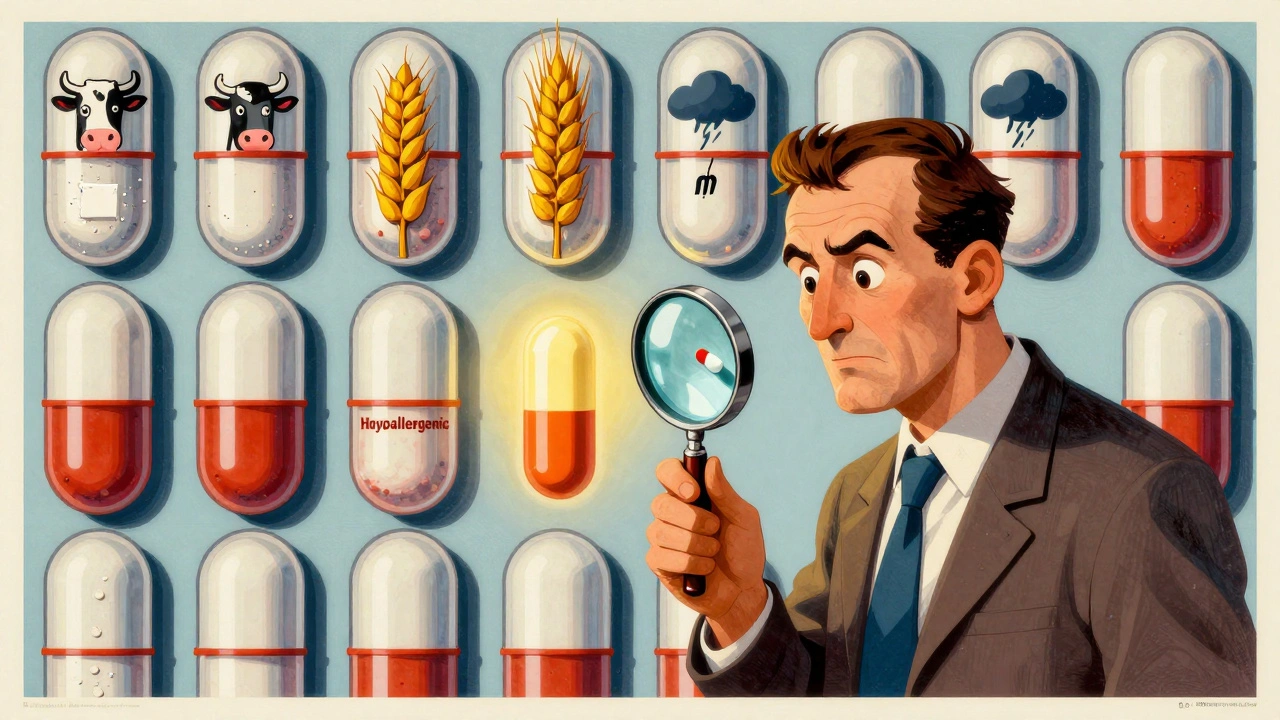
Some companies are starting to notice. A few generic makers now offer “hypoallergenic” versions-no dyes, no gluten, no lactose. They cost a bit more, but for people who need them, it’s worth it. The market is starting to respond to real patient needs.
Until regulations catch up, the burden falls on you. You deserve to know what’s in your medicine. Not just the part that’s supposed to heal you. But the rest of it too.
Why Don’t More Doctors Know?
Dr. Giovanni Traverso from MIT says it plainly: “Doctors have no idea which of these ingredients will be included in the pills they prescribe.” Medical school doesn’t teach it. Pharmacies don’t highlight it. The FDA doesn’t force transparency.
So doctors assume it’s fine. Patients assume it’s fine. But when someone gets sick after a switch, no one connects the dots.
That’s changing. Patient advocacy groups are pushing for standardized labeling. The FDA has the data. It just needs to make it accessible.
Are generic medications safe if I have allergies?
Generic medications are safe for most people, but if you have known allergies-like to lactose, gluten, or certain dyes-you need to check the inactive ingredients. The active ingredient is the same, but the fillers can vary. Always confirm the full list with your pharmacist before switching.
Can inactive ingredients cause real side effects?
Yes. While rare, inactive ingredients can trigger digestive issues, skin rashes, asthma attacks, or migraines in sensitive individuals. Studies show that up to 27% of people report new side effects after switching to generics, with most blaming the fillers. These reactions are real and documented in medical journals and patient reports.
How do I find out what’s in my generic pill?
Ask your pharmacist for the full list of inactive ingredients. Most can access the FDA’s Inactive Ingredient Database. You can also check the manufacturer’s website or look for the “inactive ingredients” section on the packaging. If it’s not listed, request the official product insert.
Should I avoid generics altogether?
No. Generics are safe and effective for the vast majority of people. They save billions in healthcare costs. But if you have sensitivities, or if you’ve had a bad reaction after switching, don’t assume it’s just in your head. Talk to your doctor and pharmacist. You may need to stick with a specific brand or a specialty generic formulation.
Can I get a generic without lactose or gluten?
Yes. Some generic manufacturers now offer versions without common allergens like lactose or gluten. These aren’t always the cheapest, but they exist. Ask your pharmacist for “lactose-free” or “gluten-free” alternatives. Some pharmacies stock them, or can order them.
Why don’t drug labels list all allergens like food does?
Current FDA rules only require labeling for a few allergens-like peanuts and bisulfites. Lactose, gluten, and FODMAPs aren’t included, even though they affect millions. This gap exists because drug regulation focuses on the active ingredient. But patient advocates are pushing for change. Until then, you need to ask.
Next Steps If You’re Worried
If you’ve ever felt worse after switching to a generic, don’t ignore it. Write down:
- What medication you switched from and to
- When the symptoms started
- What they were (stomach pain, rash, fatigue, etc.)
- When they stopped
Bring this to your doctor. Ask: “Could this be the fillers?” If your doctor doesn’t know, ask for a referral to a pharmacist who specializes in medication reviews. You’re not being difficult. You’re being smart.
Medication isn’t just about the drug. It’s about the whole pill. And if your body reacts to the parts you can’t see, you deserve to know why.
Kylee Gregory
December 4, 2025 AT 12:11It's wild how we assume pills are just medicine, but they're basically little chemical cocktails we swallow without reading the fine print. I never thought about lactose or gluten being in my thyroid med until I started having weird bloating. Switched back to brand and boom-gone. Not magic, just hidden ingredients.
It's not about being anti-generic. It's about being informed. We demand labels on yogurt, why not on meds?
Chris Brown
December 6, 2025 AT 00:28There is a profound lack of scientific rigor in the popular narrative surrounding inactive ingredients. While anecdotal reports abound, controlled studies demonstrating clinically significant differences in bioavailability due to excipients are exceedingly rare. The FDA’s bioequivalence standards are not arbitrary-they are statistically validated and rigorously enforced. To imply that these fillers are somehow nefarious is to misunderstand pharmacology entirely.
Stephanie Bodde
December 7, 2025 AT 21:06Yessss this!! 🙌 I switched generics and got a rash that lasted 3 weeks. No one believed me until I checked the label-red dye #40. My pharmacist was shocked too. They don’t tell you this stuff because they assume you’re fine. But if you’re not? You suffer in silence. Ask. Always ask. 💪
Also-lactose-free levothyroxine exists. Ask for it. You deserve better.
Philip Kristy Wijaya
December 8, 2025 AT 01:07Let me be blunt the system is broken and nobody in power gives a damn about the people who actually take these pills. You think the FDA cares if your stomach explodes because your generic has cornstarch and sorbitol No they care about cost savings and shareholder dividends. They don’t test the fillers because testing costs money and the industry doesn’t want to pay for transparency. You want change Stop trusting the label and start digging into the manufacturer’s batch sheets. Call them directly. Demand it. The silence is complicity
Jennifer Patrician
December 8, 2025 AT 03:55They’re hiding it on purpose. Big Pharma owns the FDA. They don’t want you to know that your blood pressure pill has gluten because then you’d stop buying it and they’d lose billions. That’s why they only label peanuts and bisulfites-those are too dangerous to ignore. But gluten? Lactose? FODMAPs? Those are just ‘minor inconveniences’ for the masses. Wake up. This is chemical warfare on patients. They’re poisoning us slowly and calling it ‘cost-effective.’
Mellissa Landrum
December 8, 2025 AT 17:53lol u think this is new? i been saying this since 2018. my iBS went from bad to worse after i switched to generic zoloft. turns out it had lactose and sorbitol. pharmacy said ‘oh its fine’ but i knew better. now i only take brand or the special gluten free version. they dont want you to know this but its true. ask for the insert. its in the box. they just dont hand it to you
Mark Curry
December 9, 2025 AT 14:36I used to think this was overblown. Then my mom started having migraines after switching to a generic statin. She stopped taking it for a week, went back to brand, and the headaches vanished. We called the pharmacy. Turns out the generic had a new dye. No one told us. Now we always check. It’s not hard. Just ask. Takes two minutes.
Simple solution. Why isn’t everyone doing it?
aditya dixit
December 11, 2025 AT 05:06This is a global issue. In India, I’ve seen generics with completely different fillers than those in the US, and patients report similar issues. The problem isn’t the generic model-it’s the lack of standardized, transparent labeling across manufacturers. We need a universal database, like what MIT is building. Until then, patients must become their own pharmacists. Knowledge is the only protection we have.
Mark Ziegenbein
December 13, 2025 AT 01:21One must consider the epistemological framework underpinning pharmaceutical regulation in the United States wherein the paradigm of bioequivalence is predicated upon an outdated reductionist model that ignores the complex pharmacokinetic interactions between excipients and individual metabolic phenotypes. The FDA’s regulatory architecture, designed in the 1980s, fails to account for the heterogeneity of human physiology in the 21st century. Consequently, what is deemed ‘therapeutically equivalent’ is, in many cases, pharmacologically divergent. This is not a failure of patient perception-it is a failure of institutional inertia. The system is not broken. It was never designed to protect the individual. It was designed to optimize efficiency. And efficiency, as we now know, is the enemy of personalized medicine
Ada Maklagina
December 14, 2025 AT 05:45My doc didn’t even know this was a thing. I had to show him the label. He just nodded. No follow-up. No referral. Just ‘maybe try another generic.’
So I did. Same problem.
Now I only take the ones with no dyes. No fuss. No drama. Just me and my pills.
Harry Nguyen
December 15, 2025 AT 18:35Oh wow another ‘I got sick after switching’ story. Next you’ll say your phone gives you cancer because it has a different charger. Wake up. If you’re sensitive to lactose, don’t take pills with lactose. Simple. Stop blaming the system. You’re just lazy. Buy the brand if you’re that fragile. Taxpayers shouldn’t fund your special snowflake meds.
Ali Bradshaw
December 17, 2025 AT 03:24My dad’s on six meds. He’s 72. We checked all of them last month. Three had lactose. One had gluten. One had sorbitol. He’s been tired for months. We switched to the clean versions. Energy came back in two weeks. No one told us to look. But we did. Because we care.
Don’t wait until you’re sick. Check now. Even if you feel fine. You never know what’s hiding in there.