
 Feb, 18 2026
Traveling with prescription medications isn’t just about packing your pills. If you need to refill or transfer a prescription while abroad, you’re stepping into a maze of laws, language barriers, and pharmacy rules that vary wildly from country to country. There’s no global system. No universal form. No easy button. What works in Germany won’t work in Canada. What’s allowed in Mexico might get your medicine seized at a U.S. airport. This isn’t theoretical-it’s something thousands of travelers deal with every year, often at the last minute, with real consequences.
Why Prescription Transfers Between Countries Are So Complicated
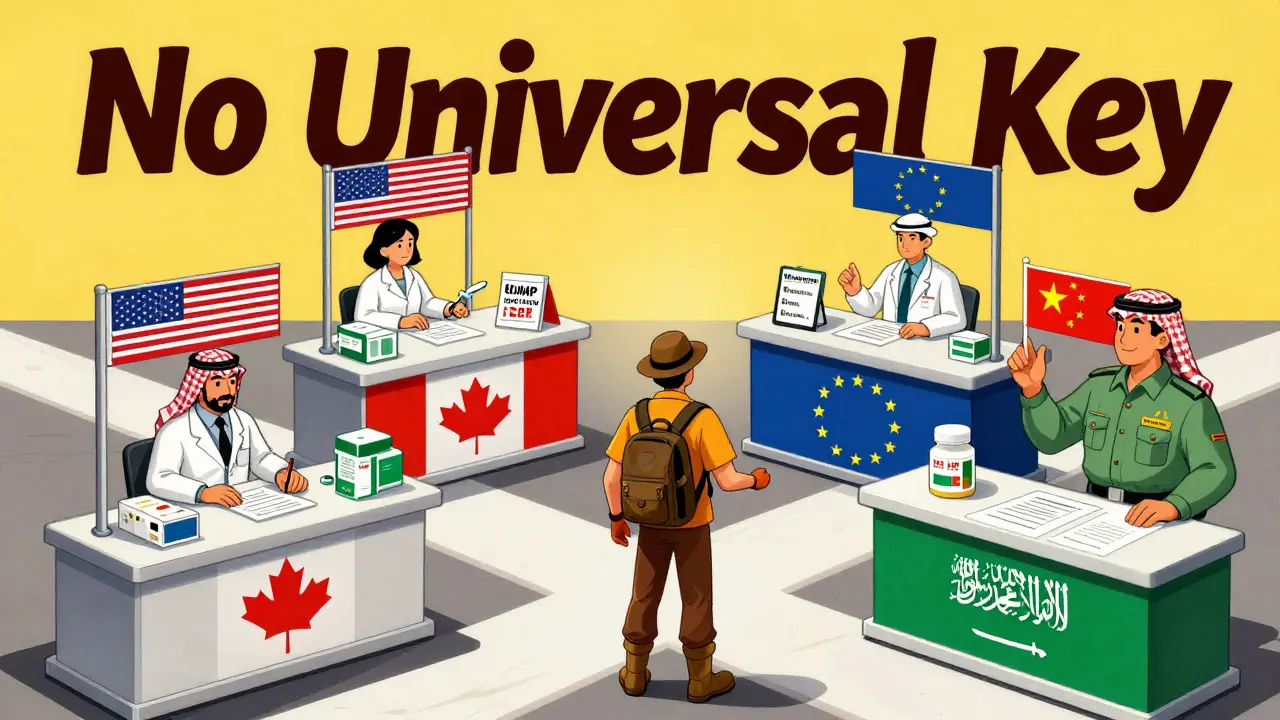
The biggest misunderstanding? That a prescription is a universal document. It’s not. A prescription written by a U.S. doctor is a legal order under U.S. law. In Canada, it’s just a piece of paper unless a Canadian doctor signs off on it. In the EU, it’s recognized-but only if it includes the generic drug name, not the brand name. In China or Saudi Arabia, you might need a notarized letter from your doctor explaining why you need the medication and confirming you’re not trying to import drugs illegally. The U.S. Food and Drug Administration (FDA) bans personal importation of prescription drugs under federal law (21 U.S. Code § 384). That sounds absolute. But in practice, the FDA doesn’t chase down every traveler carrying a 90-day supply for personal use. Enforcement is patchy. Border agents have discretion. Some let you through. Others confiscate your meds. It’s a gamble. Meanwhile, the DEA’s 2023 rule allowing electronic transfers of controlled substances (like opioids or ADHD meds) between U.S. pharmacies doesn’t apply internationally. That rule was a step forward-but only for domestic transfers. If you’re flying from New York to Berlin, that rule doesn’t help you.What Works: The EU’s Cross-Border System
If you’re traveling within the European Union, you’re in the best position. All 27 member states recognize prescriptions issued in any EU country. That means if you’re from France and need to refill your blood pressure medication in Italy, you can walk into a pharmacy with your original prescription and get it filled. But there are two big catches:- Use generic names. Your U.S. prescription might say "Lipitor". In Germany, it’s "Atorvastatin". If your prescription only lists the brand name, the pharmacist might not recognize it. Always ask your doctor to write the generic name on the prescription.
- Not all drugs are available. Just because a prescription is legal doesn’t mean the exact medication is in stock. Some drugs are sold under different brand names. Others aren’t approved at all. A medication you take daily in the UK might not exist in Poland. Always check availability ahead of time.
What Doesn’t Work: The U.S.-Canada Gap
This is where things get messy. Many Americans assume they can just transfer a prescription to a Canadian pharmacy. They can’t. Not directly. Canadian law requires every prescription to be issued by a Canadian-licensed doctor. U.S. prescriptions are not valid. Instead, you need what’s called a "cosigning" process: a Canadian pharmacist reviews your U.S. prescription, your medical history, and your current condition. Then a Canadian doctor writes you a new prescription based on that review. Most U.S. pharmacies refuse to send your prescription details to Canada. Walgreens, CVS, and Rite Aid have policies against it. You’ll often get a flat "no". That’s why services like PharmacyChecker exist-they help coordinate the cosigning process by connecting you with Canadian pharmacies that are willing to work with U.S. patients. One traveler in Toronto told a local paper: "I flew back to Canada twice because my U.S. pharmacy wouldn’t transfer my insulin prescription. I ended up paying $300 for a last-minute refill at a Canadian pharmacy that did the cosigning."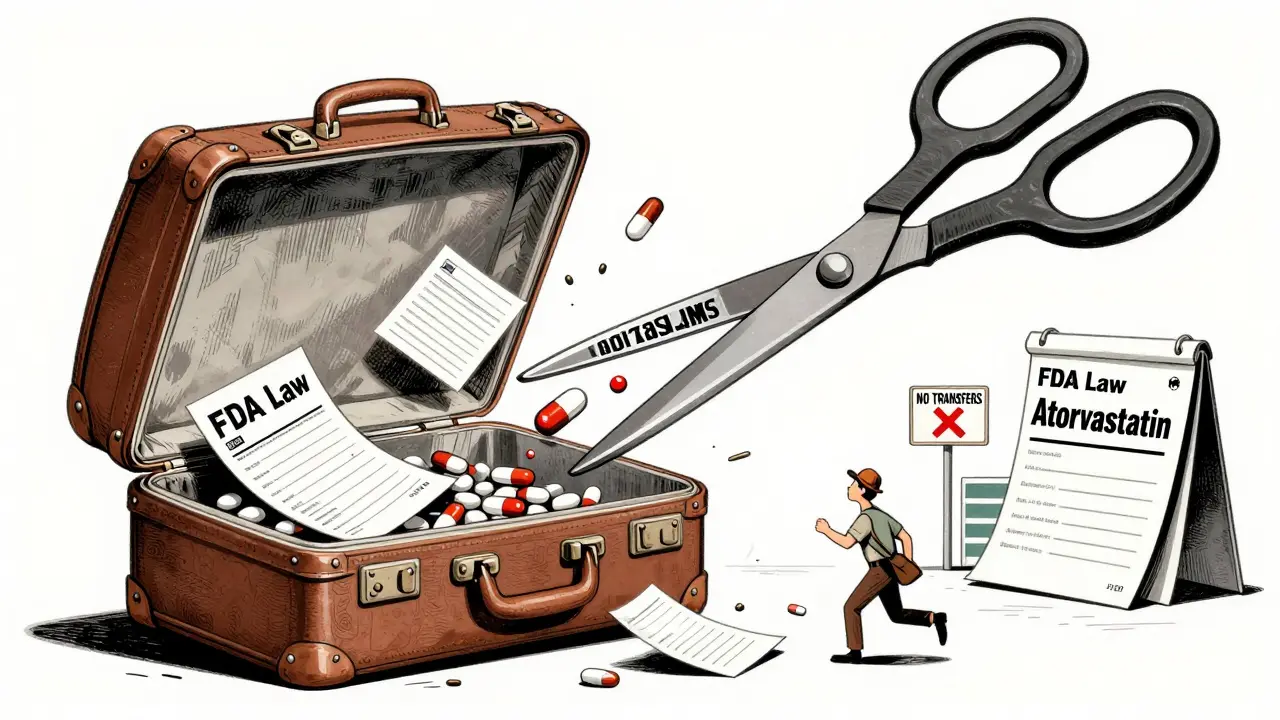
How to Prepare: 5 Steps Before You Travel
If you’re planning a trip abroad and need to refill or transfer a prescription, start early. Don’t wait until you’re out of pills. Here’s what to do:- Get your doctor to write a letter. It should include: your name, diagnosis, medication name (generic), dosage, quantity, and a statement that this is for personal use during travel. Sign and date it. Some countries require this letter to be notarized.
- Carry original prescriptions. Don’t rely on digital copies. Print physical copies of all your prescriptions. Include the prescribing doctor’s contact info.
- Check drug availability. Use tools like the WHO’s Essential Medicines List or country-specific drug databases. For example, the UK’s NHS website has a searchable database of medications. For China, check the National Medical Products Administration’s approved drug list.
- Know your limits. The FDA allows up to a 90-day supply for personal use. U.S. Customs and Border Protection says you should only carry medication prescribed to you. No bulk orders. No reselling. No third-party shipments.
- Call ahead. If you’re going to Canada, call a Canadian pharmacy and ask if they do cosigning. If you’re going to Dubai or Thailand, ask if they require a medical certificate. Don’t assume-ask.
What to Do If You Run Out Abroad
If you’re out of medication and can’t refill, don’t panic. Here’s what actually works:- Find a local doctor. Many countries have walk-in clinics for travelers. In Spain, France, or Japan, you can see a doctor for $50-$100. Bring your original prescription and doctor’s letter. They can write you a local prescription.
- Use a travel medical service. Companies like MedAire or International SOS offer prescription assistance for travelers. They’ll help you locate a doctor, translate your medical records, and even arrange delivery. These services cost $150-$300, but they save you from being stranded.
- Don’t buy online. Websites selling "international" prescriptions are often scams or illegal. You risk getting fake drugs, or worse-your credit card stolen. Stick to licensed pharmacies.
Real-World Examples: What Worked and What Didn’t
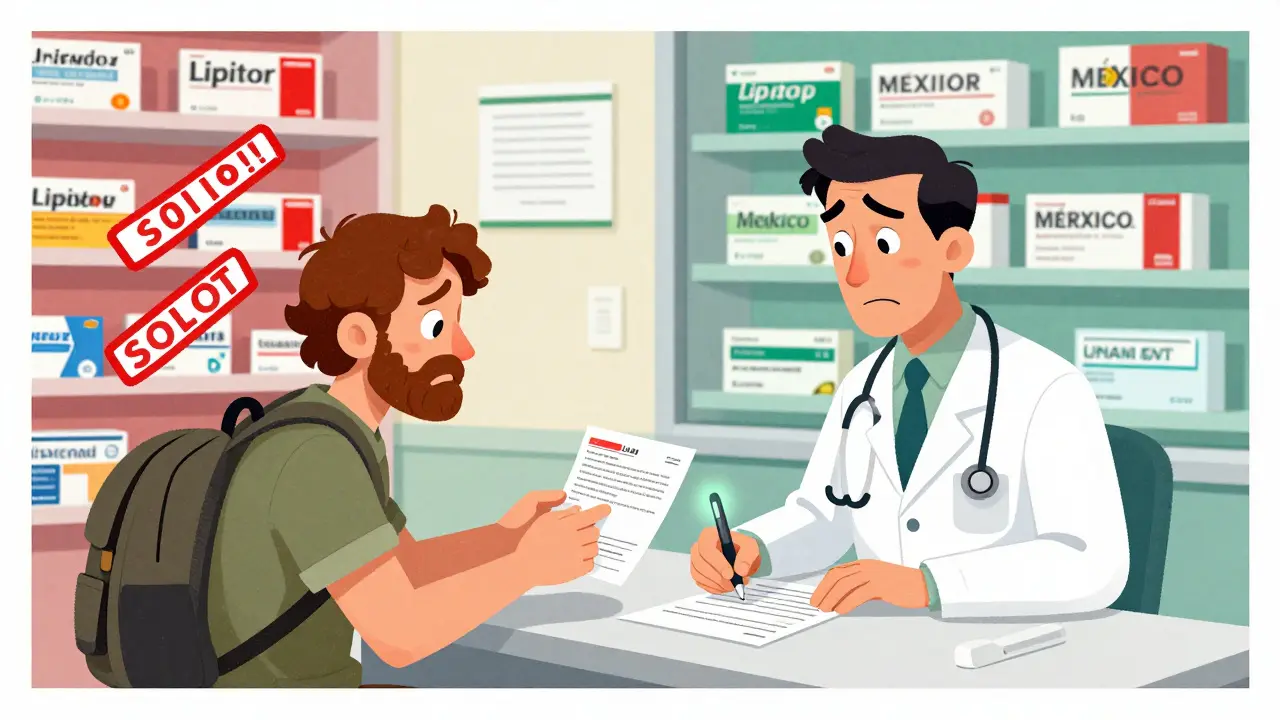
A 68-year-old retiree from Florida spent winters in Mexico. She took warfarin (a blood thinner). Her U.S. pharmacy wouldn’t transfer the prescription. She went to a local clinic in Cancún. The doctor reviewed her records, checked her INR levels, and wrote a new prescription. She filled it at a local pharmacy for $12 a month-less than half what she paid in the U.S. Another traveler, from Oregon, tried to refill her ADHD medication in Germany. She had the prescription and a doctor’s letter. The German pharmacist said, "This is not a valid prescription here." She had to fly back to the U.S. to get a new one. The difference? She didn’t know Germany requires prescriptions to be written in German or include the generic name. She had the brand name only. The doctor’s letter helped-but not enough.What’s Changing? And What’s Not
There’s no sign of a global prescription transfer system anytime soon. The World Health Organization calls international prescription transfer one of the "least developed" parts of global healthcare. The EU is improving within its bloc. The U.S. is tightening controls on controlled substances. Canada is holding firm on its cosigning rules. The only real progress? More awareness. More travelers are asking questions. More pharmacies are learning. But the system is still broken for anyone who doesn’t live in the EU or have deep pockets to pay for travel medical services.Final Rule: Don’t Rely on Luck
You can’t wing it. If you take medication for a chronic condition, you need a plan before you leave. Carry extra pills. Get your doctor’s letter. Know the rules of your destination. Call ahead. Don’t assume your U.S. pharmacy will help you. They usually won’t. The bottom line: Your prescription is not a global key. It’s a local document. Treat it that way.Can I transfer my U.S. prescription to a pharmacy in Canada?
No, not directly. Canadian law requires all prescriptions to be issued by a Canadian-licensed doctor. You’ll need to go through a "cosigning" process: a Canadian pharmacist reviews your U.S. prescription and medical history, then a Canadian doctor writes a new prescription. Some pharmacies and services like PharmacyChecker specialize in this process, but U.S. pharmacies often refuse to send your prescription details.
Is it legal to bring prescription drugs from another country into the U.S.?
Technically, no-U.S. federal law (21 U.S. Code § 384) bans personal importation of prescription drugs. But the FDA allows enforcement discretion: if you’re bringing back a 90-day supply for personal use, and the drug is not available in the U.S., you’re unlikely to be stopped. Always carry the original prescription and a doctor’s letter. Never ship drugs internationally-this increases risk.
What if I need a refill while traveling in the EU?
You can usually refill your prescription in any EU country. Bring your original prescription with the generic drug name (not brand name), and your doctor’s contact info. Some countries may ask for a translation. Always check if the exact medication is available-some drugs are sold under different names or aren’t approved at all.
Do I need a doctor’s letter to travel with medication?
Yes, especially for controlled substances or if you’re traveling to countries like China, Saudi Arabia, or Japan. The letter should include your name, diagnosis, medication details, dosage, and a statement that it’s for personal use. Some countries require it to be notarized. Always carry it with your original prescriptions.
Can I get my prescription filled in a non-EU country like Thailand or Dubai?
Possibly, but it’s not guaranteed. Many countries require a local doctor’s prescription. Bring your original prescription, doctor’s letter, and medical records. In Dubai, you may need a medical certificate from your home country. In Thailand, some pharmacies will fill a foreign prescription if it’s clear and matches their drug list. Always call ahead or ask your hotel for help.
Ashley Paashuis
February 18, 2026 AT 17:37As someone who travels internationally for work and manages a chronic condition, I can’t stress enough how crucial it is to carry a printed doctor’s letter with generic drug names. I once got held up at customs in Dubai because my prescription only listed the brand name. Took three hours and a local clinic visit to sort it out. Now I always include the WHO INN (International Nonproprietary Name) and a translated copy in the local language. It’s a small step that saves huge headaches.
Also, never assume your U.S. pharmacy will help. They’re legally restricted from transferring prescriptions abroad. Call the destination pharmacy directly - most have international liaisons now. It’s not perfect, but it’s the only reliable path forward.
Jeremy Williams
February 19, 2026 AT 10:10It’s fascinating how a document as simple as a prescription can become a geopolitical minefield. I once had to fly back to the U.S. from Canada just to refill my antidepressant because the Canadian pharmacist said, ‘We can’t validate this.’ No malice - just bureaucracy. The fact that we still live in a world where a pill’s legality depends on which side of the border you’re on speaks volumes about how fractured global healthcare really is.
Ellen Spiers
February 21, 2026 AT 02:22The author’s assertion that ‘the FDA doesn’t chase down every traveler’ is a dangerously imprecise oversimplification. Enforcement discretion is not a policy - it’s an ad hoc, inconsistently applied loophole. Under 21 U.S.C. § 384, personal importation is categorically prohibited. The FDA’s guidance documents (e.g., Import Action Manual 40-3) explicitly state that discretion is reserved for cases involving life-sustaining medications with no U.S. equivalent - not convenience refills. This post dangerously conflates tolerated non-enforcement with legal permissibility, which could lead to severe penalties, including seizure, fines, or criminal prosecution under 21 U.S.C. § 331(f).
Moreover, the EU’s mutual recognition framework is predicated on Directive 2012/52/EU, which mandates inclusion of the generic name, the prescriber’s credentials, and the patient’s full identification - not merely ‘a printed copy.’ The author’s casual tone undermines the legal rigor required here.
Maddi Barnes
February 22, 2026 AT 16:53Okay but like… why is this even a thing?? 😅 Like, I get that countries have laws, but we’re talking about people who need insulin, blood pressure meds, thyroid pills - not cocaine. Why does my life depend on whether my doctor wrote ‘Lipitor’ or ‘Atorvastatin’? It’s insane.
I had to get a new prescription in Thailand because my U.S. one didn’t list the generic. The pharmacist looked at me like I’d asked for a unicorn. I cried in the waiting room. Then a nurse helped me. She spoke zero English. I spoke zero Thai. We used Google Translate and hand-drew a pill diagram. We both laughed. We both cried. And I got my meds.
So yeah - this system is broken. But humans? We’re still kinda magic. 🤍
Jayanta Boruah
February 23, 2026 AT 03:36The EU system is not as seamless as portrayed. In Poland, atorvastatin is available only as a branded product under different nomenclature. In Greece, prescriptions require a 6-digit EU prescription code not present on non-EU documents. Furthermore, the notion that a doctor’s letter suffices in Saudi Arabia is false - they require a notarized Arabic translation, authenticated by the Saudi Embassy in the home country, which can take 6–8 weeks. The author’s advice is dangerously incomplete. This is not a checklist - it’s a labyrinth.
Taylor Mead
February 25, 2026 AT 03:17I’ve been traveling with a chronic illness for 12 years. I’ve had meds confiscated, been turned away, and once slept in a Berlin airport because I couldn’t find a pharmacy open on a Sunday. But here’s the thing - you’re not alone. Every time I’ve asked for help, someone has stepped up. A pharmacist in Lisbon stayed late to call my U.S. doctor. A nurse in Tokyo drew me a map to the nearest clinic. A stranger in Mexico bought me my refill because I looked desperate.
This system sucks. But people? People still show up. Don’t panic. Ask. Be polite. Bring paper. And if all else fails - find the quiet person in the pharmacy who’s just trying to do their job. They’ll help you. I promise.
Amrit N
February 26, 2026 AT 12:27bro i just carry extra pills lmao
like i got 6 months worth in my suitcase
no paperwork no stress
if i lose em i just buy more overseas
its not that hard
stop overthinking it
Courtney Hain
February 27, 2026 AT 09:38Let’s be real - this whole system is a front. The FDA ‘allows discretion’? That’s code for ‘we’re too lazy to enforce it.’ Meanwhile, they’re cracking down on online pharmacies selling $5 insulin while letting travelers slip through with 90-day supplies. This isn’t about safety - it’s about control. Big Pharma lobbies to keep prices high domestically, so they make it harder to get cheaper meds abroad. The real ‘conspiracy’? The fact that your life depends on which country you’re in - and whether Big Pharma’s lobbyists have influence there.
And don’t get me started on how Canadian pharmacies are forced into the cosigning system. That’s just another way to keep U.S. patients paying full price. Wake up.
Next thing you know, they’ll start charging you for the right to breathe.
Arshdeep Singh
February 28, 2026 AT 05:19You think this is chaos? Wait until you try getting a prescription in Nigeria. Or worse - Pakistan. The real issue isn’t borders. It’s the collapse of trust in medical authority. Why should a German pharmacist trust a U.S. prescription? They don’t know your doctor. They don’t know your history. The system isn’t broken - it’s deliberately designed to exclude. You’re not a patient. You’re a liability. And until we stop treating healthcare like a privilege to be gatekept, nothing changes.
madison winter
March 1, 2026 AT 02:35I read this whole thing. And I’m just… wondering who benefits from this mess? Not patients. Not pharmacists. Definitely not travelers. The only people who win are the ones who sell ‘travel medical services’ for $300. The ones who charge you to coordinate what should be a simple transfer. The ones who profit from your panic.
And yet - we keep playing along. We call ahead. We print letters. We pay for cosigning. We don’t protest. We don’t demand change. We just… adapt.
Is this the new normal? A world where your health is contingent on your passport? I’m not sure I’m okay with that.
Marie Crick
March 2, 2026 AT 02:49If you’re taking medication abroad and you didn’t plan for this, you’re irresponsible. Period. This isn’t a vacation - it’s a medical dependency. If you can’t manage your own health across borders, you shouldn’t be traveling. Stop expecting the world to accommodate your laziness.