
 Mar, 17 2026
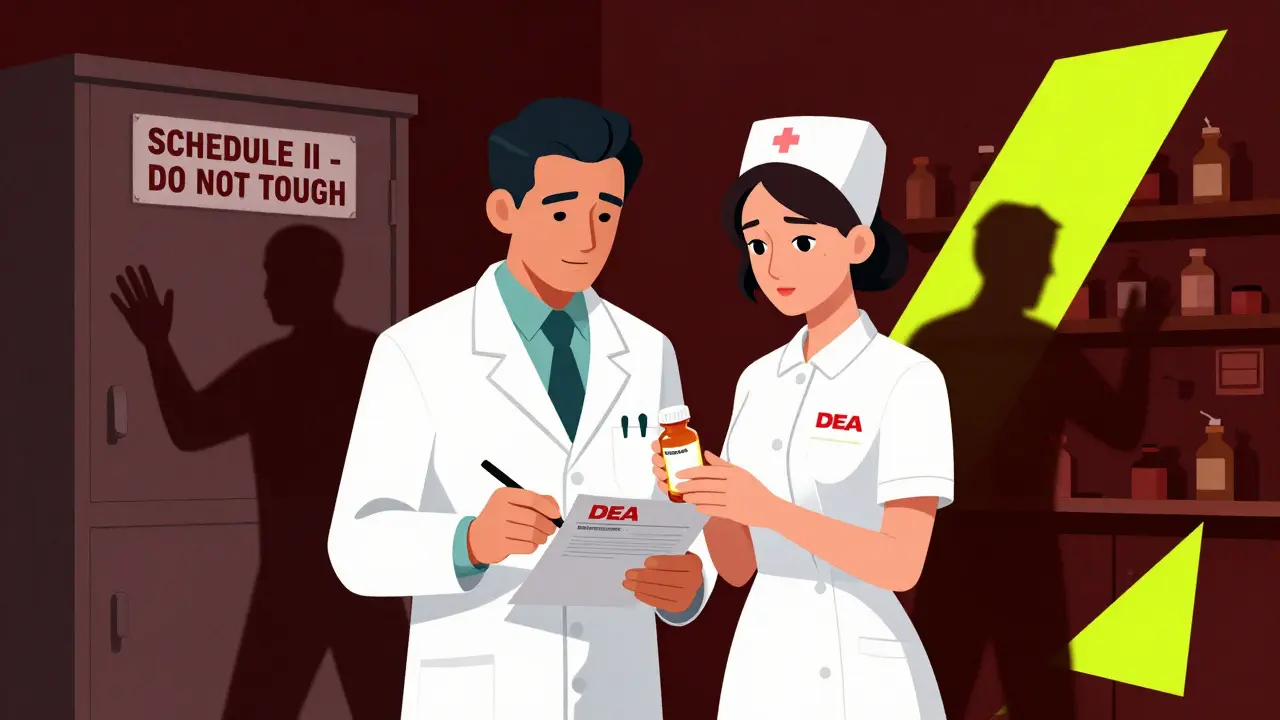
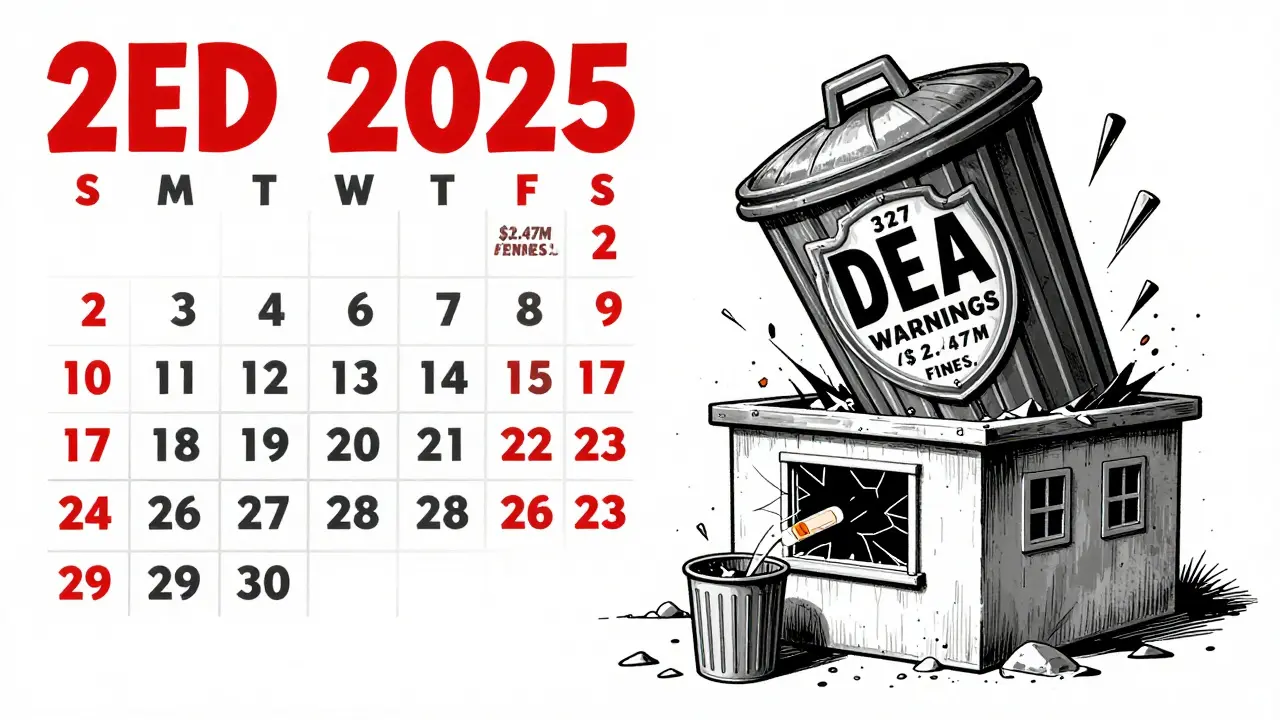
Handling expired controlled substances isn’t just about cleaning out a pharmacy shelf. It’s a legal, safety, and ethical obligation. If you’re working in a hospital, clinic, veterinary practice, or research lab, you’re responsible for making sure these drugs don’t end up in the wrong hands - or worse, in the water supply. The stakes are high: improper disposal can lead to diversion, overdose, environmental contamination, and serious fines. The DEA doesn’t take this lightly. In 2022 alone, they issued 327 warning letters and collected $2.47 million in fines for violations. This isn’t a suggestion. It’s the law.
What Counts as a Controlled Substance?
Controlled substances are drugs regulated under the Controlled Substances Act (CSA) of 1970. They’re grouped into five schedules based on their potential for abuse and medical use. Schedule I includes drugs like heroin and LSD - no accepted medical use. Schedule II covers powerful opioids like oxycodone, fentanyl, and morphine. These have high abuse potential but are used medically. Schedule III includes drugs like hydrocodone with acetaminophen and ketamine. Schedule IV includes benzodiazepines like Xanax and Valium. Schedule V includes cough syrups with low-dose codeine. Each schedule has different disposal rules.
Expired doesn’t mean useless. A bottle of expired oxycodone can still be potent enough to kill someone. That’s why you can’t just toss it in the trash, flush it, or mix it with coffee grounds like you might with an old ibuprofen. The DEA explicitly bans these methods for controlled substances. Even if the pill looks harmless, it’s still a regulated drug with a chain of custody that must be tracked.
Two Main Types of Disposal: Inventory vs. Wastage
Not all expired drugs are handled the same way. The DEA separates disposal into two categories: inventory disposal and wastage.
Inventory disposal is for larger quantities - entire bottles, boxes, or stockpiles of drugs that are no longer needed. This could be from a closed practice, a research project ending, or a pharmacy clearing out expired stock. For Schedule I and II substances, this requires a reverse distributor. You can’t destroy these yourself. You must transfer them to a DEA-registered reverse distributor who will incinerate them under strict supervision. You’ll need to complete a DEA Form 222 (now mostly electronic) and keep records for at least two years.
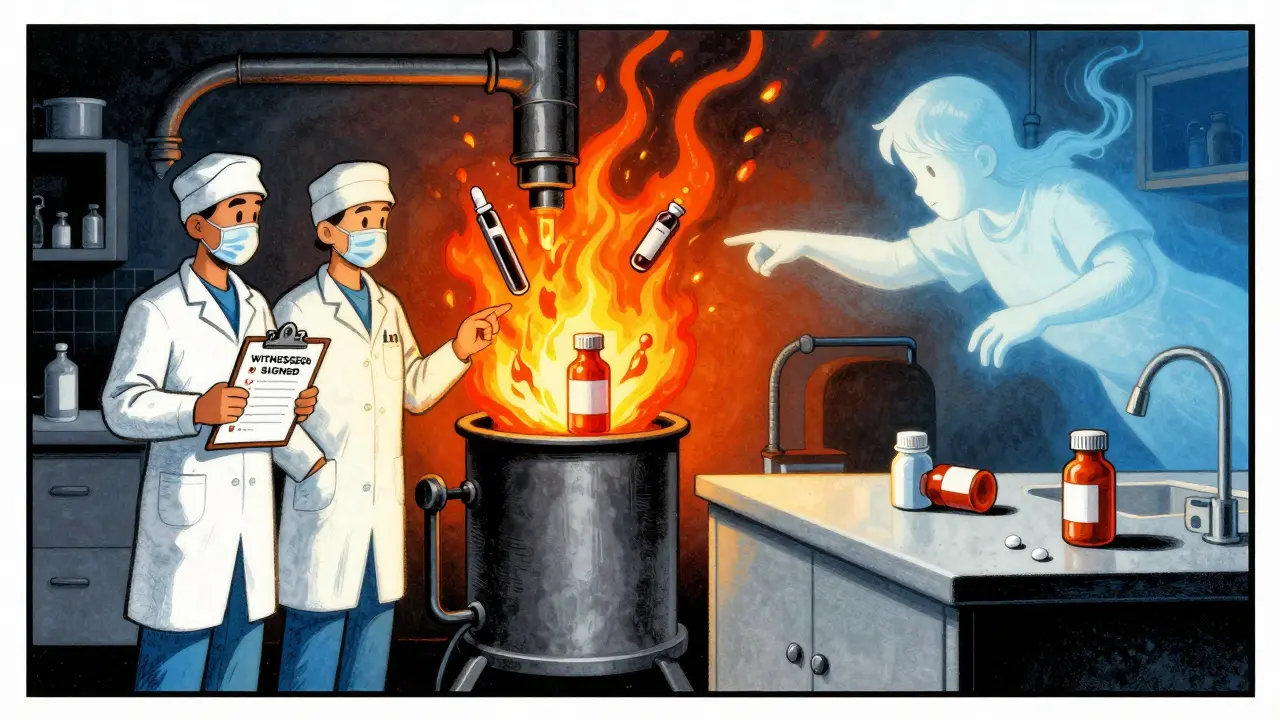
Wastage is for small amounts - a few tablets or milliliters that were drawn up but not used, or a single expired vial. This can sometimes be destroyed on-site. But even then, it’s not a solo job. Two authorized personnel must witness the destruction. One must be the registrant or an authorized agent. They must sign a log, note the date, drug name, quantity, and method. For example, a nurse might draw up 2 mL of morphine, use 1.5 mL, and waste the rest. That 0.5 mL must be destroyed with a second person watching - no exceptions.
How to Dispose of Schedule II Substances (Like Oxycodone or Fentanyl)
Schedule II drugs are the most tightly controlled. You cannot dispose of them by pouring them down the sink, burying them, or dumping them in sharps containers. The only legal method is transfer to a reverse distributor for incineration. Incineration is the only DEA-approved method that ensures the drug is rendered non-retrievable. No chemical breakdown, no neutralization - only high-temperature burning.
If you’re a hospital or large clinic, you likely have a contract with a company like Stericycle or Drug and Laboratory Disposal, Inc. (DLD). You submit a disposal request through their system, package the drugs in approved containers, and they pick them up. Fees range from $250 to $500 per pickup. Smaller practices, like dental offices or veterinary clinics, often struggle with this. A 2022 DEA audit found that 18.7% of dental practices made errors in their disposal logs - mostly because they didn’t know the rules or couldn’t afford the service.
Since January 2023, DEA Form 222 has been mandatory in electronic form through the Electronic Registration System (ERS). This cut processing time from over a week to under two days. If you’re still using paper forms, you’re behind. And if you’re trying to avoid the cost by mixing drugs with kitty litter? You’re breaking the law. The FDA and DEA both confirm: these methods are unsafe and illegal for controlled substances.
What About Schedule III-V Substances?
Schedule III through V drugs have slightly more flexibility. You can still use reverse distributors - and many do - but you also have another option: on-site destruction. This requires two witnesses, documentation, and proper labeling. For example, a vet clinic might have a bottle of tramadol (Schedule III) that expired. They can open it, pour the liquid into a secure container, add a deactivating agent (like bleach or activated charcoal - approved by the DEA), and mix it thoroughly. Then, they document the process, sign off, and keep the record.
But here’s the catch: even with this flexibility, you still can’t flush it. You still can’t dump it in the trash. You still need a witness. And you still need to keep records for two years. Many facilities skip this step because it’s inconvenient. But that’s how diversion starts. A single unaccounted pill can end up in a teenager’s medicine cabinet.
Documentation Is Non-Negotiable
You can’t wing this. Every disposal, whether it’s one tablet or 100 vials, must be recorded. The record must include:
- Date of disposal
- Name and strength of the drug
- Quantity disposed
- Name and signature of both witnesses
- Method of disposal
- For reverse distributors: the tracking number and receipt
These logs aren’t just paperwork. They’re your legal shield. If the DEA shows up for an inspection and you can’t prove you disposed of a Schedule II drug properly, you’re looking at a fine, a suspension of your DEA registration, or worse. The DEA’s 2022 audit found that 32% of violations were due to missing or incomplete records. Not because they didn’t dispose of the drugs - but because they didn’t write it down.
Some institutions use digital systems like UCSF’s Research Inventory Online (RIO). These systems auto-generate logs, track inventory in real time, and send reminders before expiration. They cut errors by over 60%. Smaller practices still rely on paper logs - and those are far more likely to get lost, damaged, or forgotten.
Training and Accountability
DEA regulations require that everyone who handles controlled substances - pharmacists, nurses, vets, lab techs - complete initial training of at least two hours, followed by annual one-hour refreshers. But a 2022 audit found only 67.3% of facilities complied. That’s a huge gap. You can’t assume someone knows the rules. If a new nurse doesn’t know that flushing a fentanyl patch is illegal, you’re putting your facility at risk.
Training should be hands-on. Show people how to use the disposal log. Demonstrate the two-witness rule. Walk them through the reverse distributor process. Don’t just hand them a PDF. Make sure they can explain it back to you.
Accountability matters too. At UCSF and the University of Michigan, every person who orders a controlled substance is personally responsible for its disposal. That means if you ordered 50 tablets of oxycodone, you’re the one who has to make sure they’re disposed of - not the pharmacist, not the admin assistant. That level of ownership reduces errors.
What Happens If You Don’t Dispose of Them Properly?
The consequences are real. In 2023, a rural veterinary clinic in Ohio was fined $85,000 after a child found an expired fentanyl patch in the trash. The DEA traced it back to improper disposal. A hospital in Pennsylvania lost its DEA registration for two years after failing to document the destruction of 12 bottles of hydromorphone. These aren’t rare cases. The DEA conducted 1,847 inspections in 2022. Over 17% of them found serious violations.
Diversion doesn’t just happen in big cities. A 2022 study by the American Veterinary Medical Association found that 14.3% of veterinary drug diversion cases started with expired drugs that weren’t properly destroyed. Pets don’t need morphine. But people do. And if a pet owner takes home an expired bottle because it was left unsecured, that’s your fault.
What You Can Do Today
If you’re unsure how to dispose of expired controlled substances, here’s what to do:
- Check your DEA registration status. If it’s expired, you can’t legally possess or dispose of these drugs.
- Review your inventory. Label expired or damaged drugs clearly: “DO NOT USE - TO BE DISPOSED.”
- Separate them from active stock. Store them in a locked cabinet, separate from other medications.
- Identify your disposal method. Are you using a reverse distributor? Or are you doing on-site destruction? Know which schedule your drugs belong to.
- Train your team. Even one person who doesn’t know the rules can cause a violation.
- Start your log. Record every disposal, no matter how small. Keep it for two years.
There’s no shortcut. No easy way out. The system is strict because the risks are real. But if you follow the rules, you’re not just staying compliant - you’re saving lives.
Can I throw expired controlled substances in the trash?
No. Throwing expired controlled substances in the trash is illegal under DEA regulations. Even if the drug looks harmless, it can still be retrieved and misused. The DEA requires that Schedule I and II drugs be incinerated by a registered reverse distributor. For Schedule III-V drugs, on-site destruction with two witnesses is allowed - but never simple disposal in the trash.
Can I flush expired narcotics down the toilet?
Absolutely not. The FDA and DEA both state that flushing is never acceptable for controlled substances. This method can contaminate water supplies and is a direct violation of federal law. Even drugs labeled as "flushable" on their packaging do not apply to Schedule II-V narcotics. This rule applies to all settings - hospitals, clinics, homes, and veterinary offices.
What is a reverse distributor?
A reverse distributor is a DEA-registered company that collects and destroys expired or unwanted controlled substances. They handle the entire process - pickup, documentation, and incineration - ensuring compliance with federal law. Common providers include Stericycle, Daniels Health, and Drug and Laboratory Disposal, Inc. (DLD). Most healthcare facilities contract with them for inventory disposal, especially for Schedule I and II drugs.
Do I need two people to dispose of a single expired pill?
Yes. For any on-site destruction of controlled substances - even one tablet - two authorized personnel must be present. One must be the registrant or their designated agent. Both must witness the destruction, sign the disposal log, and record the details. This rule prevents theft, error, or falsified records. It applies regardless of quantity.
How long do I need to keep disposal records?
You must keep disposal records for at least two years. This includes logs, DEA Form 222 copies, reverse distributor receipts, and witness signatures. The DEA can inspect these records at any time. Failure to maintain accurate records is one of the most common reasons for fines and enforcement actions.
Are there free disposal options for small practices?
The DEA’s National Take Back Day, held twice a year, offers free disposal at designated collection sites. However, this is for the public - not for registered entities like clinics or pharmacies. Registered facilities must use reverse distributors or approved on-site methods. There are no free, legal alternatives for healthcare providers. Some states offer grant programs to help small practices cover disposal costs - check with your state pharmacy board.
Melissa Stansbury
March 18, 2026 AT 14:35I worked at a vet clinic for five years, and let me tell you-no one ever told us how to dispose of expired morphine. We just dumped it in the sharps bin. Then one day, an intern flushed a fentanyl patch because she thought it was "like the ones at home." We got audited. Lost our registration for three months. Now we have a locked box, two signatures, and a damn spreadsheet. It’s ridiculous how easy it is to mess this up when no one trains you properly.
And don’t even get me started on the cost. $400 for a pickup? We’re a small practice. We can’t afford that every quarter. I’ve seen clinics just stop ordering Schedule II drugs because the disposal fees eat their profit. That’s not safety-that’s denial.
DEA doesn’t care if you’re broke. They just want paperwork. But if you don’t have the resources, you’re stuck between a rock and a hard place. Either break the law or go out of business.
And yeah, I know I’m supposed to use reverse distributors. But when your only option is to pay $2000 a year just to get rid of expired meds… that’s not compliance. That’s exploitation.
I’m not saying we should ignore the rules. I’m saying the system is broken. Fix the cost, fix the access, fix the training. Then maybe people will actually follow it.
Until then? We’re all just pretending.
And someone’s kid is still going to find a pill in the trash.
cara s
March 20, 2026 AT 09:18It is, indeed, a profoundly concerning reality that the regulatory framework surrounding the disposal of controlled substances has become so rigidly inflexible, and yet so inconsistently enforced across disparate healthcare environments, that compliance is less a matter of ethical diligence and more a function of institutional wealth and administrative capacity. I find it particularly troubling that the DEA, despite its ostensibly noble mission of public safety, has effectively created a two-tiered system wherein affluent hospitals can afford Stericycle contracts and digital logging systems, while rural clinics, dental offices, and veterinary practices-often operating on shoestring budgets-are left to either violate federal law or cease providing essential care altogether. The fact that a single unlogged milliliter of hydromorphone can trigger a two-year suspension of a DEA registration, while the same violation in a major urban hospital goes unnoticed for years, speaks to a systemic bias that is both morally indefensible and operationally absurd. Furthermore, the insistence on two witnesses for the destruction of even a single tablet, while theoretically sound, imposes an unreasonable logistical burden on understaffed facilities where one nurse may be managing triage, med administration, and charting simultaneously. The answer is not more bureaucracy-it is smarter regulation, targeted subsidies, and a reevaluation of the underlying assumptions that equate paper trails with safety. Perhaps if the DEA invested in secure, community-based collection kiosks-modeled after the Take Back Day infrastructure but permanently installed-they might actually reduce diversion, rather than merely increase fear and noncompliance.
David Robinson
March 20, 2026 AT 17:56This whole post is just fearmongering dressed up as regulation. You act like people are just walking around flushing fentanyl patches like they’re toilet paper. The real problem? Overregulation. You’re making it so expensive and complicated that clinics just stop using these drugs at all. Which means patients suffer. Why not just let us destroy them ourselves with bleach? It’s not rocket science. The DEA doesn’t need to micromanage every pill.
And don’t get me started on the "two witnesses" rule. Who the hell has time for that? You’re not protecting the public-you’re just creating paperwork for bureaucrats who’ve never held a syringe in their life.
Also, $500 per pickup? Are you kidding? I’ve seen clinics throw expired meds in the trash and lie on the logs. It’s not because they’re evil. It’s because the system is rigged. Fix the system. Don’t just scare people with audit stats.
Shameer Ahammad
March 22, 2026 AT 07:09It is absolutely appalling that any individual, let alone a healthcare professional, would even consider the notion of disposing of Schedule II narcotics via municipal waste or aquatic systems. Such behavior is not merely negligent-it is criminally irresponsible, and reflects a profound ignorance of federal statutes and the ethical obligations incumbent upon those entrusted with pharmaceutical stewardship. The Controlled Substances Act exists not as a suggestion, but as a solemn covenant between society and those who handle its most dangerous pharmacological agents. The fact that 18.7% of dental practices commit disposal errors is not a testament to complexity-it is a failure of education, oversight, and moral character. I find it particularly distressing that some commenters here advocate for cost-cutting measures or lax enforcement. There is no such thing as a "minor" violation when the stakes involve opioid diversion, pediatric overdose, and ecological contamination. One must ask: if you cannot adhere to the most basic legal and ethical standards of drug handling, then why are you licensed to handle them at all? The answer, I fear, is that too many practitioners view regulation as an inconvenience rather than a sacred duty. This is not a bureaucratic nuisance. It is a public health imperative. And if your facility cannot afford compliance, then perhaps you are not fit to operate in this domain. There are no exceptions. There are no gray areas. Only right and wrong.
jared baker
March 23, 2026 AT 02:54Simple version: if it’s a controlled substance, don’t toss it. Don’t flush it. Don’t mix it with kitty litter. Call your reverse distributor. Get two people to watch you destroy it if you’re doing it onsite. Write it down. Keep the paper. That’s it.
Don’t overthink it. The DEA isn’t trying to ruin your business. They’re trying to stop kids from finding pills in their grandma’s medicine cabinet. Just do the thing.
And if you can’t afford the service? Talk to your state pharmacy board. Some states help small clinics. You’re not alone.
Paul Ratliff
March 24, 2026 AT 00:23man i just read this and thought ‘why does this feel like a government PSA?’
like yeah, don’t flush fentanyl. got it. but the way this is written? like i’m supposed to be scared of the DEA showing up at my door with a clipboard.
truth is, most people who work with these drugs just want to do the right thing. the problem is no one ever taught them how. not in school, not in training, not even in the damn manual.
so yeah, the rules are clear. but the system? it’s a mess.
also, reverse distributors charge more than my monthly rent. how is that fair? just sayin’.
Amadi Kenneth
March 25, 2026 AT 21:27Let me tell you something… they’re not telling you the whole truth here…
Did you know that the DEA doesn’t actually destroy these drugs? No… no they don’t…
They sell them… to private contractors… who then repackage them… and send them back into the black market… under new labels…
I’ve seen the documents… I’ve seen the shipping logs… they’re not incinerated… they’re redistributed…
And who benefits? Big Pharma… and the DEA… who get paid for the disposal… then profit from the resale…
That’s why they’re so strict about the logs… because if you know the truth… you’d stop signing them…
They’re not protecting you… they’re protecting the system…
And if you think this is coincidence… why are there no independent audits? Why is there no public tracking? Why is Stericycle the only option?
It’s not about safety… it’s about control.
Wake up.
They’re not disposing of the drugs… they’re recycling them…
And you’re helping them do it… by signing your name…
SNEHA GUPTA
March 27, 2026 AT 10:07There is a deeper philosophical question here, one that transcends the legal technicalities of DEA Form 222 and reverse distributors. The very notion that a substance-once imbued with therapeutic intent-must be rendered non-retrievable through incineration, speaks to a societal fear of the body, of pain, of dependency. We do not treat expired insulin this way. We do not incinerate expired antihypertensives. Why? Because we do not fear the body’s need for healing as we fear its need for escape. The controlled substance is not merely a chemical compound; it is a symbol of human vulnerability. To destroy it with fire is to perform a ritual of purification, a symbolic rejection of the very humanity we claim to serve. And yet, in our zeal to control the substance, we neglect the systems that produce its misuse: poverty, trauma, lack of access, abandonment. The real violation is not the unlogged tablet-it is the unmet need. Perhaps the question is not how to dispose of the drug… but how to dispose of the conditions that make its abuse inevitable.
Gaurav Kumar
March 27, 2026 AT 11:05India has been handling controlled substances for decades-without this absurd American bureaucracy. We have a centralized pharmacy authority, trained pharmacists, and a culture of accountability. No two witnesses. No $500 pickups. No digital logs. Just competence.
Why can’t the U.S. learn from a developing nation? Because you’re obsessed with paperwork, not results.
And let’s be honest: if you can’t handle a bottle of expired oxycodone without a third-party contractor, maybe you shouldn’t be in healthcare at all.
Stop pretending your system is superior. It’s not. It’s just expensive.
And yes, I’ve worked in both countries. I know.
Also, emoticons are for children. This is serious business. 😎
Jeremy Van Veelen
March 28, 2026 AT 22:24There is a quiet horror in the way we treat these drugs-not as medicine, but as weapons. Each expired pill, each unlogged vial, each flushed patch is not just a regulatory infraction. It is a betrayal. A betrayal of the patient who once needed relief. A betrayal of the nurse who worked double shifts. A betrayal of the child who shouldn’t have to find a patch in their parent’s sock drawer. This isn’t about fines. It’s about legacy. What will you leave behind? A clean log? Or a life lost because you chose convenience over conscience?
I’ve held a fentanyl patch in my hand. I’ve watched a man die because someone didn’t destroy one. I’ve signed logs. I’ve witnessed destruction. I’ve cried in the supply closet.
Don’t tell me about cost. Don’t tell me about bureaucracy.
Ask yourself: when the DEA comes knocking… will you be able to look your conscience in the eye?
Because the drugs don’t care about your budget.
But the dead… they remember.