
 Feb, 24 2026
When patients leave the doctor’s office feeling unheard, confused, or anxious, it’s rarely because the diagnosis was wrong. More often, it’s because the communication broke down. Studies show that up to 80% of serious medical errors are tied to poor communication between providers, staff, and patients. That’s not a bug-it’s a systemic flaw. And institutions across the U.S. are finally building structured education programs to fix it.
Why Communication Training Isn’t Optional Anymore
For years, hospitals treated communication like a soft skill-something nice to have, but not essential. That changed when data started piling up. The Agency for Healthcare Research and Quality found that 15-20% of adverse patient outcomes stem directly from communication failures. Johns Hopkins Medicine discovered physicians who completed communication training had 30% fewer malpractice claims. Meanwhile, Press Ganey’s data showed patient satisfaction scores rose by nearly 80% when communication quality improved. These aren’t abstract numbers. They’re tied to money, safety, and trust. Medicare now ties 30% of hospital reimbursements to HCAHPS scores, which heavily weigh how well staff explain care, answer questions, and listen. If your hospital’s communication scores drop, your funding drops too.What These Programs Actually Teach
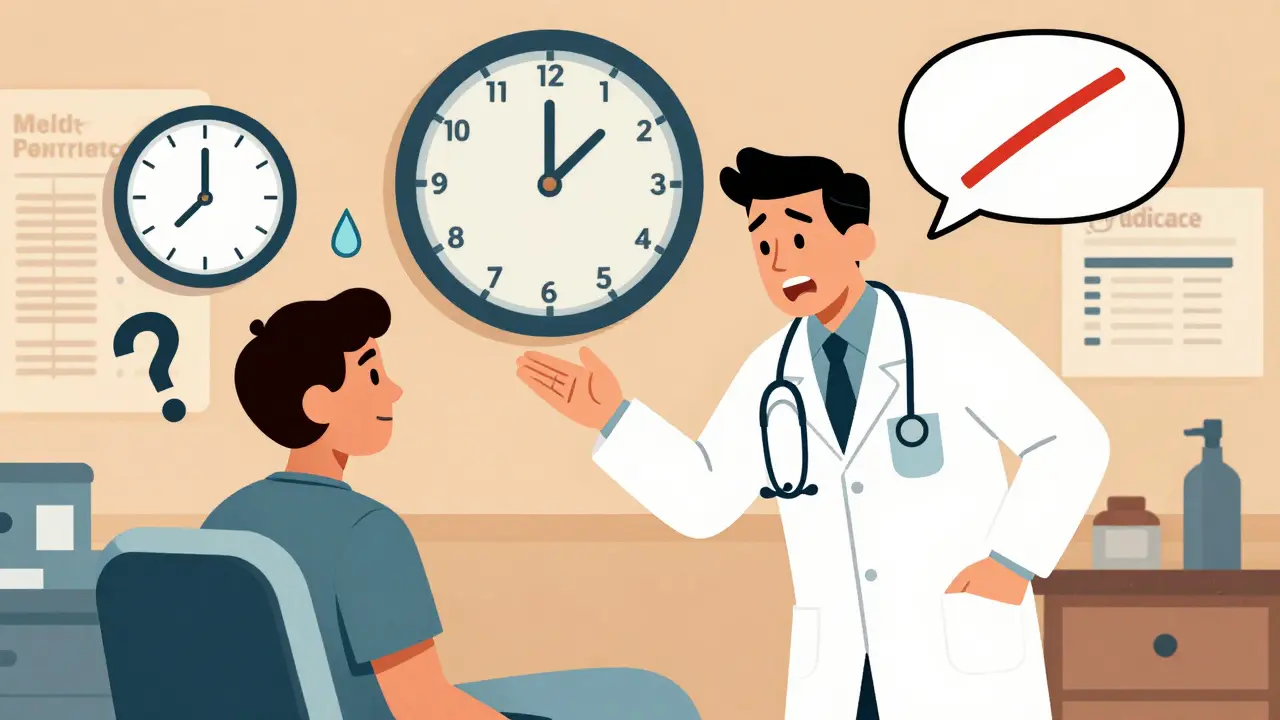
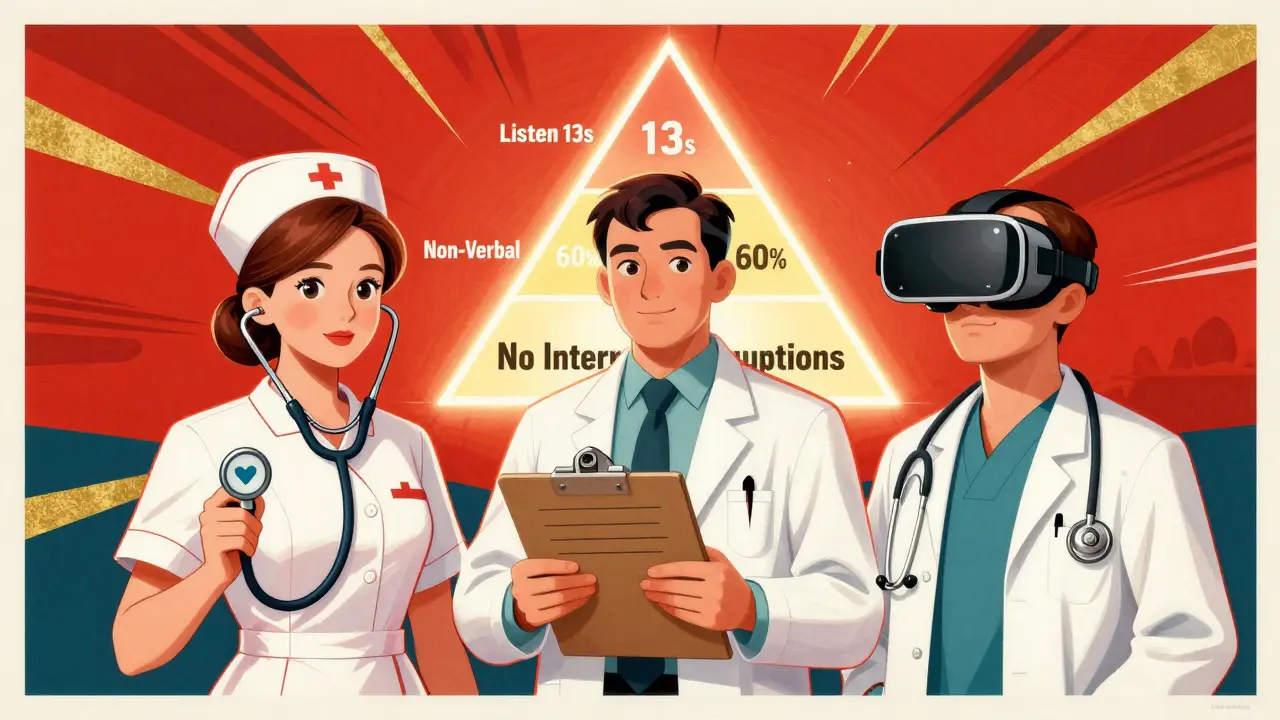
Generic workshops on "being nice" don’t cut it. Modern institutional programs are precise, evidence-based, and built around measurable behaviors. Here’s what’s actually in the curriculum:- Eliciting the patient’s story-not just asking "What’s wrong?" but letting them tell it without interruption. Research shows patients need 13-15 seconds to get to the real issue. Most doctors interrupt before 7.
- Responding with empathy-using phrases like "That sounds incredibly frustrating" instead of "I understand."
- Boundary setting-how to say "no" to unreasonable demands without burning out. Nurses who took Mayo Clinic’s course reported a 40% drop in burnout.
- Non-verbal communication-eye contact, posture, and tone account for over 60% of how messages are received.
- Managing challenging scenarios-confronting misinformation, handling angry families, or delivering bad news.
How Different Programs Compare
Not all training is created equal. Here’s how some leading programs stack up:| Program | Target Audience | Key Focus | Duration | Credits/Cost |
|---|---|---|---|---|
| Program for Excellence in Patient-Centered Communication (PEP) | Physicians, nurses | Patient-centered dialogue, empathy | Full-day workshop | 6.5 AMA credits |
| Mayo Clinic’s Effective Communication | Nurses, PAs, clinicians | Boundary setting, non-verbal cues, difficult conversations | Self-paced online | 3.50 ASWB/IPCE credits; free |
| Northwestern University Simulation Program | Medical students, residents | Mastery learning via simulations | 4-6 sessions during clinical rotations | No credit; required curriculum |
| SHEA Communication Course | Infection preventionists | Policy advocacy, media, social media | 4 modules (60-90 min each) | $75-$125 |
| UT Austin HCTS | Public health workers | Pandemic response, health equity | Free, self-paced | None |
PEP stands out for its impact on patient satisfaction-23% higher gains than generic training. But it doesn’t cover interprofessional communication, which causes 65% of breakdowns in team settings. Northwestern’s mastery learning model, where learners must hit 85% proficiency on simulations, has 37% higher skill retention after six months. But it needs expensive simulation labs. SHEA’s course is unique for teaching infection control staff how to handle public misinformation-a critical gap during the pandemic.
What’s Missing in Most Programs
Even the best programs have blind spots. A 2023 AAMC review found that 60% of communication curricula ignore health disparities. Only 12% of programs track whether skills are used beyond six months. And here’s the biggest gap: time. Doctors average 13.3 seconds before interrupting patients-even after training. A 2023 AAMC survey found 58% of clinicians said they knew the right techniques but didn’t have time to use them in 15-minute appointments. Training alone won’t fix a system that overbooks, underfunds, and under-staffs.How Successful Programs Get Bought In
The most effective programs don’t just train-they integrate. They follow a proven four-step model:- Assess the gap-Use patient surveys to find where communication fails most (e.g., discharge instructions, pain management).
- Pick 3-5 behaviors-Focus on high-impact, teachable skills. Don’t try to fix everything.
- Use real scenarios-Train with actual patient cases, not hypotheticals. Northwestern uses standardized patients who simulate anxiety, confusion, or anger.
- Embed it in workflow-Add prompts in the EHR. For example: "Did you confirm the patient can explain their discharge plan?"
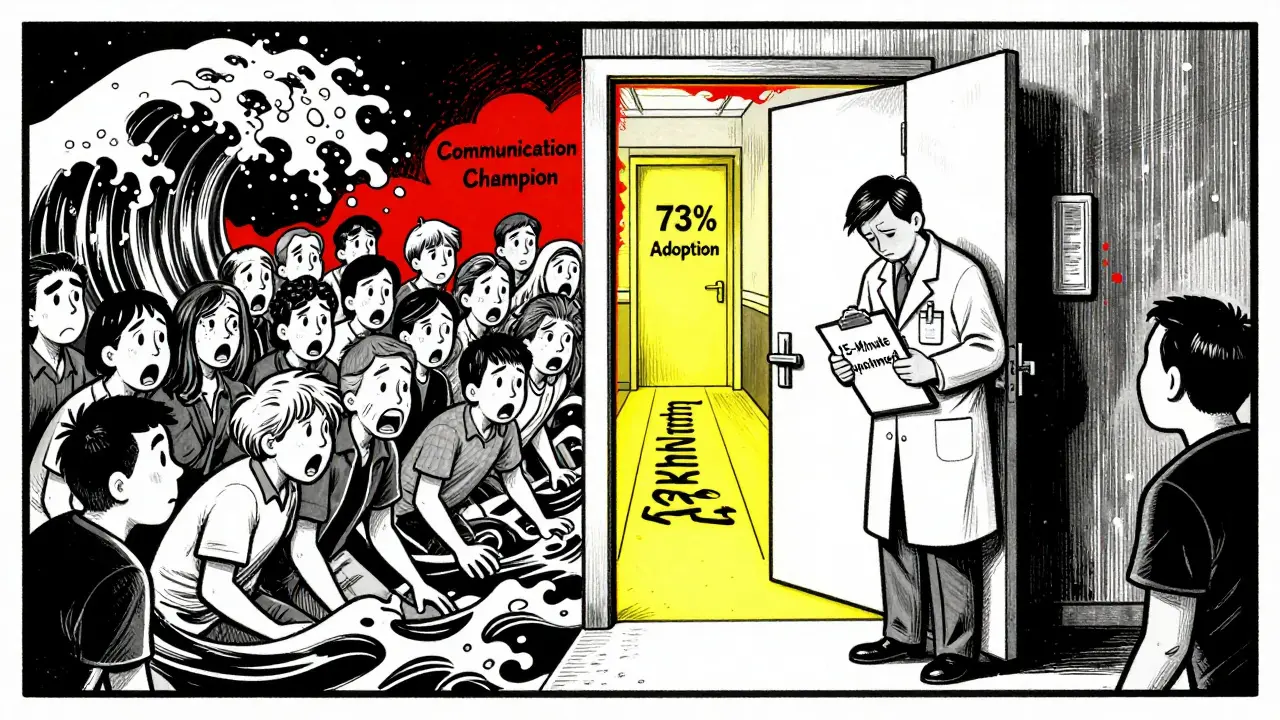
Northwestern’s program saw 73% adoption when each unit had a communication champion-a senior nurse or doctor who modeled the behavior. Mayo Clinic had senior physicians lead 60% of sessions. Peer modeling works better than lectures.
The Future: AI, Equity, and Telehealth
The field is evolving fast. In 2024, the Academy of Communication in Healthcare launched AI-powered feedback tools that analyze clinician-patient conversations and give real-time coaching. Pilot data shows 22% faster skill acquisition. Health equity is now central. UT Austin and TEPHI added new modules in January 2024 focused on bridging the 28% communication satisfaction gap between white patients and communities of color. New programs are training staff to recognize cultural norms, language barriers, and implicit bias-not just as an add-on, but as core to every interaction. Telehealth is another frontier. Thirty-five percent of new programs now include virtual communication modules-how to build trust on a screen, read body language through a camera, and avoid miscommunication without physical cues.Bottom Line: Communication Is a Clinical Skill
This isn’t about being polite. It’s about survival-patient safety, financial sustainability, and trust. Institutions that treat communication as a technical skill-like reading an EKG or suturing a wound-see real results. Those that treat it as a "nice to have" are still losing patients, money, and staff. The data is clear: structured, evidence-based communication training works. But it only works if it’s required, measured, supported, and embedded-not just another checkbox on a compliance list.Are healthcare communication programs mandatory for clinicians?
No, not yet nationwide. But The Joint Commission requires hospitals to have effective communication processes (Standard RI.01.01.01), and Medicare ties reimbursement to communication scores. Many hospitals now require training for staff, especially in high-risk areas like emergency departments and ICUs. Some states and academic medical centers have made it mandatory for residents and new hires.
Can communication training reduce medical errors?
Yes. The Joint Commission’s analysis found that 80% of sentinel events-serious patient injuries or deaths-were linked to communication failures. Programs that teach clear handoffs, confirm understanding, and reduce interruptions have been shown to cut preventable errors by up to 40% in studies from Johns Hopkins and the University of Maryland.
Which program is best for nurses?
Mayo Clinic’s free online course is highly rated by nurses for its focus on boundary setting and emotional resilience. For those needing formal credits, PEP at the University of Maryland is excellent for patient-centered dialogue. Northwestern’s simulation model is ideal for nurses in training or working in high-acuity settings where team communication is critical.
Do these programs help with patient trust?
Absolutely. Press Ganey data shows a 0.78 correlation between communication quality and patient satisfaction. When patients feel heard, they’re more likely to follow treatment plans, show up for appointments, and recommend the facility. Trust isn’t built with brochures-it’s built in the moment, one conversation at a time.
Why do some clinicians resist communication training?
Many feel it’s "fluffy" or a waste of time. Others fear it adds to their workload. Some believe they’re already good communicators. Research shows 15-20% of clinicians resist because they don’t see the direct link to patient outcomes. The most effective programs combat this by showing real data-like reduced complaints or improved scores-and letting peers lead the training.
Is there a difference between communication training for doctors vs. nurses?
Yes. Doctors often need training on interrupting less, managing difficult conversations, and explaining complex info. Nurses need more focus on boundary setting, managing emotional demands, and coordinating care across teams. Programs like SHEA target infection control staff with policy and media skills, while PEP focuses on direct patient interaction. The best programs tailor content to the role.
Nandini Wagh
February 25, 2026 AT 01:32So we’re spending millions training doctors to not interrupt patients… but still giving them 12-minute appointments? 😏
It’s like teaching a chef how to plate Michelin-star dishes while only giving them a microwave and a can of spam.
Communication training is great-until you realize the system is designed to break it.
Also, who approved ‘empathy’ as a KPI? Next they’ll measure compassion in kilojoules.
Lillian Knezek
February 25, 2026 AT 02:43ALERT: This is all a BIG PHARMA / AMA / JHU cover-up.
They don’t want you to know that communication training is just a distraction while they secretly implant tracking chips in stethoscopes.
Remember: 80% of errors? That’s the number THEY want you to believe.
The real number is 97%. And they’re using AI to erase the evidence.
👁️🧠 #MindControl #HealthcareShills
Joanna Reyes
February 25, 2026 AT 10:10I’ve worked in three different hospital systems, and I’ve seen firsthand how communication training can transform outcomes-but only when it’s sustained. What kills these programs is the ‘one-and-done’ workshop culture. You can’t just throw a 4-hour module at nurses and expect them to internalize boundary-setting when they’re understaffed, overworked, and drowning in EHR alerts.
The real magic happens when you embed prompts into the workflow-like the Northwestern model where EHRs ask, ‘Did the patient summarize their discharge plan?’ That’s not fluff. That’s systems thinking.
And let’s not ignore the emotional labor. Nurses aren’t just ‘communicating’-they’re absorbing trauma, managing grief, and holding space for people who are terrified. Training that doesn’t address burnout is just performance theater.
Also, the data on 65% of breakdowns happening in interprofessional handoffs? That’s the elephant in the room. Doctors and nurses aren’t trained to speak each other’s languages. Literally. We need cross-role simulations, not siloed modules.
And yes, AI feedback tools are promising, but if they’re not designed with frontline input, they’ll just add more noise. We’ve been here before with ‘smart’ EHRs that made documentation worse.
Bottom line: Training works when it’s continuous, peer-led, and tied to real-time feedback-not annual compliance checkboxes.
Stephen Archbold
February 26, 2026 AT 18:53Love this. Honestly? My nurse friend did the Mayo course and said it saved her sanity. She used to cry after shifts, now she says ‘I set boundaries like a boss’ 😅
Also, eye contact matters more than we think. I had a doc once look at his laptop the whole time. Felt like I was talking to a robot.
And yeah, 13 seconds? I timed it once. My doc cut me off at 7. Felt like my pain wasn’t real.
Training’s good-but we gotta fix the clock too. No one’s gonna be empathetic if they’ve got 6 patients lined up.
Also, shoutout to nurses. They’re the real heroes. 🙌
Nerina Devi
February 26, 2026 AT 21:06In India, we don’t have the luxury of structured programs. But we have something else: deep cultural intuition.
When my grandmother went to the hospital, the doctor didn’t need a 6.5-credit course to know she was scared. He sat on the edge of her bed, held her hand, and spoke slowly. No PowerPoint. No simulation.
Empathy isn’t a skill you learn-it’s a habit you live.
Maybe we don’t need more training. Maybe we need to stop treating human connection like a compliance checkbox.
And yes, I’ve seen nurses in rural clinics do more with silence than urban hospitals do with AI.
Don’t underestimate the power of just being there.
Dinesh Dawn
February 27, 2026 AT 05:50My cousin’s a nurse in Mumbai. She told me they don’t even have time to drink water between shifts, let alone ‘practice empathy.’
Meanwhile, U.S. hospitals are running simulations with mannequins that cry.
Maybe the real solution is hiring more staff, not more PowerPoint slides.
Just saying.
Also, love the Mayo course. Free? That’s the only one that makes sense.
Vanessa Drummond
March 1, 2026 AT 01:32Ugh, here we go again with the ‘soft skills’ nonsense.
Let me guess-next they’ll train doctors to ‘hold space’ while they’re getting sued for malpractice.
Real talk: patients don’t care if you said ‘That sounds frustrating.’ They care if you fixed their problem.
And let’s be real-most of these ‘training programs’ are just PR stunts to make hospitals look good on HCAHPS surveys.
Meanwhile, the system is still a money machine that chews up nurses and spits out patients.
Stop pretending communication is the problem. It’s the profit motive.
And don’t even get me started on AI feedback tools. That’s just surveillance with a smiley face.
Nick Hamby
March 1, 2026 AT 16:23There is a profound philosophical shift occurring here-one that moves us from a biomedical model of care to a phenomenological one. The patient is not a case, nor a data point, nor a reimbursement metric; they are an embodied subject, navigating vulnerability in a system designed for efficiency, not humanity.
When we train clinicians to elicit the patient’s story without interruption, we are not merely teaching technique-we are reasserting the dignity of narrative in a world increasingly dominated by algorithmic abstraction.
The 13-second rule is not a behavioral quirk-it is a symptom of a civilization that has commodified time, and by extension, attention.
It is not enough to say, ‘We must train better.’ We must restructure the entire architecture of care to make space for silence, for listening, for the sacred pause.
And yet, paradoxically, the very tools meant to aid-AI feedback, EHR prompts, simulation labs-are themselves instruments of instrumentalization.
Perhaps the truest form of communication is not taught at all, but remembered: when we see another human being, and choose, however briefly, to be fully present.
That is the unmeasurable metric.
And perhaps, the only one that matters.
kirti juneja
March 1, 2026 AT 21:17Y’all are overcomplicating this like it’s a TED Talk.
Here’s the real tea: if you treat people like humans, they’ll treat you like one too.
No fancy simulations. No 6.5-credit courses. Just: look them in the eye. Say their name. Ask how they’re *really* doing. And shut the hell up when they answer.
My aunt in Delhi had a stroke. The nurse didn’t know the EHR, but she held her hand, brought her chai, and laughed with her. That’s the whole curriculum right there.
Stop treating communication like a corporate L&D product. It’s not a skill-it’s a heartbeat.
And yeah, nurses? They’re the ones keeping this whole damn thing alive. Give ‘em a raise. Not a PowerPoint.
Haley Gumm
March 2, 2026 AT 05:35Let’s be real-the whole thing is a scam.
They train doctors to ‘listen better’ while cutting their hours.
They measure satisfaction scores while raising copays.
They use AI to ‘coach’ communication while firing staff for ‘low productivity.’
This isn’t improvement. It’s rebranding.
And the worst part? We’re all playing along like it’s working.
It’s not. It’s just prettier packaging for the same broken machine.
Wake up.