
 Jan, 3 2026
Imagine looking at a traffic light and not being able to tell the difference between red and green. Not because you’re squinting or it’s foggy - but because your eyes just don’t see those colors the way most people do. This isn’t rare. About 8% of men and less than 1% of women around the world live with this every day. It’s called red-green color blindness, and it’s not a disease. It’s a genetic quirk - one that’s been passed down for generations, often without anyone realizing why.
What Actually Happens in Your Eyes?
Your eyes have three types of cone cells that detect color: one for red, one for green, and one for blue. These cones contain light-sensitive proteins called photopsins. When light hits them, they send signals to your brain, which mixes them together to create the full spectrum of colors you see. In red-green color blindness, something goes wrong with the red or green photopsins. Either the gene that makes them is missing, broken, or swapped with the other. This doesn’t mean you see in black and white. Most people with this condition still see plenty of colors - they just mix up reds, greens, browns, and oranges more easily than others. There are two main types: protanopia (no working red cones) and deuteranopia (no working green cones). These are the most severe forms. More common are the milder versions: protanomaly (red cones don’t work right) and deuteranomaly (green cones are off). Deuteranomaly is the most common - affecting about 5% of men. That’s one in every 20 men you know.Why Do Men Get It More Than Women?
The answer lies in your chromosomes. The genes for red and green photopsins sit on the X chromosome. Men have one X and one Y chromosome. Women have two X chromosomes. If a man inherits a faulty red-green gene on his single X chromosome, he has no backup. He’ll have color blindness. But a woman needs two faulty copies - one on each X chromosome - to be affected. If she has only one faulty gene, she’s a carrier. She usually sees colors fine, but she can pass the gene to her children. That’s why the numbers look like this: 8% of men affected, but only about 0.5% of women. Mathematically, if 8% of men have it, you’d expect around 0.64% of women to have it (0.08 × 0.08). But because of how X chromosomes work in women - one is randomly turned off in each cell - the actual number is even lower. This isn’t just theory. John Dalton, the scientist who first described his own color blindness in 1798, was a man. He passed the trait to his son, and his son passed it to his son. It’s been tracked in families for over 200 years.How Is It Passed Down?
Let’s say a man has red-green color blindness. He can’t pass it to his sons - because he gives his Y chromosome to his boys, not the X. But he gives his X chromosome to all his daughters. So all his daughters become carriers. They don’t usually have symptoms, but they can pass the gene to their sons. Now, if a woman is a carrier and has a son, there’s a 50% chance he’ll be color blind. If she has a daughter, there’s a 50% chance the daughter will be a carrier too. Here’s a real-world example: A man with deuteranomaly has two children - a son and a daughter. His son has a 50% chance of being color blind. His daughter will definitely carry the gene but likely won’t notice any difference in color vision. If that daughter later has a son, that grandson has a 50% chance of being color blind too. It’s a quiet inheritance. Many people don’t know they’re carriers until their son fails a color test at school or during a job application.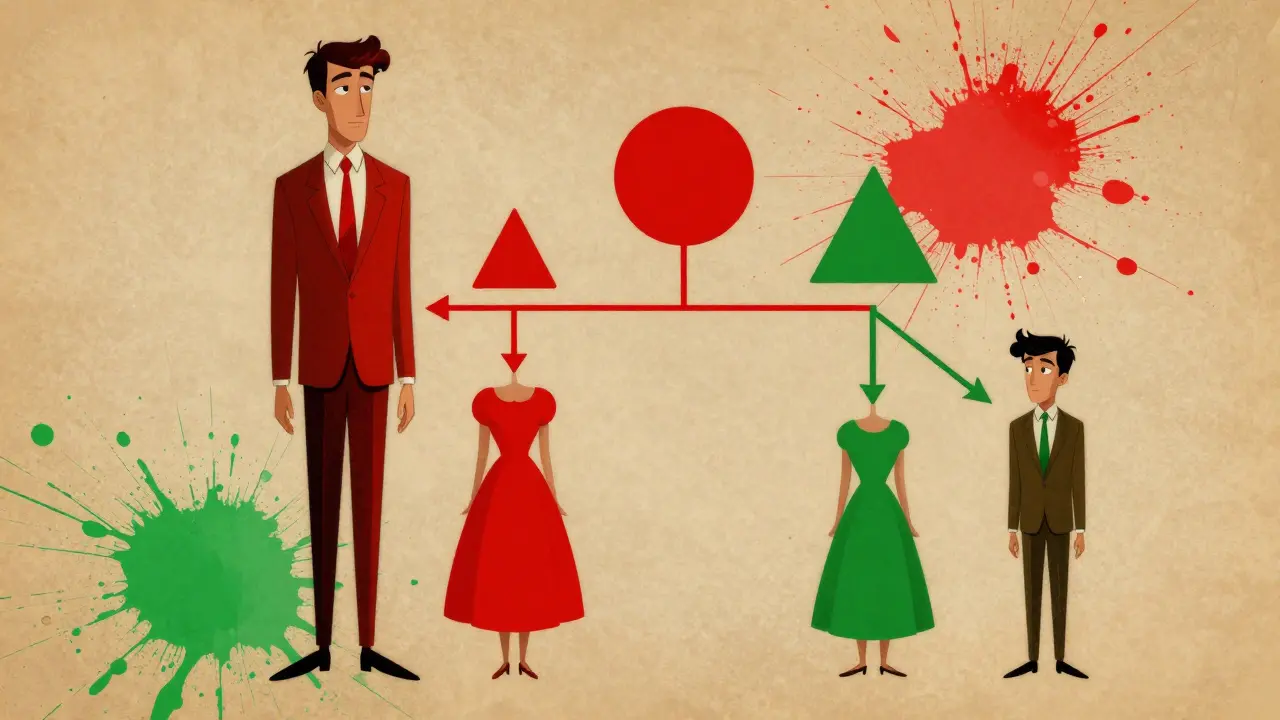
How Is It Diagnosed?
The most common test is the Ishihara test - those plates with colored dots that form numbers. People with normal color vision see a 5. Someone with red-green color blindness might see a 2, or nothing at all. It’s simple, cheap, and still used worldwide. But it’s not perfect. Some people guess the numbers. Others have mild forms that don’t show up on the test. More advanced tests, like the Farnsworth-Munsell 100 Hue Test, measure how well someone can arrange colors in order. These are used in jobs where color accuracy matters - like aviation, electrical work, or graphic design. In the UK, schools don’t routinely screen for color blindness. Many people only find out when they’re older - often during a driving test, a job interview, or when they struggle to match socks.What Does It Actually Feel Like?
People with red-green color blindness don’t see the world in grayscale. They see color - just differently. One man, a pilot applicant in the US, was turned down because he couldn’t pass the color test. He had perfect 20/20 vision. He just couldn’t tell red from green on runway lights. He’s now a flight instructor - using labels and positions instead of color to navigate. Another person, an electrician, told a forum: “I used to wire things by color. Now I label every wire with numbers. My coworkers think I’m obsessive. But I’d rather be safe than shocked.” Students with color blindness often struggle with graphs in science class. A red line on a green background? Invisible. Teachers who don’t know about this mistake can make students feel like they’re not trying. And yes - people get embarrassed. A woman on Reddit wrote: “I wore a red shirt to my sister’s wedding and everyone said it clashed with the decor. I didn’t know it was red. I thought it was brown.”Can It Be Fixed?
No cure exists yet. But there are tools that help. EnChroma glasses - those expensive red-tinted lenses - don’t restore normal color vision. But for about 80% of people with red-green deficiency, they make colors feel more distinct. They’re not magic. You still won’t see new colors. But reds and greens stop blending together as much. Digital tools help too. Apple and Windows let you turn on color filters that shift hues to make them easier to tell apart. Apps like Color Oracle let designers simulate what their websites look like to someone with color blindness. The Colour Blind Awareness group even made a free Photoshop plugin that does the same thing. And then there’s ColorADD - a system of symbols that replace color codes. A triangle means red. A circle means green. It’s used in public transit maps in Portugal, Spain, and the UK. A blind person can’t see color. But they can see a symbol.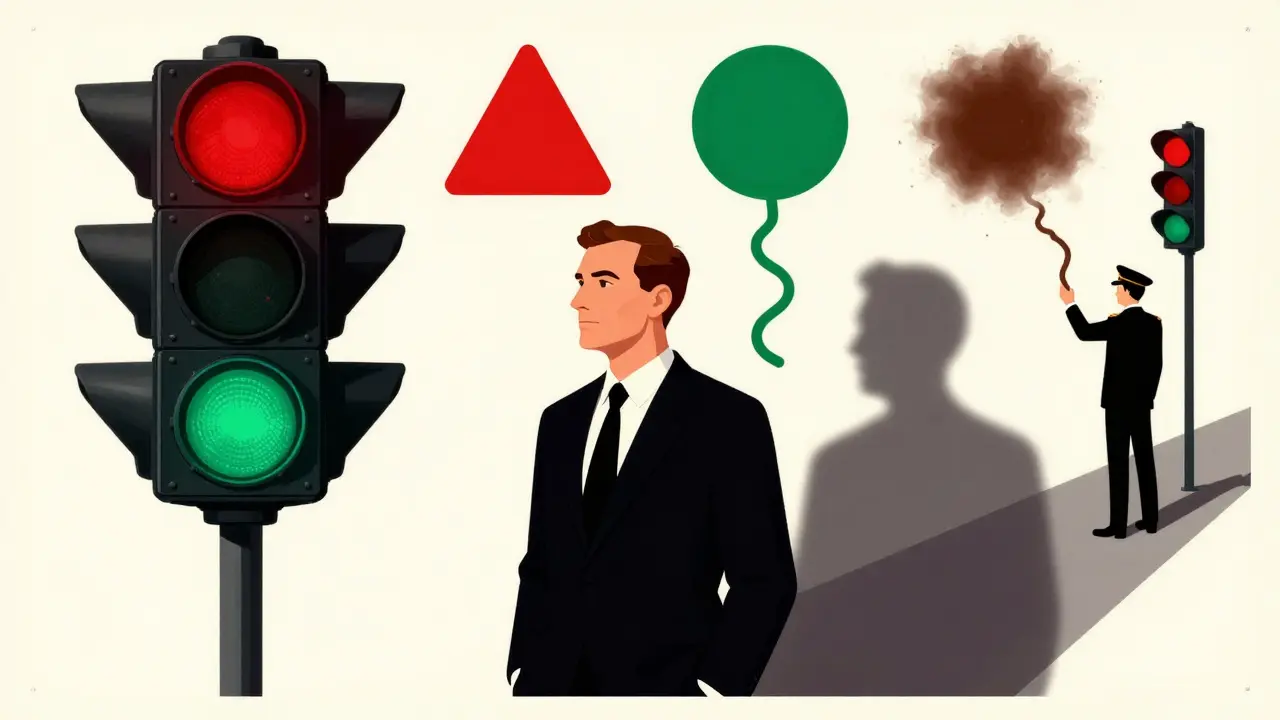
How It Affects Work and Life
In 2022, a UK survey found that 78% of people with red-green color blindness had trouble with color-coded learning materials. 65% struggled with traffic lights in bad weather. 42% had issues with apps and websites that relied on color alone. That’s why accessibility standards like WCAG 2.1 now require websites to use patterns, labels, or contrast - not just color - to convey meaning. The EU’s Accessibility Act and the UK’s Equality Act 2010 recognize color blindness as a disability. Employers must make reasonable adjustments. Some people thrive because of it. A graphic designer in Bristol told me: “I used to rely on color. Now I pay attention to brightness, shape, spacing. My designs are actually better because I think about contrast more.”What’s Next?
Scientists are working on gene therapy. In 2022, researchers gave color-blind squirrel monkeys a gene that restored full color vision - and it lasted over two years. Human trials are still years away, but the proof of concept is there. Meanwhile, tech is catching up. New EnChroma lenses launched in 2023 claim to improve color discrimination by 30% over older versions. Augmented reality glasses that label colors in real time are in development. The big shift? We’re moving from seeing color blindness as a flaw to seeing it as a different way of seeing. It’s not broken. It’s just different.Frequently Asked Questions
Can color blindness get worse over time?
No. Red-green color blindness is genetic and doesn’t change with age. Unlike cataracts or macular degeneration, it doesn’t progress. What changes is your ability to adapt - people learn to use context, labels, and brightness to compensate. The condition stays the same, but your strategies get better.
Can a woman be color blind?
Yes, but it’s rare. A woman needs to inherit the faulty gene from both her mother and father. If her father is color blind and her mother is a carrier, she has a 50% chance of being affected. Most women with one faulty gene are carriers and see colors normally. Only about 0.5% of women have red-green color blindness - compared to 8% of men.
Is red-green color blindness the same as being totally color blind?
No. Total color blindness, called monochromacy, is extremely rare - about 1 in 30,000 people. People with this condition see only in shades of gray. Red-green color blindness is a deficiency, not a loss. Most people with it see colors fine - they just mix up reds and greens. It’s like being slightly tone-deaf in music, not deaf.
Do color-correcting glasses work for everyone?
No. They help about 80% of people with red-green deficiency, but only if they have a specific type - usually deuteranomaly or protanomaly. They don’t work for people with complete loss of red or green cones (dichromats), and they don’t help at all with blue-yellow color blindness. They’re filters, not cures. They make existing colors pop more, but they don’t add new ones.
Can you be tested for color blindness as an adult?
Absolutely. Many people are never tested as kids. Eye doctors can run the Ishihara test, Farnsworth test, or more advanced digital screenings. If you’ve ever struggled with matching clothes, reading color-coded charts, or distinguishing traffic lights, it’s worth getting checked. It’s quick, painless, and can explain years of confusion.
Does color blindness affect driving?
In most cases, no. The UK and many other countries allow people with red-green color blindness to drive. Traffic lights are arranged in the same position every time - red on top, green on bottom. Most people learn to rely on position, not color. However, in very poor visibility - heavy fog or glare - it can be harder. That’s why some countries require extra tests for commercial drivers.
Doreen Pachificus
January 4, 2026 AT 10:39My brother didn’t know he was color blind until he was 22 and tried to pick out a tie for his wedding. He thought it was navy. It was bright red. He still wears that tie every anniversary just to laugh about it.
Ashley Viñas
January 4, 2026 AT 17:50Ugh, I swear people act like color blindness is some kind of mystical superpower now. It’s not. It’s a genetic glitch. And yes, if you’re a man and you can’t tell red from green, maybe stop blaming society for your inability to match socks. Just label your clothes.
Michael Rudge
January 5, 2026 AT 12:08Oh wow, so now we’re treating color blindness like it’s a cultural identity? Next they’ll be making rainbow flags for deuteranomaly. Can we get a Pride Month for people who can’t tell if their avocado is ripe? 🙄
Ethan Purser
January 6, 2026 AT 20:42It’s funny how we’ve built an entire world on color - traffic lights, warning signs, data charts - and then act surprised when half the population can’t decode it. We don’t design for difference. We design for the average. And then we call the outliers broken. But maybe… maybe the world is broken, not them.
Uzoamaka Nwankpa
January 8, 2026 AT 06:36I’ve been color blind since birth and never had a test. In Nigeria, nobody checks. I thought everyone saw the world like I did - until I saw a child cry because they couldn’t match crayons in school. That’s when I realized: it’s not just me. It’s a silent majority.
bob bob
January 9, 2026 AT 13:09I work in UX and we redesigned our app last year to stop relying on color alone. We added icons, labels, and contrast gradients. User feedback went from ‘confusing’ to ‘so intuitive.’ Turns out, making things accessible doesn’t just help color-blind people - it helps everyone. Weird, right?
Chris Cantey
January 10, 2026 AT 20:52Gene therapy worked on squirrel monkeys. That’s wild. But here’s the real question - if we can fix it, should we? What if color blindness isn’t a defect but a different way of perceiving reality? Maybe we’re the ones missing something by seeing too much.
Oluwapelumi Yakubu
January 10, 2026 AT 20:52Let me tell you something - in Yoruba culture, we have words for colors that don’t exist in English. We don’t just say ‘red’ or ‘green.’ We have hues for the color of ripe plantain at dawn, the shade of mud after first rain. Maybe color blindness isn’t a lack - maybe it’s a different lexicon. Maybe we’re the ones who lost the vocabulary.
melissa cucic
January 11, 2026 AT 03:41It is, indeed, a fascinating - and profoundly under-discussed - genetic phenomenon, one that underscores the intricate interplay between biology, environment, and societal design; and yet, we persist in treating it as a mere inconvenience, rather than a legitimate perceptual variation that demands structural accommodation - not pity, not mockery, but inclusion.
Enrique González
January 11, 2026 AT 21:57My daughter just failed her school’s color test. They didn’t tell me until she came home crying. Now I’m pushing for a district-wide screening. No kid should feel dumb because their eyes work differently.
Catherine HARDY
January 12, 2026 AT 07:12Wait… so if this is on the X chromosome… and men get it more… and women are carriers… then who’s really controlling the gene pool? Are we being manipulated? Who benefits from this? Why is this not on the news? I’m starting to think it’s not genetic… it’s engineered.