
 Feb, 6 2026
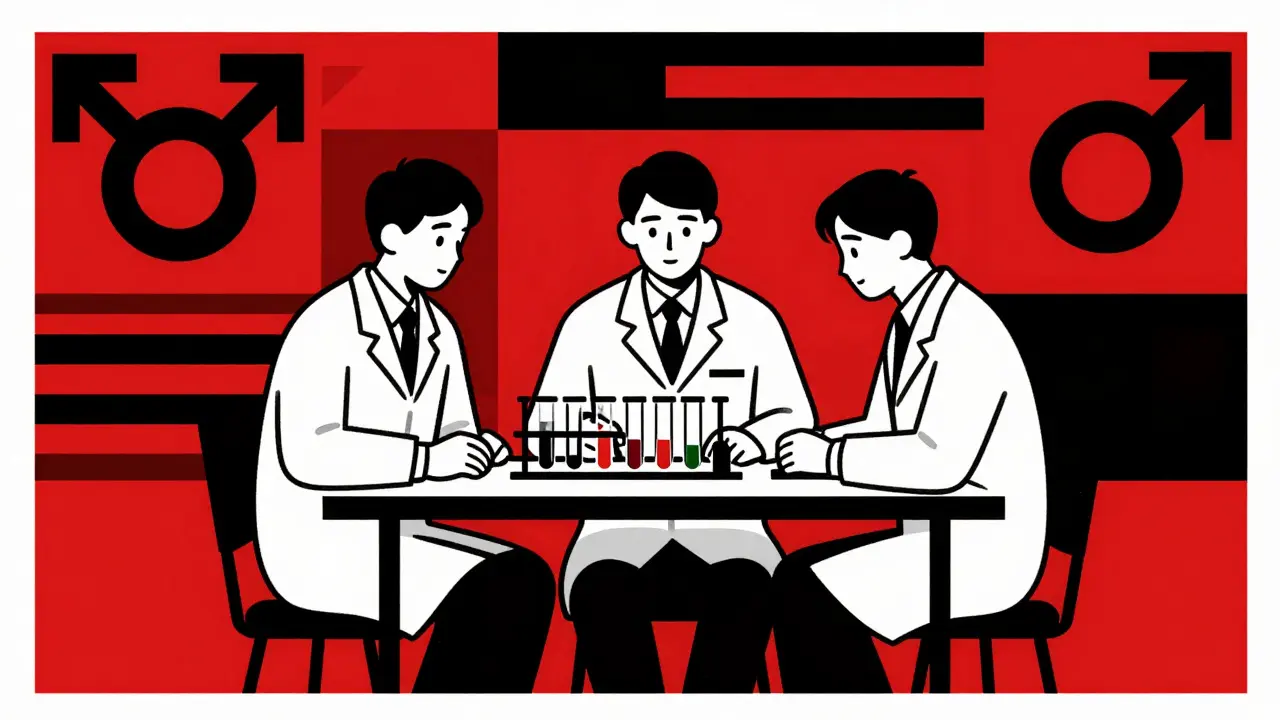
Bioequivalence studies are clinical trials designed to demonstrate that two pharmaceutical products deliver the same amount of active ingredient into the bloodstream at the same rate.
For decades, these trials used almost exclusively young, healthy men. That’s changing fast. Regulatory agencies now recognize that ignoring age and sex differences can lead to unsafe or ineffective treatments for real patients.
Why bioequivalence studies need diverse participants
Historically, bioequivalence studies focused on young, healthy male volunteers. A 2018 Journal of Pharmacy and Therapeutics paper found 90% of trials enrolled only men. The reasoning was simple: controlling variables was easier with a homogeneous group. But this approach ignored critical differences in how drugs behave across populations.
Women often process drugs differently due to body composition, hormone levels, and enzyme variations. For instance, a 2023 University of Toronto study showed 37% of commonly tested drugs clear 15-22% faster in males than females. That difference matters. A drug that works perfectly for men might cause side effects in women or fail to treat effectively.
How regulators are changing the rules
Today, major regulatory bodies have updated guidelines to address these gaps. Here’s how they compare:
| Regulatory Body | Sex Requirements | Age Requirements | Other Key Details |
|---|---|---|---|
| FDA | 50:50 male-female ratio unless justified | 18+; 60+ for elderly drugs | Requires detailed justification for single-sex studies |
| EMA | "Subjects could belong to either sex" (no balance mandate) | 18+; BMI 18.5-30 kg/m² | Focuses on detecting formulation differences |
| ANVISA | Equal male-female distribution | 18-50 years; non-smokers | Strict BMI range ±15% of normal |

Real-world challenges in implementation
Changing guidelines is one thing-implementing them is another. Recruiting women for studies is harder. Many clinical sites report 40% longer timelines for gender-balanced trials. A 2020 FDA analysis found gender-balanced studies cost 20-30% more due to lower female participation rates.
Statistical issues also complicate things. Small sample sizes can create false positives. For example, a 2017 study with only 14 participants showed a bioinequivalence in males (79% point estimate) but equivalence in females (95%). Larger studies (n=36) later proved it was a statistical artifact. This highlights why proper sample sizes and sex-stratified analysis matter.

Why representation gaps still exist
Despite updated rules, real-world data shows persistent gaps. FDA analysis of 1,200 ANDA submissions between 2015-2020 revealed only 38% achieved 40-60% female representation. The median female participation was just 32%. Contrast that with levothyroxine-a common thyroid medication used by 63% women (National Health and Nutrition Examination Survey, 2019). Yet BE studies for this drug typically enroll ≤25% women.
This mismatch has real consequences. Women may receive doses that don’t work for them, leading to under-treatment or side effects. For drugs like antidepressants or blood thinners, these differences can be life-threatening.
Where things are heading
Regulators are pushing harder for change. The FDA’s May 2023 draft guidance explicitly states: "If a drug product is intended for use in both sexes, the applicant should include similar proportions of males and females." This is a major shift from previous non-binding recommendations.
The EMA is reviewing its 2010 guidelines for updates expected in 2024. ANVISA has already tightened requirements for equal male-female distribution. Industry is adapting too-a 2022 Generic Pharmaceutical Association survey found 68% of contract research organizations now use proactive female recruitment strategies. However, only 29% track sex-specific pharmacokinetic data routinely.
Future directions include sex-specific bioequivalence criteria for narrow therapeutic index drugs, as recommended by the 2021 National Academies of Sciences report. Emerging research, like the University of Toronto study on drug clearance rates, will likely drive further regulatory evolution. The FDA’s 2023-2027 strategic plan explicitly identifies "enhancing representation of diverse populations in generic drug development" as a priority, signaling continued pressure for inclusive study designs.
Why were bioequivalence studies historically done only on men?
Historically, regulators and researchers believed using young, healthy men simplified study variables. It was easier to control factors like age, health status, and hormonal fluctuations. However, this approach ignored critical differences in drug metabolism between sexes, leading to potential safety risks for women.
What’s the biggest challenge in recruiting women for bioequivalence studies?
Recruitment challenges include lower participation rates due to childcare responsibilities, concerns about pregnancy, and historical distrust of clinical trials among women. Sites report 40% longer timelines for gender-balanced studies, with recruitment costs 20-30% higher than all-male trials.
How do sex differences affect drug effectiveness?
Women often metabolize drugs differently due to body fat percentage, hormone levels, and enzyme activity. For example, a 2023 University of Toronto study found 37% of tested drugs clear 15-22% faster in males than females. This can lead to under-dosing in women or overdosing in men, affecting treatment outcomes and safety.
Do all regulatory agencies require balanced sex representation?
No. The FDA now requires similar male-female proportions unless scientifically justified. The EMA states subjects "could belong to either sex" without mandating balance. ANVISA requires equal distribution. This variation creates challenges for global drug development.
What’s being done to improve representation in future studies?
Regulators are updating guidelines, industry is adopting targeted recruitment strategies, and researchers are developing sex-specific analysis methods. The FDA’s 2023-2027 strategic plan prioritizes diverse population representation, while emerging research on sex-dependent pharmacokinetics is driving evidence-based changes.
Amit Jain
February 6, 2026 AT 09:42Historically, using young men reduced variability in trials. That's why it was standard practice. Now regulators are changing rules without solid evidence.
Forcing diversity could lead to flawed data.
Catherine Wybourne
February 8, 2026 AT 05:23Oh sure, because men are perfect test subjects. Never mind the fact that most drugs are used by women too.
The 'simplicity' argument ignores real-world consequences. We've seen the harm-like with zolpidem where women had more side effects.
It's time to stop pretending diversity isn't necessary.
Sarah B
February 9, 2026 AT 00:22Women's health matters.
Natasha Bhala
February 10, 2026 AT 03:36we can do better. its time for change. everyone deserves safe meds.
no more excuses.
Mark Harris
February 11, 2026 AT 16:23Let's get this right. Diversity in trials saves lives. Time to act.
Ritu Singh
February 12, 2026 AT 15:02Indeed. Inclusive studies ensure equitable healthcare.
This is a critical step towards justice.
We must prioritize research that reflects the diversity of our patients.
Joey Gianvincenzi
February 12, 2026 AT 15:54The EMA's stance is inadequate.
Equal representation is non-negotiable for patient safety.
Any deviation from this standard is a disservice to public health.
Mary Carroll Allen
February 13, 2026 AT 19:12yep. the current system is flawed. we need to fix it.
some drugs have different effects based on sex-blood thinners require lower doses for women.
its not politics, its science.
Heather Burrows
February 15, 2026 AT 16:37This is all just political correctness.
Real science doesn't care about gender.
Let's focus on the data.
Tola Adedipe
February 16, 2026 AT 14:24Actually, the science does care.
Studies show clear differences.
Ignoring it is dangerous.
We need to take this seriously.
Marcus Jackson
February 17, 2026 AT 06:06The data is clear. Sex differences matter. But the FDA is overcomplicating it.
Keep it simple.
Gouris Patnaik
February 17, 2026 AT 22:35You're wrong.
It's not about politics.
It's about science.
You don't know what you're talking about.
Mayank Dobhal
February 18, 2026 AT 15:06Women's health is ignored. Time to change.
Eric Knobelspiesse
February 19, 2026 AT 18:47It's not that simple.
There are economic factors.
But yes, we need more data.
The current system is broken.
Savannah Edwards
February 20, 2026 AT 03:51It's fascinating how the historical bias in bioequivalence studies has impacted drug safety. I remember reading about how women were excluded from trials because of concerns about menstrual cycles affecting results. But this led to serious issues later, like with zolpidem where women had higher blood levels and more side effects. The FDA had to adjust dosages specifically for women after the fact.
There's also the case of blood thinners like warfarin. Studies showed that women metabolize it differently, leading to higher risks of bleeding. Yet, many trials still don't account for sex differences properly. The 2023 University of Toronto study is a wake-up call-37% of drugs clear faster in men, which means women might be underdosed. That's not just theoretical; it affects real people.
Regulators are finally catching up. The FDA's new guidelines are a step in the right direction, but implementation is slow. Clinical sites report 40% longer recruitment times for gender-balanced trials. It's not just about numbers; it's about understanding how drugs behave in different populations. We need to move beyond the old paradigm where 'healthy men' were the default.
Another issue is the lack of sex-stratified analysis. A 2017 study with only 14 participants showed a bioinequivalence in males but equivalence in females. Later, a larger study proved it was a statistical artifact. This shows why proper sample sizes and analysis matter. We can't afford to ignore these details anymore.
Looking ahead, the National Academies of Sciences recommends sex-specific criteria for narrow therapeutic index drugs. That makes sense. Drugs like digoxin or lithium have tight safety margins. Tailoring dosages based on sex could prevent adverse events. It's not about politics; it's about science and patient safety.
But we also need to address the real-world barriers. Women often face childcare responsibilities, pregnancy concerns, and historical distrust in clinical trials. Sites need to be more proactive in recruitment. Maybe offering childcare support or flexible scheduling could help. It's a complex problem, but the solution is clear: inclusive trials save lives.