
 Feb, 17 2026
Serotonin Syndrome Risk Assessment Tool
Risk Assessment Calculator
This tool estimates your risk of developing serotonin syndrome when taking antiemetics with other serotonergic medications. Enter your information below to receive a risk assessment and personalized recommendations.
Risk Assessment Results
Your Risk Level
Recommendations
Key Information
Every year, millions of people get nausea and vomiting treated with antiemetics like ondansetron (Zofran). It’s one of the most commonly prescribed drugs in hospitals, clinics, and even dental offices. But what happens when you’re already taking an SSRI for depression or anxiety? The answer isn’t simple. While most people take these drugs without issue, a small but dangerous risk exists: serotonin syndrome.
What Exactly Is Serotonin Syndrome?
Serotonin syndrome isn’t just a side effect - it’s a medical emergency. It happens when too much serotonin builds up in your nervous system. This isn’t about feeling a little off. Symptoms can include tremors, muscle rigidity, high fever, confusion, rapid heartbeat, and even seizures. In severe cases, it can be fatal. It was first noticed in the 1960s when doctors saw patients on MAOIs (older antidepressants) develop strange symptoms after taking other drugs. Today, we know it’s not just about MAOIs. It’s about combinations. The American Academy of Family Physicians found that 85% of serotonin syndrome cases happen because of two or more serotonergic drugs being taken together. That’s why a drug like ondansetron - meant to stop nausea - can become a hidden risk.How Do Antiemetics Fit Into This?
Not all antiemetics are the same. There are three main types, and each carries different levels of risk:- 5-HT3 antagonists - like ondansetron, granisetron, dolasetron. These block serotonin receptors in the gut to stop vomiting. But they’re not as simple as they seem.
- Dopamine antagonists - like metoclopramide (Reglan). These work differently but can still affect serotonin levels.
- NK1 antagonists - like aprepitant. These rarely cause serotonin issues directly, but they can interfere with how other drugs are broken down.
Why Do Some People Get It and Others Don’t?
It’s not random. Genetics, age, and other drugs play a huge role. Take CYP2D6, a liver enzyme that breaks down many drugs, including ondansetron and several SSRIs. About 7-10% of people of European descent have a genetic variation that makes this enzyme work poorly. These “poor metabolizers” end up with much higher levels of ondansetron in their blood - up to 2.3 times more. A 2020 study from the Mayo Clinic showed this directly increased serotonin syndrome risk. Age matters too. People over 65 make up only 18.7% of the population, but 41.3% of serotonin syndrome cases involving ondansetron and SSRIs. Why? Older bodies process drugs slower. Their kidneys and liver don’t clear medications as efficiently. They’re also more likely to be on multiple medications at once. And then there’s the cocktail effect. Most patients who develop serotonin syndrome aren’t taking just one serotonergic drug. They’re often on an SSRI, maybe an SNRI, a triptan for migraines, and then get ondansetron for nausea after surgery. Each one adds a little more serotonin. The system gets overloaded.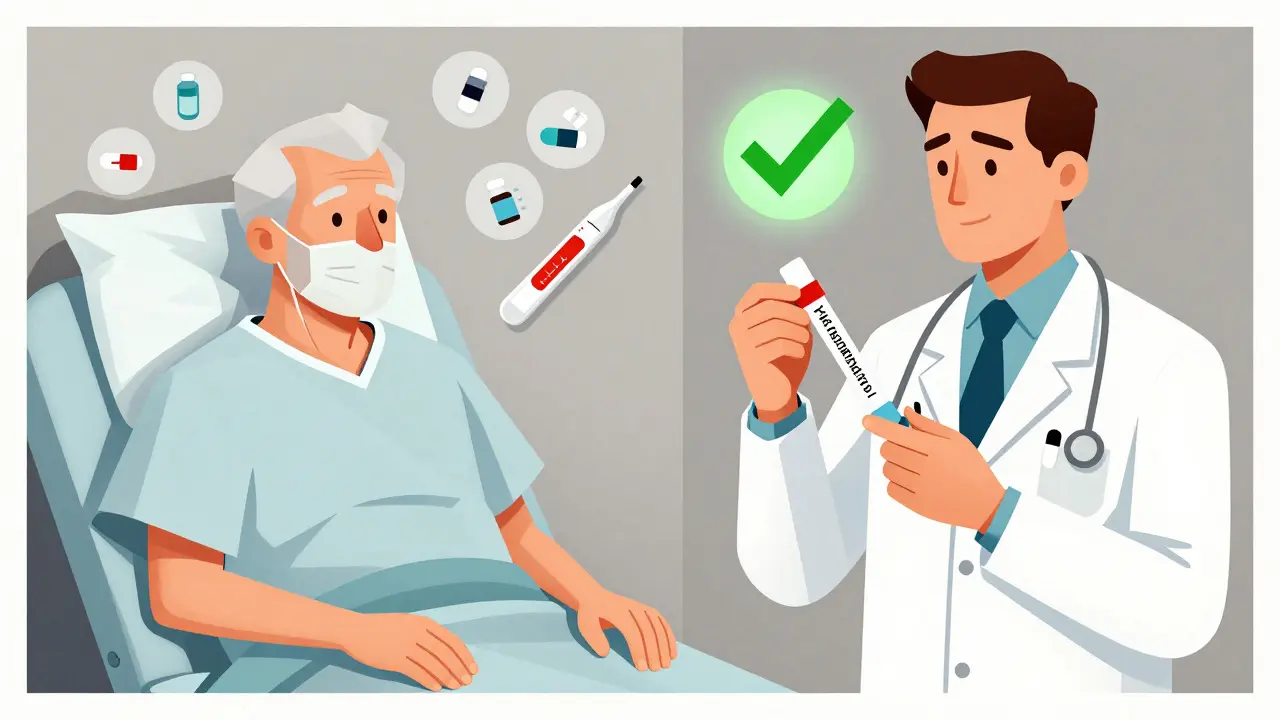
What Are the Real Numbers?
It’s rare - but it’s real. The FDA reports only 4.2 cases of serotonin syndrome per 100,000 antiemetic prescriptions. That sounds low. But when you consider that over 22 million ondansetron prescriptions were filled in the U.S. in 2022 alone, that adds up to hundreds of cases a year. And the number of emergency visits involving antiemetics and serotonin syndrome rose 29% between 2018 and 2022. Patient reviews tell another side. On Drugs.com, 1,247 people rated ondansetron. While 7.8 out of 10 said it worked well for nausea, only 5.2 out of 10 said it was safe when taken with SSRIs. Reddit threads like r/SSRI have dozens of stories from people who developed tremors, sweating, and confusion after a dental visit where they got ondansetron. Eleven of them ended up in the ER.How Do Doctors Spot It?
The key is the Hunter Serotonin Toxicity Criteria. It’s not based on guesswork. It’s a validated tool with 84% sensitivity and 97% specificity. If a patient has one of these, serotonin syndrome is likely:- Serotonin agonist use + spontaneous clonus
- Serotonin agonist use + inducible clonus + agitation or diaphoresis
- Serotonin agonist use + ocular clonus + agitation or diaphoresis
- Serotonin agonist use + tremor + hyperreflexia
- Serotonin agonist use + hypertonia + temperature over 38°C + ocular or inducible clonus
What Should You Do If You’re on Both?
You don’t have to avoid antiemetics entirely. But you need to be smart.- Check your meds. If you’re on an SSRI, SNRI, MAOI, or even a migraine drug like sumatriptan, tell your doctor before you get any antiemetic.
- Ask about alternatives. Dexamethasone (a steroid) is just as effective for nausea and has zero serotonin activity. It’s often used in cancer care for this reason.
- Consider dose adjustments. The American Society of Health-System Pharmacists recommends cutting the ondansetron dose by 50% if you’re taking a strong CYP2D6 inhibitor like fluoxetine.
- Think about genetics. If you’re of European descent and have a history of drug sensitivity, ask about CYP2D6 testing. It’s becoming more common in hospitals.
- Know the signs. If you feel sudden shaking, confusion, or a spike in body temperature after taking ondansetron, stop the drug and get help immediately.
What’s the Best Treatment?
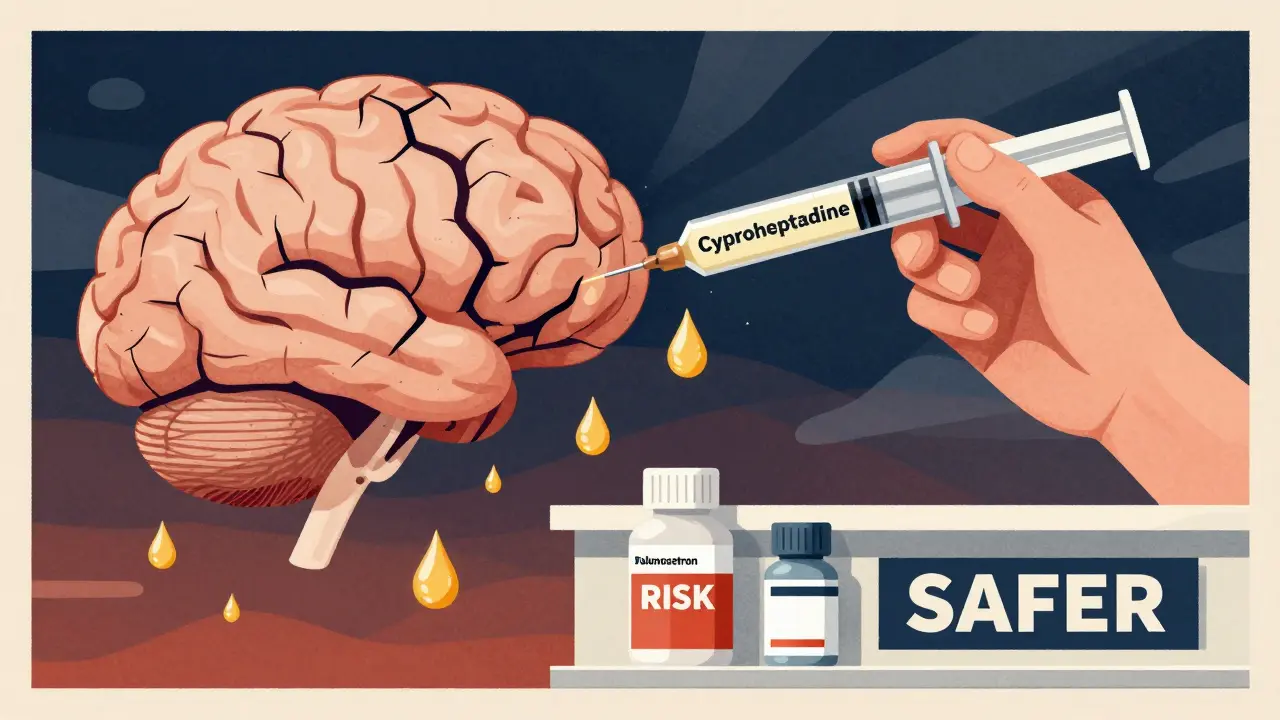
If serotonin syndrome is suspected, the first step is simple: stop all serotonergic drugs. That includes antidepressants, migraine meds, and yes - even antiemetics. The gold-standard antidote is cyproheptadine, an antihistamine that blocks serotonin receptors. The usual dose is 4-8 mg orally, repeated every 2 hours until symptoms improve. In hospitals, doctors may also use dexmedetomidine, which calms the nervous system by reducing serotonin release. It’s not FDA-approved for this use, but studies show it works better than benzodiazepines in severe cases.Is There a Safer Alternative?
Yes - and it’s already here. Palonosetron is a second-generation 5-HT3 antagonist. Unlike ondansetron, it binds differently to receptors and has a longer duration of action. A 2023 study in the Journal of Clinical Psychopharmacology found switching from ondansetron to palonosetron cut serotonin syndrome risk by 63.2% in patients on SSRIs. It’s more expensive, but for high-risk patients, it’s worth it. The American Geriatrics Society now advises avoiding ondansetron in people over 65 who are on MAOIs. For those on SSRIs, they recommend caution. That’s not a warning to stop using it - it’s a call to be smarter about it.Final Thoughts
Serotonin syndrome from antiemetics isn’t common. But it’s real, preventable, and often missed. Most doctors know about the risks with MAOIs and SSRIs. Fewer realize that a single dose of ondansetron in someone on an SSRI - especially if they’re older or metabolize drugs slowly - can push them over the edge. The takeaway isn’t to avoid antiemetics. It’s to talk about them. Ask your pharmacist: "Is this safe with my other meds?" Tell your doctor: "I’m on an SSRI. Can we use something else?" And if you’re taking multiple serotonergic drugs, pay attention to your body. A sudden tremor or fever isn’t normal. It’s a signal. The science has evolved. The tools to prevent this are here. What’s missing is awareness - from patients and providers alike.Can ondansetron cause serotonin syndrome on its own?
No, ondansetron alone is extremely unlikely to cause serotonin syndrome. It blocks serotonin receptors rather than increasing serotonin levels. Almost all documented cases involve a combination with another serotonergic drug, like an SSRI, SNRI, or MAOI. The risk is in the interaction, not the drug by itself.
Which antiemetics are safest if I’m on an SSRI?
Dexamethasone is the safest option - it has no serotonergic activity and works just as well for nausea in many cases. Metoclopramide carries moderate risk due to weak serotonin reuptake inhibition. Palonosetron is a better choice than ondansetron if you must use a 5-HT3 antagonist, as it has a lower risk profile in combination with SSRIs. Always discuss alternatives with your doctor.
Are older adults more at risk?
Yes. People over 65 account for over 40% of serotonin syndrome cases involving ondansetron and SSRIs, even though they make up less than 20% of the population. Aging slows drug metabolism, increases medication use, and reduces organ function. The American Geriatrics Society specifically advises caution with ondansetron in this group.
Can genetic testing help prevent serotonin syndrome?
Yes. About 7-10% of people of European descent are poor metabolizers of CYP2D6, the enzyme that breaks down ondansetron and many SSRIs. These individuals can have 2-3 times higher drug levels, increasing risk. The Clinical Pharmacogenetics Implementation Consortium recommends CYP2D6 testing before combining these drugs, especially if you’ve had drug reactions before.
What should I do if I think I have serotonin syndrome?
Stop taking all serotonergic drugs immediately and seek emergency care. Symptoms like tremors, high fever, confusion, or rapid heartbeat require urgent attention. Do not wait. Cyproheptadine is the standard antidote, and early treatment prevents complications. Hospitals use the Hunter Criteria to confirm diagnosis quickly.
Tommy Chapman
February 19, 2026 AT 02:35Look, I don't care how many studies you cite - if you're on an SSRI and still letting your doctor give you Zofran, you're either dumb or lucky. I've seen people turn into human tremor machines after a dental visit. One guy I know had to get rushed to the ER because he thought 'a little nausea' was worth risking his brain melting. Stop being lazy and ask for dexamethasone. It's not rocket science. Your pharmacist isn't your therapist - they're your last line of defense before your serotonin turns into a fireworks show.
Robin bremer
February 19, 2026 AT 20:34bro i just got ondansetron last week for my hangover nausea 😅 and im on lexapro 😭 i hope i didnt just doom myself lmao anyone else feel like a lab rat rn?? 🤯🫠
Hariom Sharma
February 20, 2026 AT 07:28Wow, this is such an eye-opener! I never realized how complex drug interactions can be - especially with something as simple as nausea relief. In India, we often use ginger or ajwain for nausea, but I get why modern medicine needs to catch up. Kudos to the author for breaking this down so clearly! Let's all be smarter about our meds, not just scared. A little awareness goes a long way - and yes, palonosetron sounds like a game-changer. Stay safe, stay informed! 🙌🌍
John Cena
February 21, 2026 AT 12:57There's a lot here, and honestly, it's scary how many people just take meds without asking questions. I'm not saying avoid Zofran - I'm saying ask. Ask your doctor, ask your pharmacist, Google it with a critical eye. The fact that 41% of cases involve people over 65? That’s not a coincidence. It’s systemic. We treat elderly patients like they’re just ‘slow metabolizers’ instead of adjusting protocols. This isn’t about fear - it’s about responsibility. And yeah, CYP2D6 testing should be routine. Not optional.
aine power
February 21, 2026 AT 15:49Overblown. Dexamethasone isn’t magic. Palonosetron is cost-prohibitive. Stop fearmongering.
Freddy King
February 22, 2026 AT 09:55Let’s unpack this through a neuropharmacological lens. The 5-HT3 antagonist mechanism is ostensibly antagonistic, but allosteric modulation of SERT - even at low affinity - creates a permissive environment for serotonergic overload in polypharmacy contexts. Add in CYP2D6 poor metabolizer status (phenotypic prevalence ~8% in EUR populations) and age-related hepatic decline, and you’ve got a perfect storm. The Hunter Criteria are robust, but clinical recognition lags because we’re still stuck in 'one drug, one symptom' thinking. The real issue? Systemic siloing of prescriber knowledge. ER docs don’t talk to oncologists. Oncologists don’t ask about dental meds. It’s a coordination failure, not a pharmacological one.
Laura B
February 23, 2026 AT 04:56I’m a nurse, and I’ve seen this happen twice. One patient - 71, on sertraline, got ondansetron after chemo, developed clonus and a fever of 103. We almost lost her. I wish more people knew how fast this can escalate. The good news? It’s 100% preventable. If you’re on an SSRI, just say: 'Is there a non-serotonergic option?' It’s not rude. It’s smart. And if your doctor brushes you off? Get a second opinion. Your life isn’t a gamble.
Nina Catherine
February 24, 2026 AT 11:45omg i had no idea about the CYP2D6 thing!! i’ve been on prozac for 10 years and got ondansetron last year for a stomach bug - i thought the shaking was just anxiety 😅 but now i’m kinda freaked out… does anyone know if testing is covered by insurance? i’m gonna ask my doc next week!! also, palonosetron sounds like the real MVP 😍
Taylor Mead
February 25, 2026 AT 03:17Great post. I’ve been on citalopram for years and got ondansetron after surgery - zero issues. But I also got my CYP2D6 tested last year because I’m European and had a bad reaction to codeine. So maybe I’m just lucky? Point is - don’t assume you’re fine. Don’t assume you’re doomed. Test, ask, track. Knowledge is your best tool. And yeah, dexamethasone? Totally worth asking for. It’s not 'alternative medicine' - it’s science with fewer side effects. Respect the science, not the fear.