
 Dec, 22 2025
Anticholinergic Risk Calculator for BPH Patients
Calculate Your Risk
Enter your prostate health metrics to determine if anticholinergics are safe for you.
Men with an enlarged prostate are often told to take anticholinergics for bladder urgency. But what if those same pills could lock their bladder shut? This isn’t a rare side effect-it’s a well-documented risk that sends thousands to the ER every year.
How Anticholinergics Work (And Why They’re Risky for Prostate Patients)
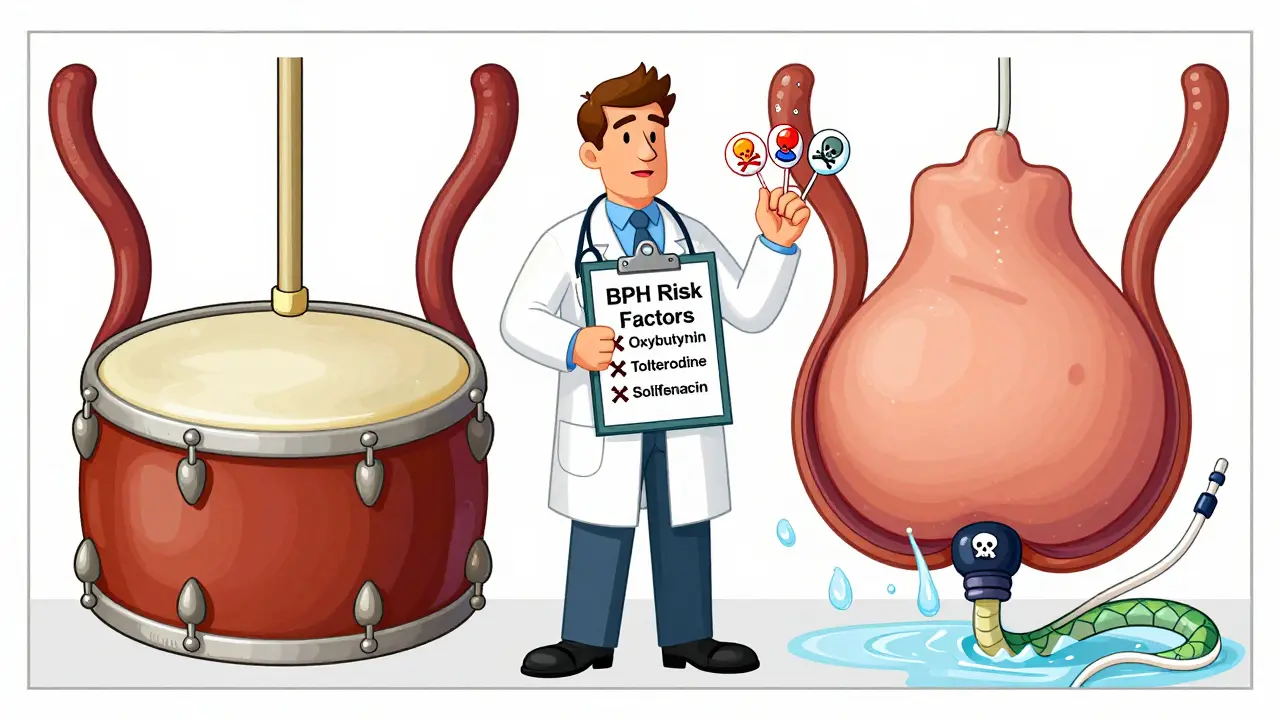
Anticholinergics like oxybutynin, tolterodine, and solifenacin block acetylcholine, a chemical that tells your bladder to squeeze. For someone with overactive bladder, this can reduce sudden urges and leaks. But if your prostate is already enlarged, your bladder is already working overtime just to push urine out. Adding an anticholinergic is like turning down the engine on a car stuck in snow. The bladder loses strength just when it needs it most.
Studies show men with benign prostatic hyperplasia (BPH) who take these drugs have a 2.3 times higher risk of acute urinary retention. That means they suddenly can’t pee at all-even after trying for hours. The bladder fills up, sometimes to over a liter, causing severe pain and potential kidney damage. Emergency catheterization is often the only solution.
Who’s Most at Risk?
It’s not just any man with prostate trouble. The risk spikes if you have:
- An AUA symptom score above 20 (moderate to severe lower urinary tract symptoms)
- A prostate volume over 30 grams (measured by ultrasound or MRI)
- A peak urine flow rate below 10 mL/sec
- A post-void residual volume over 150 mL
Age matters too. Over 65? You’re more likely to be on multiple medications. Anticholinergics are just one piece of a risky puzzle. The American Geriatrics Society’s Beers Criteria lists them as potentially inappropriate for older adults with BPH or urinary retention. Yet, 40% of nursing home residents with these conditions still get prescribed them.
The Real Numbers Behind the Warnings
The FDA’s adverse event database recorded 1,247 cases of urinary retention linked to anticholinergics between 2018 and 2022. Sixty-three percent of those cases involved men over 65 with diagnosed BPH. That’s not a fluke-it’s a pattern.
One Cochrane review of 51 trials found anticholinergics only improved incontinence by one episode every 48 hours compared to placebo. That’s a small win. But 8-15% of users reported difficulty urinating. For men with BPH, that number climbs even higher.
On patient forums, stories are consistent. A Reddit thread from June 2022 analyzed 142 comments from men with BPH. Seventy-eight percent reported negative experiences with anticholinergics. Thirty-four percent had acute retention requiring catheterization. One user, ‘BPHWarrior,’ wrote: “After Detrol, I ended up in the ER with a 1,200 mL bladder. Now I have a catheter and face surgery.”
What Doctors Should Do Before Prescribing
Good urologists don’t just write a prescription. They check.
Before starting any anticholinergic, they should:
- Perform a digital rectal exam to estimate prostate size
- Measure peak urine flow rate with uroflowmetry
- Check post-void residual volume with ultrasound
- Review all current medications for other anticholinergic effects (like antihistamines, antidepressants, or sleep aids)
If flow rate is below 10 mL/sec or residual urine is over 150 mL, anticholinergics are a bad idea. The American Urological Association’s 2018 guidelines say they should be avoided outright in these cases.
What Are the Safer Alternatives?
There are better options-ones that help without blocking the bladder’s last bit of strength.
Alpha-blockers like tamsulosin (Flomax) and alfuzosin (Uroxatral) relax the muscles around the prostate and bladder neck. They don’t weaken the bladder. In fact, studies show men with BPH who start tamsulosin right after catheterization are 30-50% more likely to urinate successfully within 2-3 days.
5-alpha reductase inhibitors like finasteride (Proscar) and dutasteride (Avodart) shrink the prostate over time. Long-term use cuts the risk of acute retention by half. But they take months to work-so they’re not for emergencies.
Mirabegron and vibegron (Gemtesa) are newer drugs that work differently. Instead of blocking signals, they stimulate beta-3 receptors to help the bladder relax and store more urine. A 2022 study in European Urology showed only a 4% retention rate with mirabegron in men with mild BPH-compared to 18% with anticholinergics. The FDA approved vibegron in 2020 specifically for patients who can’t tolerate anticholinergics.

When Might Anticholinergics Still Be Used?
Some experts argue there’s a narrow window. Dr. Kenneth Kobashi suggests that in men with mild BPH and dominant overactive bladder symptoms-confirmed by urodynamics-low-dose solifenacin might be safe under close monitoring.
One 2017 study found a 12% retention rate in this carefully selected group, versus 28% in unselected patients. That’s still a risk. But if a man has tried everything else and still leaks badly, and his urologist is watching his flow rates every month, it might be worth a try.
Still, the European Association of Urology’s 2023 guidelines say it clearly: “The risk-benefit ratio is unfavorable in all but the most carefully selected patients.” That’s not a green light-it’s a yellow caution.
What to Do If You’re Already Taking One
If you’re on an anticholinergic and have BPH, don’t stop cold turkey. Talk to your doctor. But ask these questions:
- Have I had my flow rate and post-void residual checked in the last 6 months?
- Is my prostate size known? Is it over 30 grams?
- Am I taking other medications that also have anticholinergic effects?
- Have we considered switching to tamsulosin or vibegron?
If you suddenly can’t pee, feel bloated, or have lower abdominal pain-go to the ER. Don’t wait. Acute retention can cause kidney damage if left untreated.
The Future Is Changing
Research is moving fast. The National Institute of Diabetes and Digestive and Kidney Diseases is funding studies to predict who might safely use anticholinergics using prostate MRI and genetic markers. By 2025, we may have personalized risk scores instead of blanket warnings.
Market data predicts a 35% drop in anticholinergic prescriptions for men over 65 with BPH by 2028. Why? Better alternatives, more awareness, and lawsuits. The tide is turning.
For now, the message is simple: if you have prostate enlargement, anticholinergics are not your friend. They’re a gamble with your ability to urinate. And in a population already struggling to empty their bladder, that’s a risk no one should take lightly.
Can anticholinergics cause urinary retention even in men without BPH?
Yes, but it’s far less common. Anticholinergics can cause urinary retention in anyone by reducing bladder muscle contraction. However, men without prostate enlargement usually have strong detrusor muscles that can compensate. The risk jumps dramatically in men with BPH because their bladders are already working at maximum capacity. In healthy younger men, retention is rare and usually only occurs with overdose or when combined with other anticholinergic drugs.
What are the signs of acute urinary retention?
You can’t urinate at all, even though you feel the urge. You may feel intense pressure or pain in your lower belly. Your bladder may feel swollen or hard to the touch. Some people experience nausea or sweating. If you’ve been unable to pee for more than 8-12 hours, especially with discomfort, seek emergency care. Left untreated, it can lead to bladder damage or kidney problems.
Is it safe to take anticholinergics if I have mild BPH and no symptoms?
If you have no lower urinary tract symptoms-like slow stream, frequent urination, or urgency-then you likely don’t need anticholinergics at all. Mild BPH without symptoms doesn’t require treatment. Taking these drugs unnecessarily increases your risk of retention without any benefit. Always treat the symptoms, not just the diagnosis.
Can over-the-counter sleep aids or allergy pills cause urinary retention too?
Absolutely. Many OTC meds have anticholinergic effects. Diphenhydramine (Benadryl), doxylamine (Unisom), and even some cold medicines contain these compounds. If you have BPH and take these regularly, you’re adding to your risk. Always check labels for “anticholinergic” or “drowsiness” as a side effect. Combine them with prescription anticholinergics, and your risk multiplies.
How long does it take for anticholinergics to cause retention?
It can happen quickly-sometimes within days of starting the drug. But it can also be delayed, especially if you’re on multiple medications or have undiagnosed prostate enlargement. Some men don’t notice problems until they’re stressed, dehydrated, or on antibiotics. There’s no safe waiting period. If you have BPH, the safest approach is to avoid these drugs entirely unless your urologist has ruled out obstruction and is monitoring you closely.
What should I do if I’ve had urinary retention from anticholinergics?
Stop taking the medication immediately. Talk to your urologist about switching to a safer option like tamsulosin or vibegron. You’ll likely need follow-up tests-uroflowmetry, post-void residual, and possibly a bladder ultrasound. If you’ve had one episode of retention, you’re at high risk for another. Don’t assume it won’t happen again. Prevention is better than another ER visit.
Katie Taylor
December 24, 2025 AT 02:39This is the kind of post that saves lives. I’ve seen too many older men get prescribed these drugs like they’re candy, then end up in the ER with a bladder the size of a watermelon. If you’re reading this and you’re on oxybutynin or something similar-talk to your doctor today. You don’t need to suffer in silence or get catheterized because someone thought it was a quick fix.
Payson Mattes
December 25, 2025 AT 13:12Did you know the FDA’s database only captures 10% of actual adverse events? The real number of anticholinergic-induced retentions is probably in the tens of thousands. Big Pharma doesn’t want you to know this because they make billions off these pills. They push them through TV ads while doctors are rushed and don’t check flow rates. It’s a conspiracy wrapped in a prescription pad.
Isaac Bonillo Alcaina
December 27, 2025 AT 08:48Let’s be precise: anticholinergics inhibit parasympathetic outflow via M3 receptor antagonism, thereby reducing detrusor contractility. In patients with BOO secondary to BPH, this creates a dangerous imbalance between bladder outlet resistance and detrusor force. The 2.3x increased risk of AUR is not merely statistical-it’s biomechanical inevitability. If your urologist prescribes this without uroflowmetry and PVR, they’re practicing malpractice, not medicine.
Delilah Rose
December 27, 2025 AT 15:25I’m not a doctor, but I’ve been managing BPH for over a decade, and I’ve watched friends go through this exact thing. One guy took tolterodine for a month and woke up one morning unable to pee at all. He thought it was just constipation until his stomach started swelling. He ended up in the hospital, got a catheter, and now he’s on tamsulosin and feels like a new man. I wish someone had told him this before he started the pills. It’s not just about side effects-it’s about understanding your body’s limits. I’ve started sharing this post with every guy I know over 55. It’s too important to keep quiet about.
Bret Freeman
December 29, 2025 AT 14:52They’re poisoning our fathers with pills. I saw my dad go from walking around like a normal guy to needing a catheter because some doctor thought he had an overactive bladder. He didn’t even have symptoms before the meds. Now he’s scared to take anything. And don’t get me started on the OTC stuff-my uncle takes Benadryl every night to sleep and wonders why he can’t pee. It’s not an accident. It’s negligence dressed up as care.
Jillian Angus
December 29, 2025 AT 16:15My grandpa was on solifenacin for a year. He never said anything until he couldn’t pee. Took him three days to tell us. By then he was in pain. We didn’t know what was going on until the ER doctor asked if he was on any bladder meds. That’s the problem. Nobody connects the dots. Just something to think about.
Georgia Brach
December 31, 2025 AT 08:22While the data presented is compelling, it lacks a control group for comparison. The Cochrane review cited shows marginal efficacy, but does not account for placebo response variability or patient compliance. Furthermore, the FDA adverse event data is passive surveillance and subject to reporting bias. Until prospective, randomized trials demonstrate causality beyond correlation, this remains a hypothesis, not a clinical mandate.
Diana Alime
January 1, 2026 AT 19:05ok so i was on detrol for 3 months and i couldnt pee and i had to go to the er and they put a catheter in and it hurt so bad and now im on flomax and its like night and day but like why does no one tell you this before you take it?? like its just like… boom here’s a pill and good luck??
Adarsh Dubey
January 2, 2026 AT 11:05This is a well-researched and critical post. I’m from India, and here, many doctors still prescribe anticholinergics without checking prostate size or urine flow. It’s partly due to lack of equipment and partly due to outdated training. We need more awareness campaigns in non-Western countries too. Thank you for highlighting the alternatives-tamsulosin and vibegron are far safer and should be first-line.
Bartholomew Henry Allen
January 3, 2026 AT 22:16Our medical system is broken. Doctors are pressured to prescribe quick fixes. Insurance doesn’t pay for uroflowmetry. Patients are too tired to ask questions. This is not about science. It’s about profit. And it’s killing American men. We need policy change not just advice.
Dan Gaytan
January 5, 2026 AT 10:57Thank you for sharing this. I just started vibegron last month after my urologist pulled me off oxybutynin. I was terrified at first but now I can actually sleep through the night without worrying about getting stuck. This post should be required reading for every man over 50. Seriously, share it with your dad, your uncle, your brother. It could save them from a nightmare.
Usha Sundar
January 6, 2026 AT 18:26My mom is a nurse. She says 3 out of 10 elderly men on anticholinergics end up with retention. She’s seen it too many times. Don’t wait until it’s too late.
claire davies
January 8, 2026 AT 17:29As someone who’s spent years working in geriatric care across the UK and now here in the States, I can tell you this: the tragedy isn’t just the medical oversight-it’s the silence around it. Men are taught to ‘tough it out,’ to not complain about ‘private’ issues. So they suffer in shame until they’re doubled over in pain, and then suddenly, it’s an emergency. We need to normalize these conversations-over coffee, at the pub, in family dinners. A man shouldn’t have to get a catheter to finally speak up about his bladder. Let’s change the culture, not just the prescriptions.